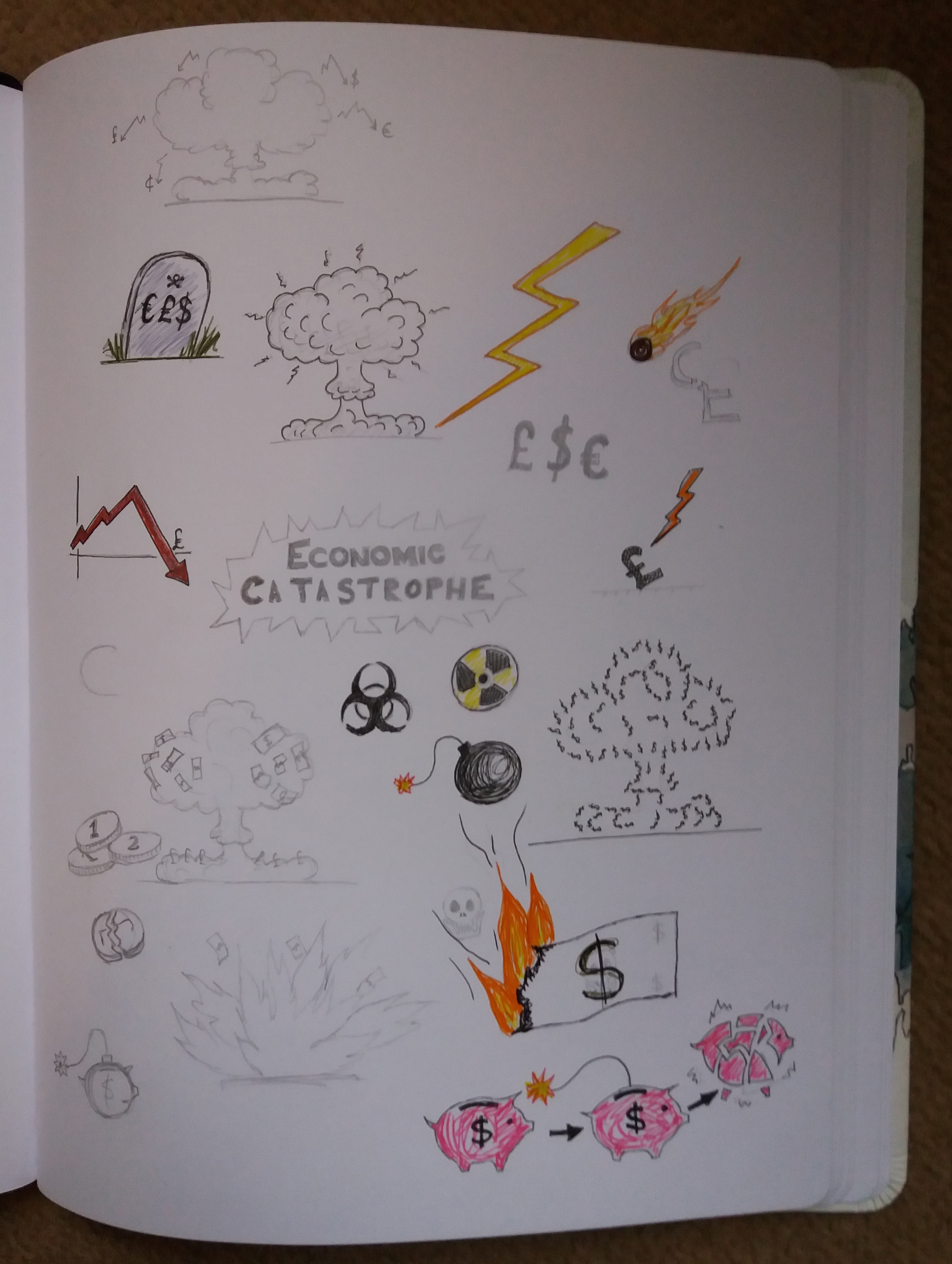
The aim of this exercise is to sketch out a list of objects and subjects that could be used to symbolise the phrase ‘economic catastrophe’.
The category containing all posts for part 2.
The aim of this exercise is to sketch out a list of objects and subjects that could be used to symbolise the phrase ‘economic catastrophe’.
This exercise is about choosing content to produce a simple portrait of the character represented in the following exerpt of text.
The room was void and unquickened; it was like a room in a shop window but larger and emptier; and the middle-aged man who sat at the desk had never thought to impress himself upon what he entered every day. Comfort there was none nor discomfort; only did the occupant deign to qualify the pure neutrality of his surroundings, it would surely be austerity that would emerge. The spring sunshine turned bleak and functional as it passed the plate glass of the tall-uncurtained windows.
The windows were large; the big desk lay islanded in a creeping parallelogram of light; across this and before the eyes of the man sitting motionless passed slantwise and slowly a massive shaft of shadow.
Perhaps twenty times it passed to and fro, as if outside some great joy wheel oscillating idly in the derelict amusement park. And the man rose, clasped hands behind him and walked to a window – high up in New Scotland Yard. He looked out and war-time London lay beneath … on his brow was fixed a contraction; this he carried from desk to window, and now there was neither hardening nore relaxation as he looked out … during 15 years he had controlled the file of police papers which dealt with the abduction and subsequent history of feeble minded girls. Here lay his anger as he looked out over London … year by year the anger had burst deeper until now it was the innermost principle of the man.
Michael Innes Adapted from The Daffodil Affair.
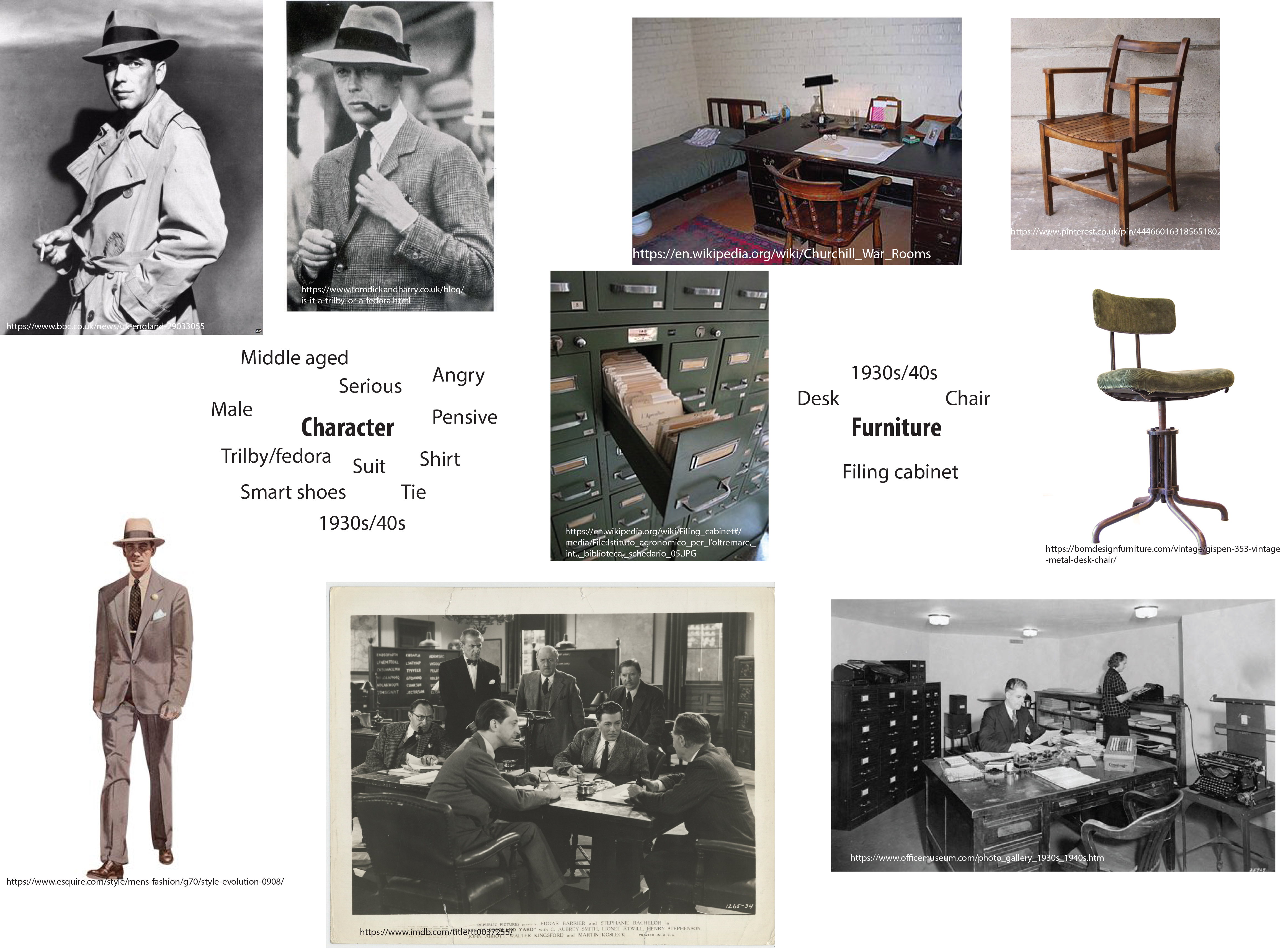
If this were to be made into a film what would the main character be like?
Male. Middle-aged. Serious. Pensive. Angry. British. Detective.
What clothes would the character be wearing?
Trilby/fedora hat. Suit, shirt, tie. Shoes. Trench coat.
What furniture is in the main area where the action takes place?
Table/ desk. One or more chairs. Maybe a filing cabinet. Very little furniture. Plain, functional furniture from the 1930s/40s.
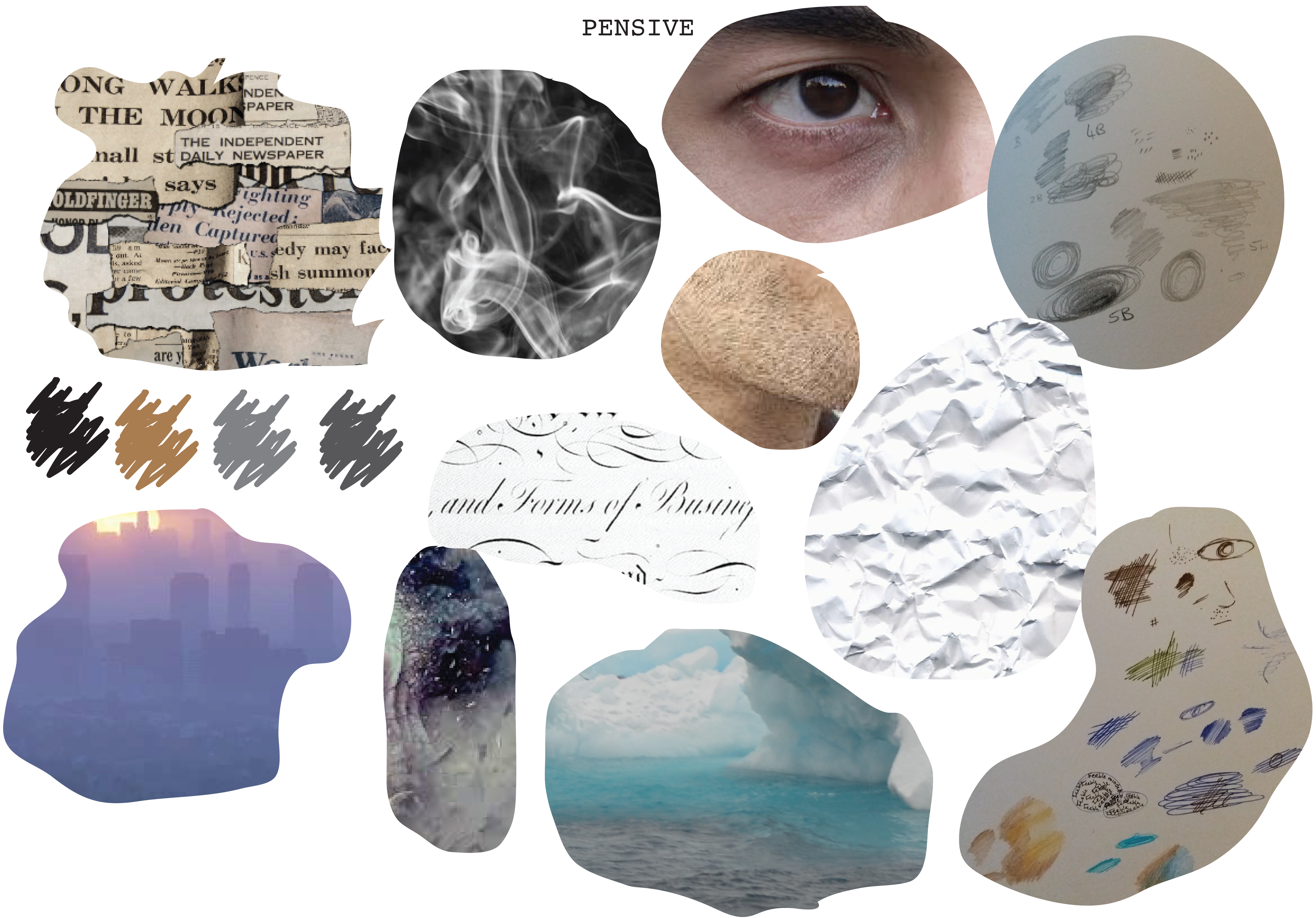
I created a moodboard for the word ‘pensive’. Interestingly this moodboard highlighted quite cold colours, pale blues, greys and brown. I also quite like the idea of incorporating the crumpled paper, or old typed text into the image in order to convey the frustration that I think is present in the text. Maybe using old newsprint to fill in the image with collage, or alternatively as a background.
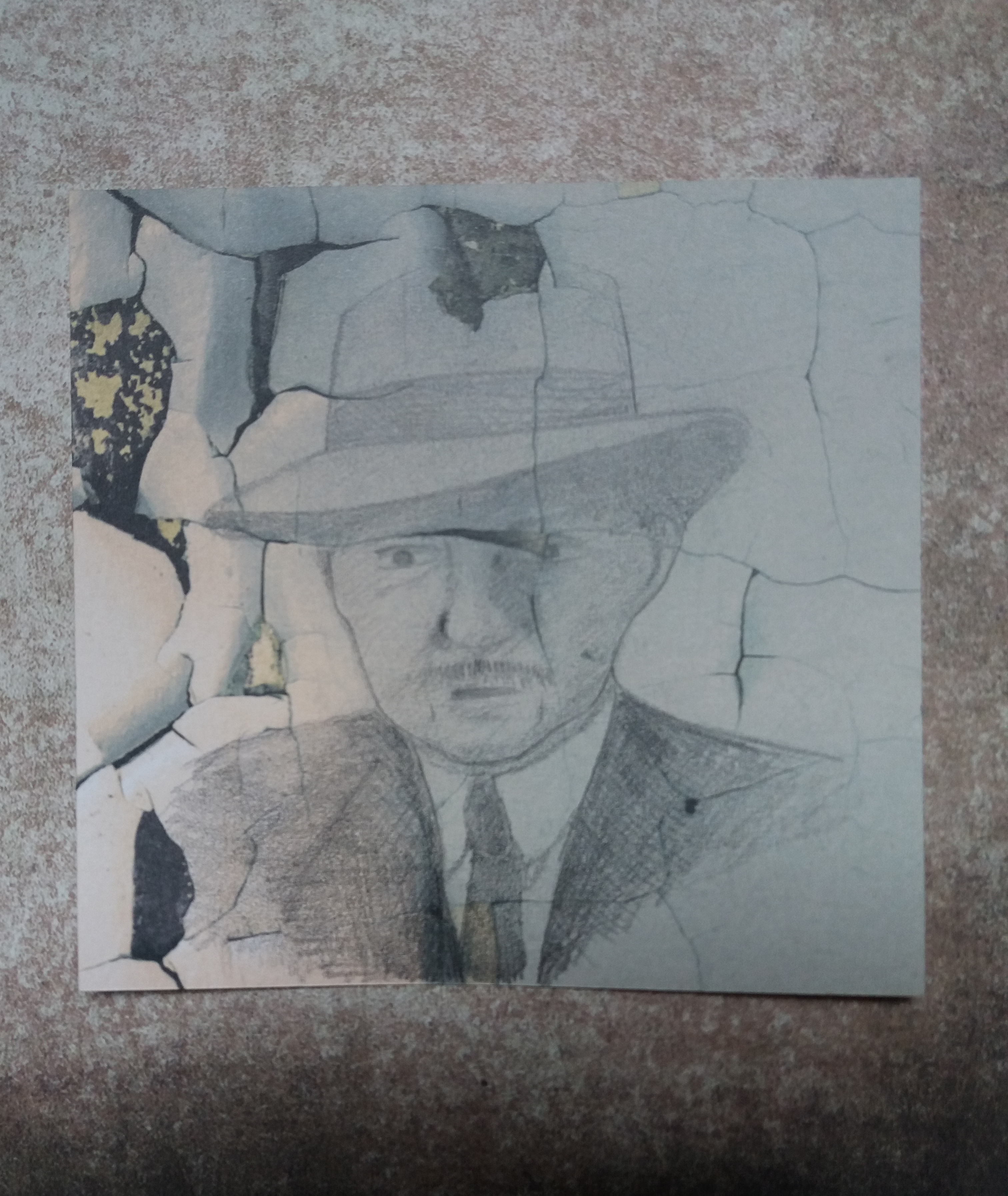
I used part of an image of paint flaking off a wall for the background and made a rough sketch of the character in front of this. I wanted the character to be shadowy and blend into the background somewhat. I think that it is quite a bleak image of the character staring out of the window down onto wartime London.
The aim of this exercise was to produce a line image around the word ‘sea’, then to invert the image and use shapes cut from the inverted image to fill in the original image.
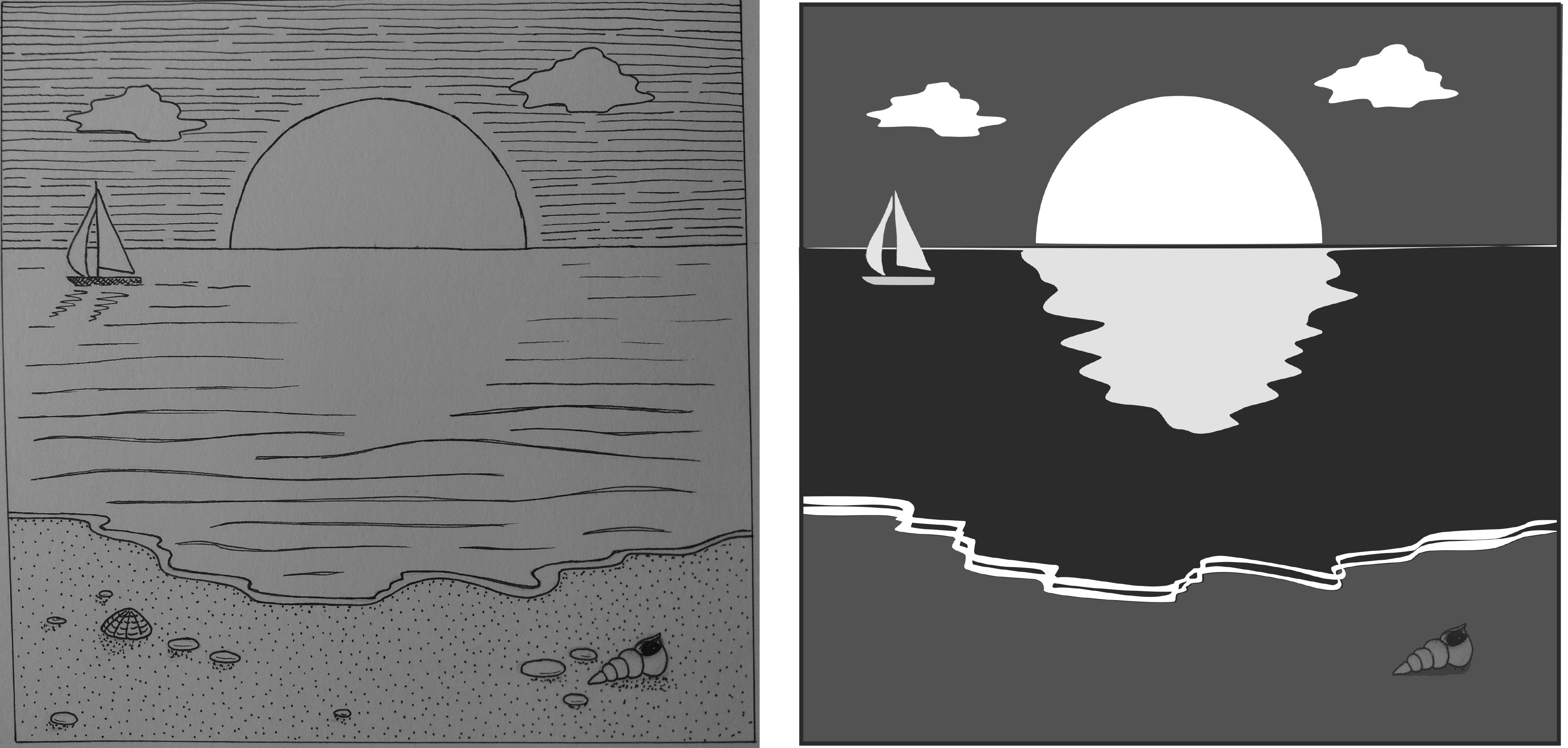
My original line image did not work well for this exercise as there were too many different marks in it. Therefore when I inverted the original image using adobe photoshop I removed a lot of these detailed marks from the image. As I didn’t have access to a printer I decided to do the ‘cutting and sticking’ using adobe illustrator.
I like how bold the final image is when compared to the original. I cheated a little by using different tones for the sea, sky and sand, rather than sticking rigidly to black and white. A disadvantage of doing this task digitally is that I lost the ragged edges and texture that I would have got from cutting and sticking paper.
The final image has a very different feel to the original – day has turned to night and the sun has become the moon. The final image reminds me of a monochrome version of the types of images used on the US National Park posters that I discussed in an earlier post – simple, graphic, bold.
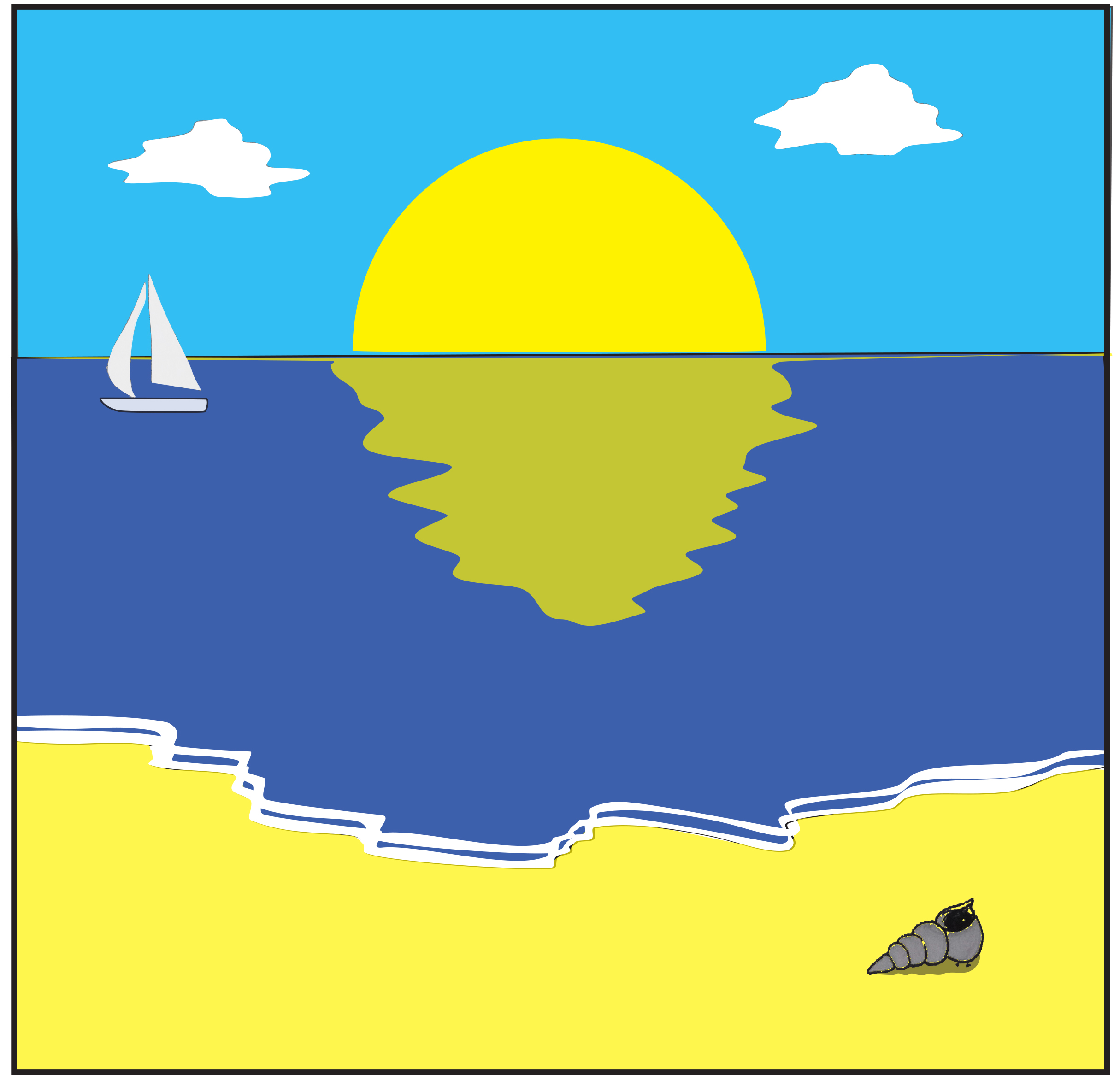
As I produced the final image in illustrator I decided to have a quick play with converting the monochrome image to colour but with a limited colour palette.
The aim of this exercise was to produce an illustration that illustrates an object, whilst highlighting a quality of the object. For this exercise I chose a packet of polo mints and wanted to highlight their ‘mintiness’. For the final illustration I combined collage using found materials with markerpen and fineliner.
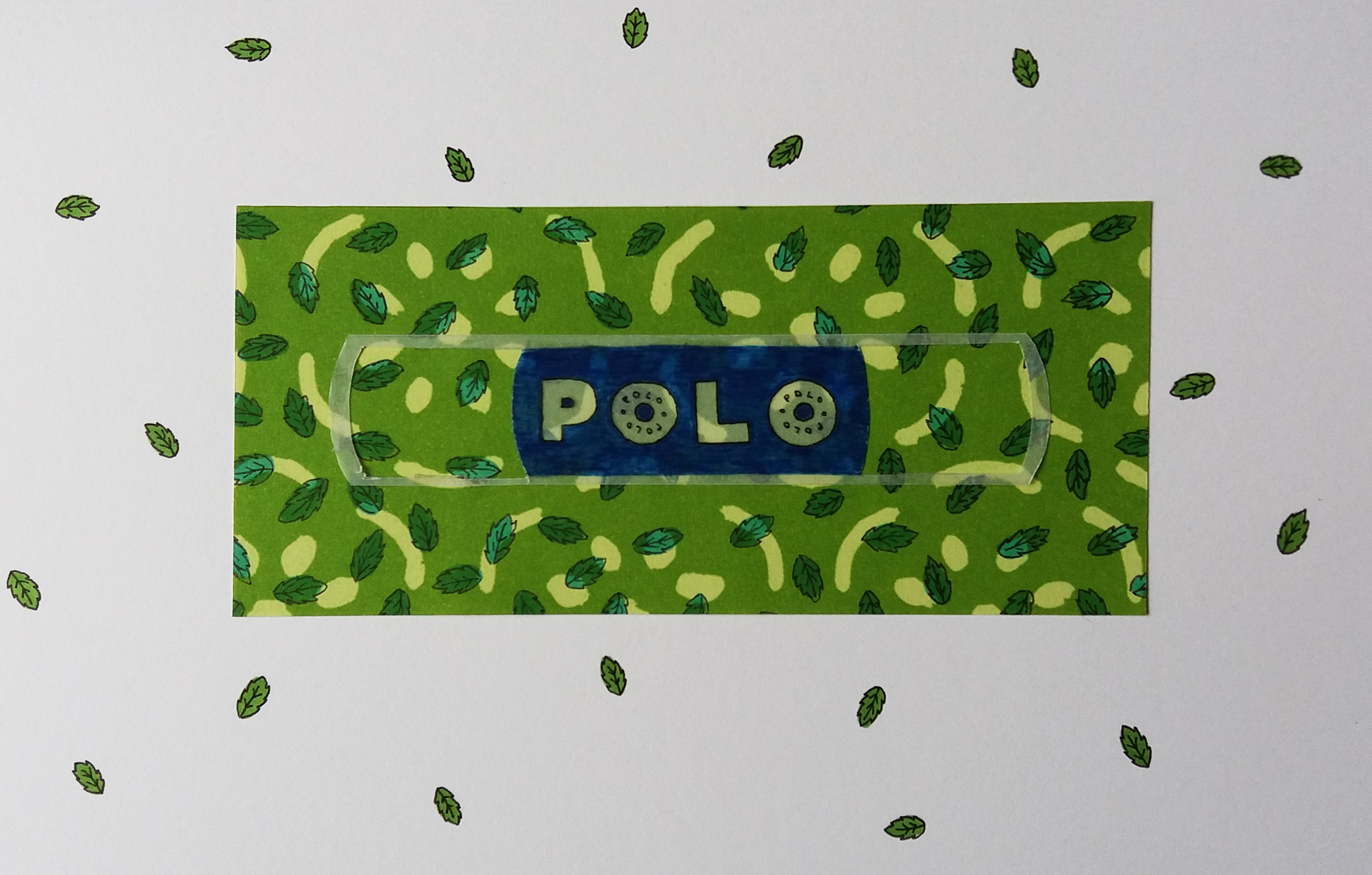
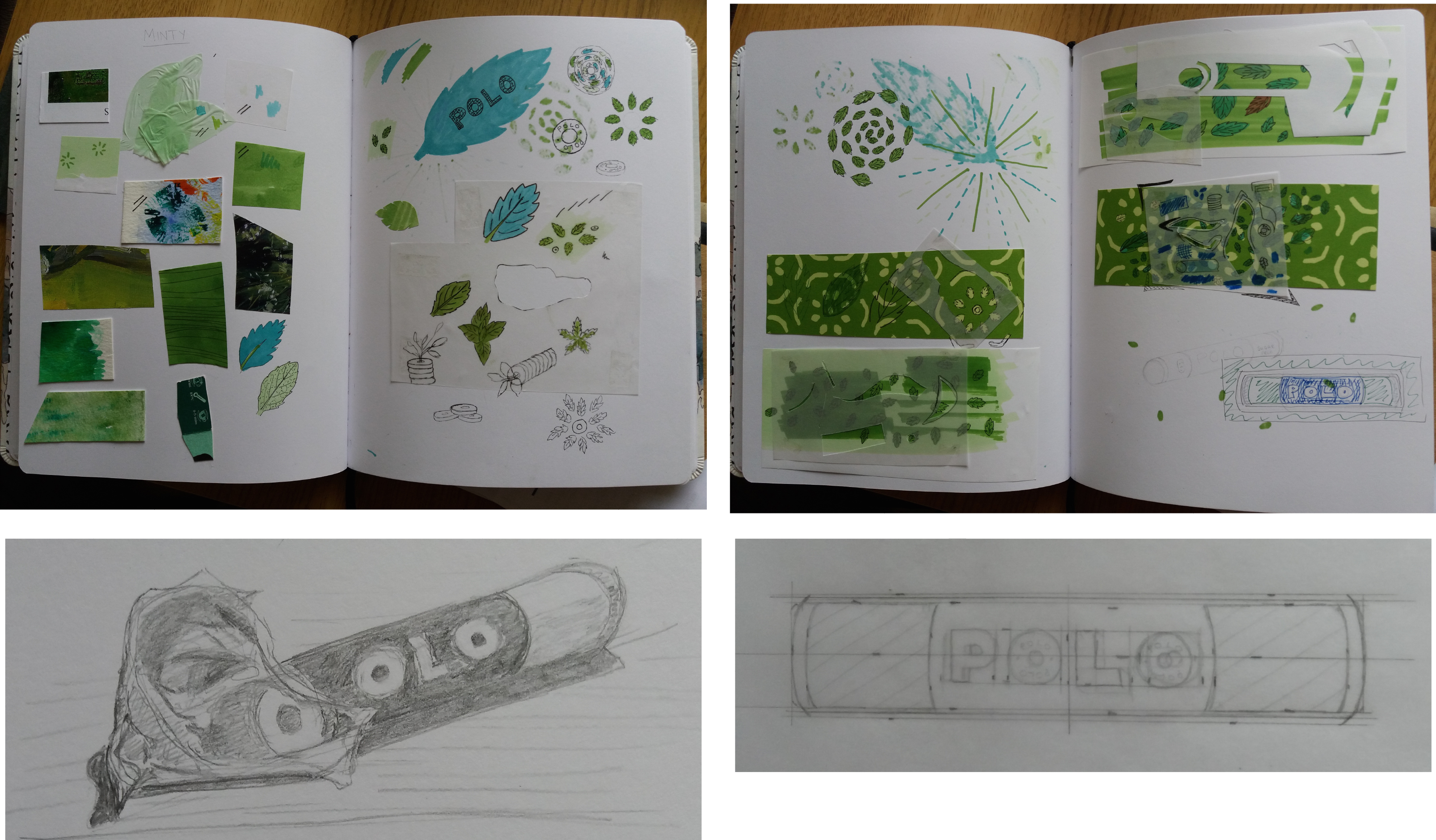
I began by creating a moodboard to investigate different materials, which included, plastics, found papers from magazines and wrapping papers, different paints and pens on different papers. I gradually developed the idea of having a silhouette of the polo tube on a piece of green wrapping paper decorated with mint leaves in pen. I used tracing paper for the silhouette as I wanted to be able to see the decoration underneath. Finally once I’d completed the image I liked the idea of the leaves going beyond the edge of the image in order to highlight them further.
I like the simplicity of the final piece however, I think that it is a little boring. I think that it might have been more interesting to choose a different shape for the background block of colour and also to vary the size of the drawn leaves for example by making some of them bigger.
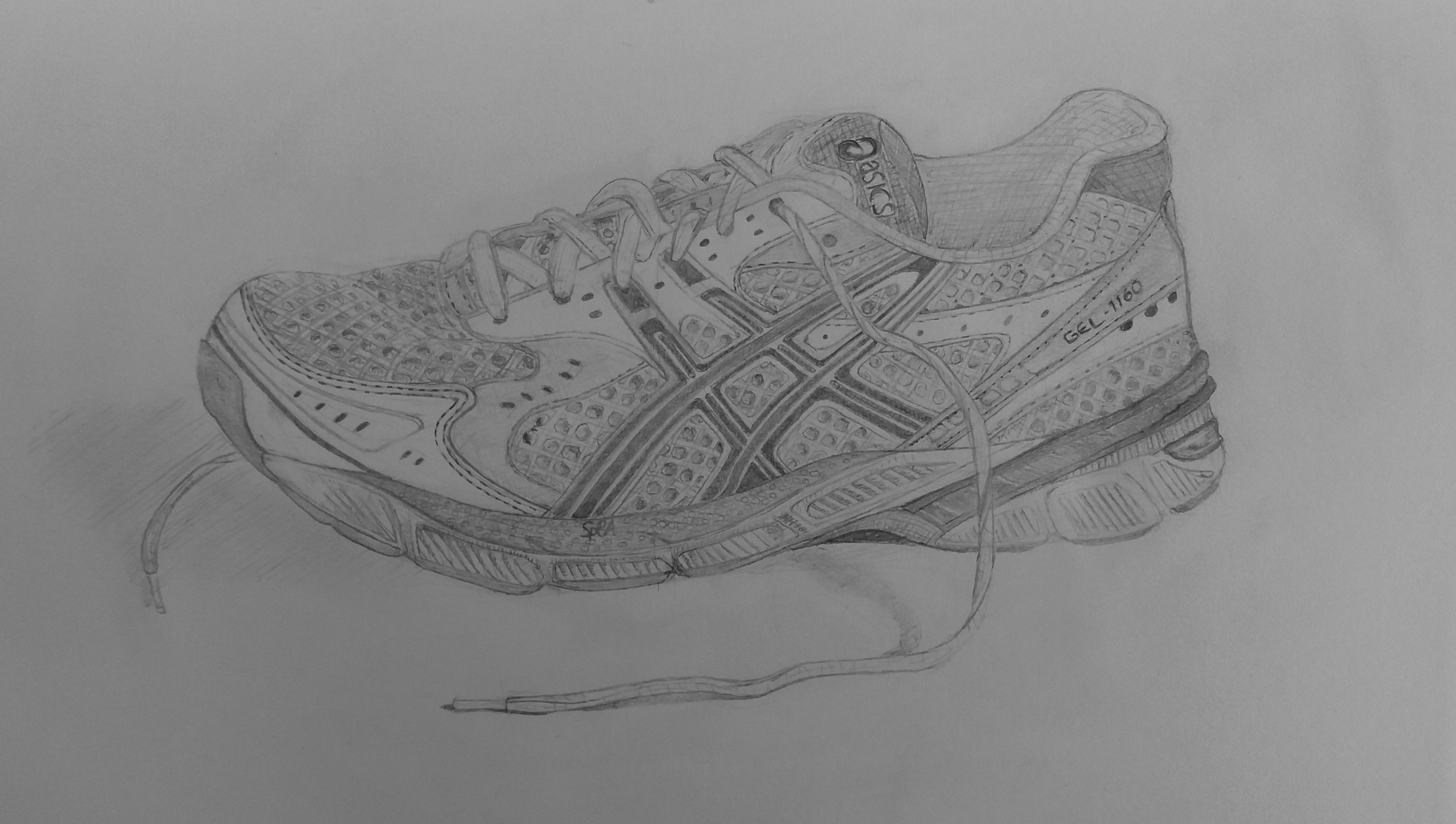
The aim of this exercise was to use either pencil or fineliner to produce an objective drawing with a high degree of visual accuracy. I produced my drawing with a range of pencils from HB through to 2B.
I really enjoyed this exercise and I am quite pleased with the result. This exercise made me really look at the object and think about proportion. There are a lot of geometric patterns within the trainer design that I had never previously noticed. I chose this shoe because it has a lot of different textures, which made me experiment with shading and mark making to try to represent these textures e.g. smooth leather, versus rough webbing. The exercise also made me look carefully at the relative tones of different parts of the shoe in order to convert from the colour that I was seeing on the object to different shades of grey in the drawing.
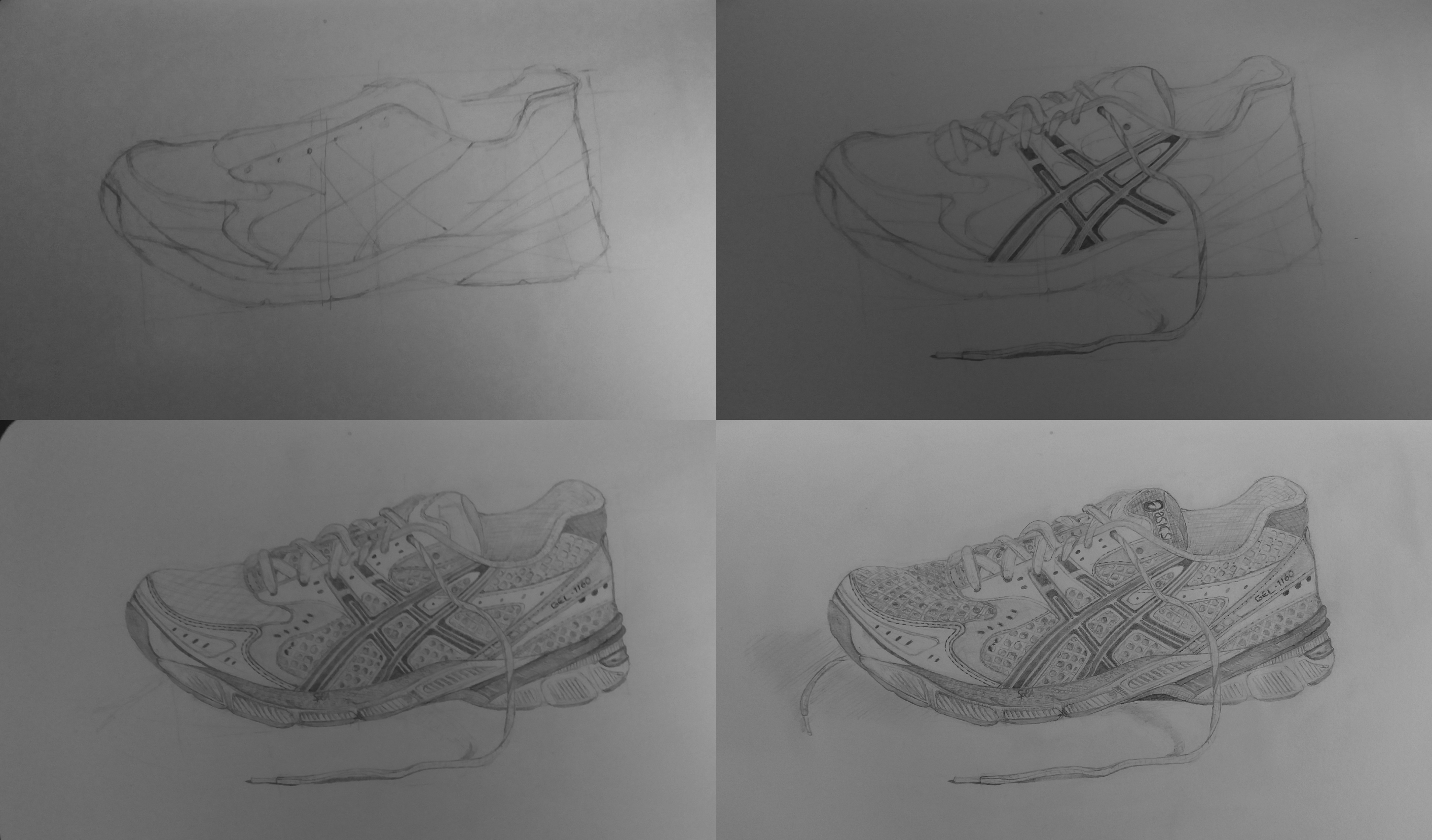

The aim of this exercise was to draw the same object using different media and different types of papers. I found it extremely hard to break away from the types of media that I like – anything that allows me to make accurate marks. I did enjoy the looseness of thumbprinting overlain with some obsessive markmaking (#5); despite this image least resembling what I was drawing. I hated trying the pastels and graphite, they were just frustrating, I guess they are intended for larger drawings. I think what I learnt from this exercise is that I need to loosen up and be more adventurous … easier said than done!
The purpose of this exercise was to collect reference material in order to build up a picture of the 1950s from a visual perspective and then to produce an illustration that would give a modern teenager an idea of the 1950s.
Prior to doing this research I had thought of the 1950s as being quite a boring and drab post war era. However, my research revealed that many of the bold colourful designs of the 1960s were beginning to evolve albeit with a somewhat subdued colour pallette.
The 1950s seems to be an era in which people were beginning to have disposable income. House interiors are becoming more colourful; furniture is sleek and no longer purely functional; and colourful geometric patterns are common for wallpaper and soft furnishings.
Much of the advertising that I found from the 1950s was for the latest household gadgets. Advertising is bold and colourful and relies on illustration rather than photography. My main impressions of the 1950s from advertising are that everybody is terrifyingly happy despite the grotesque gender stereotyping that is being depicted.
I began by brainstorming my pre-existing knowledge of the 1950s before pulling together moodboards on the topics of: people and costume; architecture and interioirs; art; graphic design; advertising; transport; film and TV; and surface pattern.
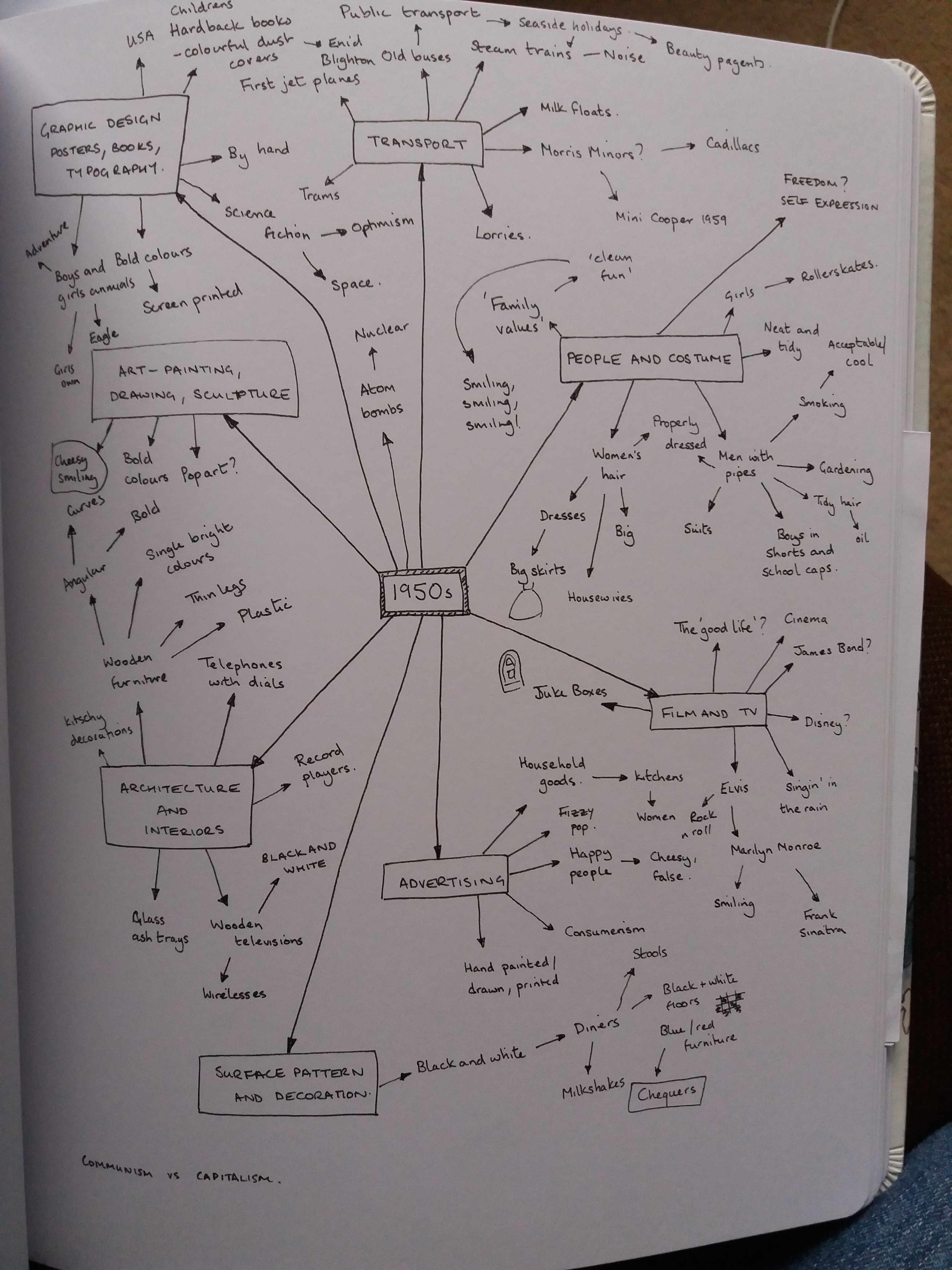
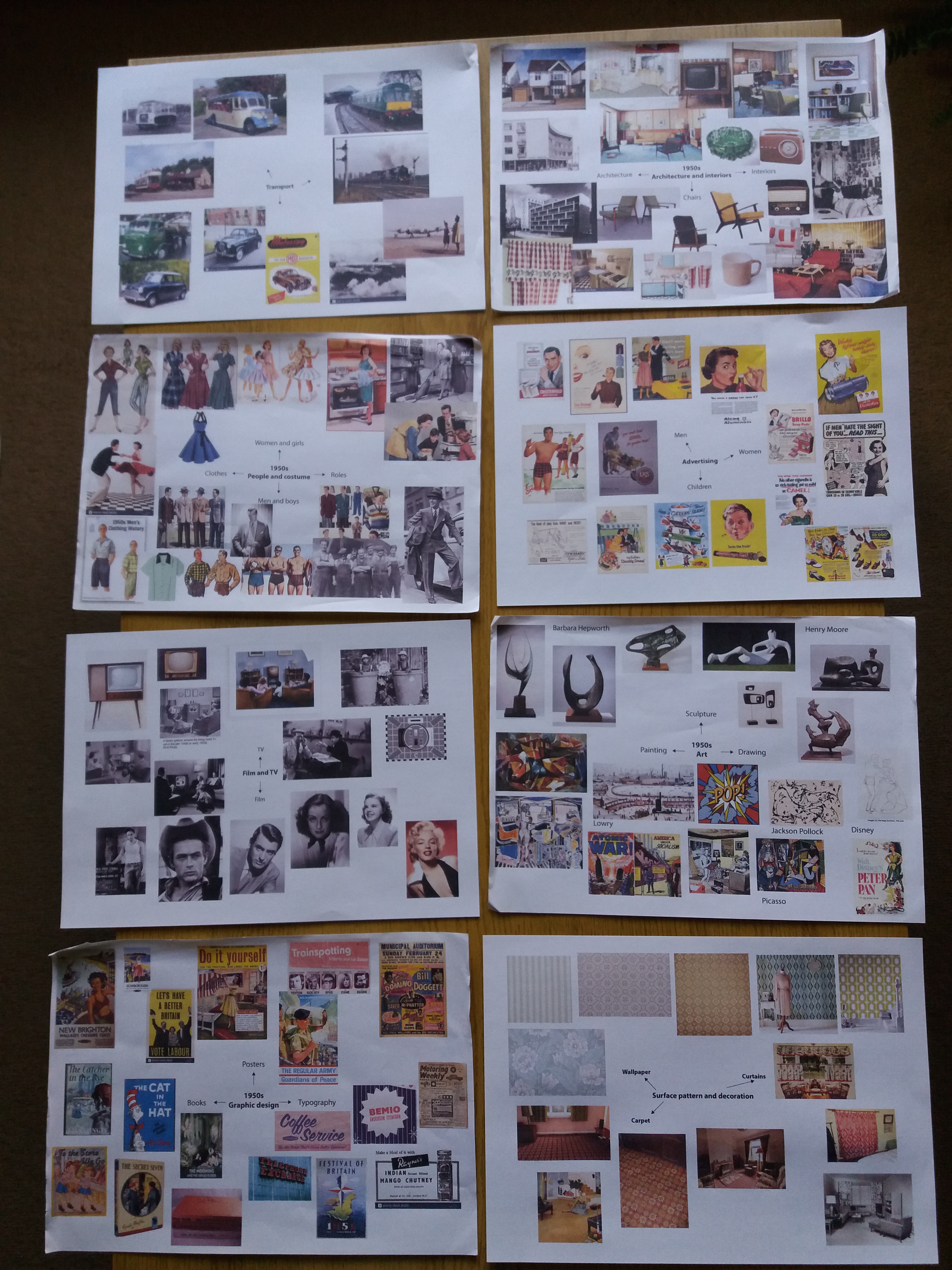
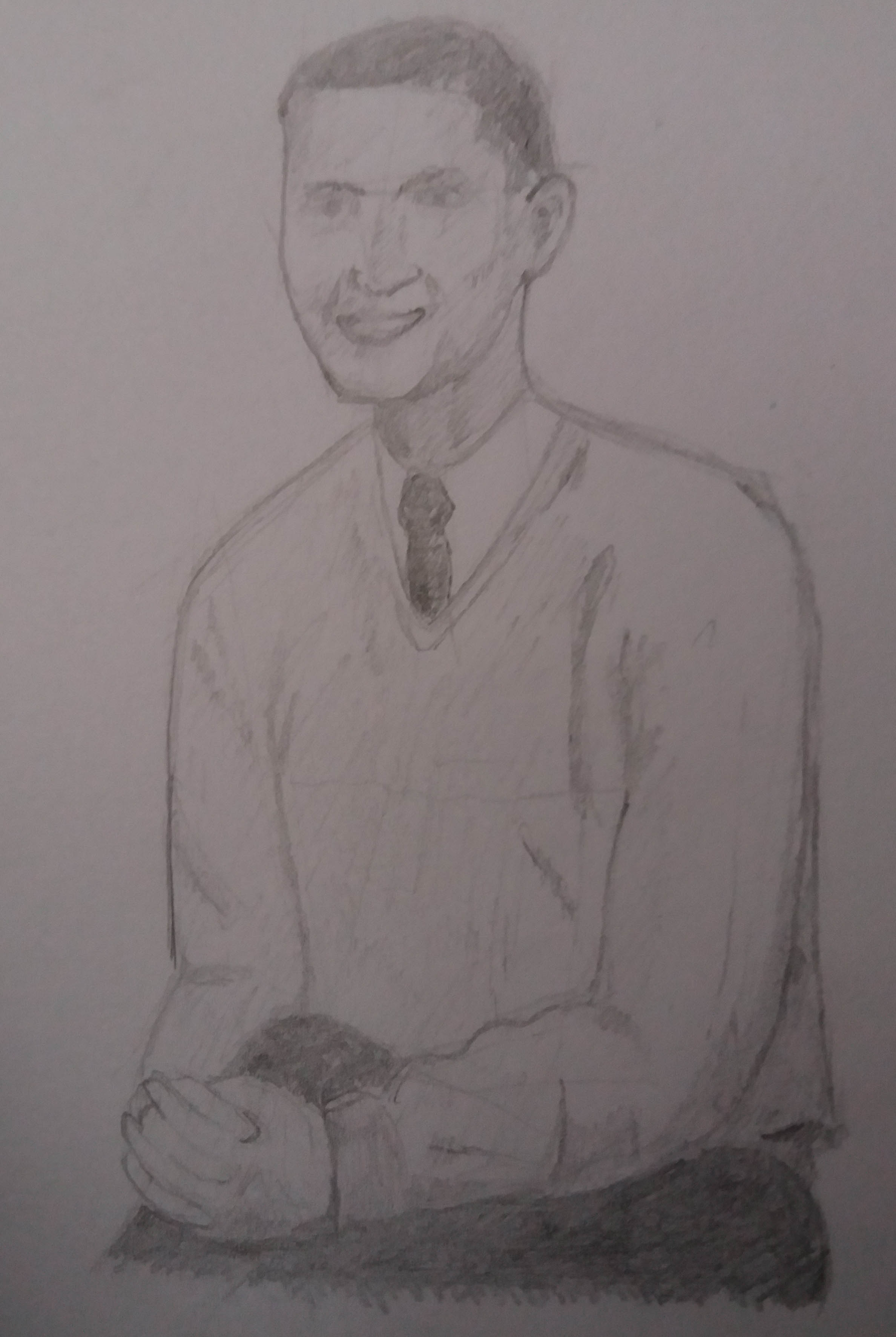
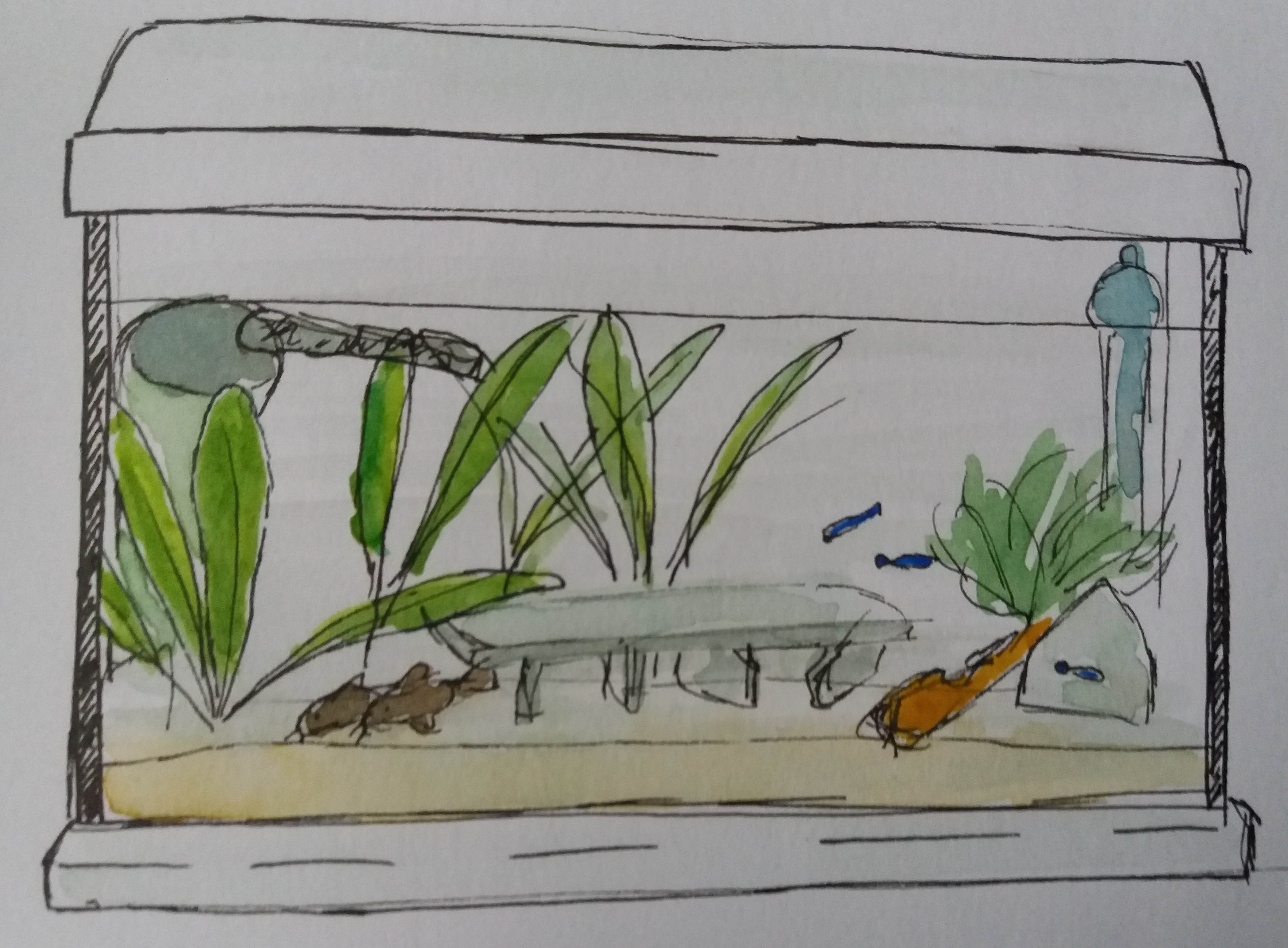
I also incorporated 1950s themes into my sketching practice.
One of my aims with this course is to experiment with different media, so I bought myself some watercolour paints and began to play around with using these to add colour to pen and ink drawings. I really liked how quickly they enabled colour to be added to rough sketches.
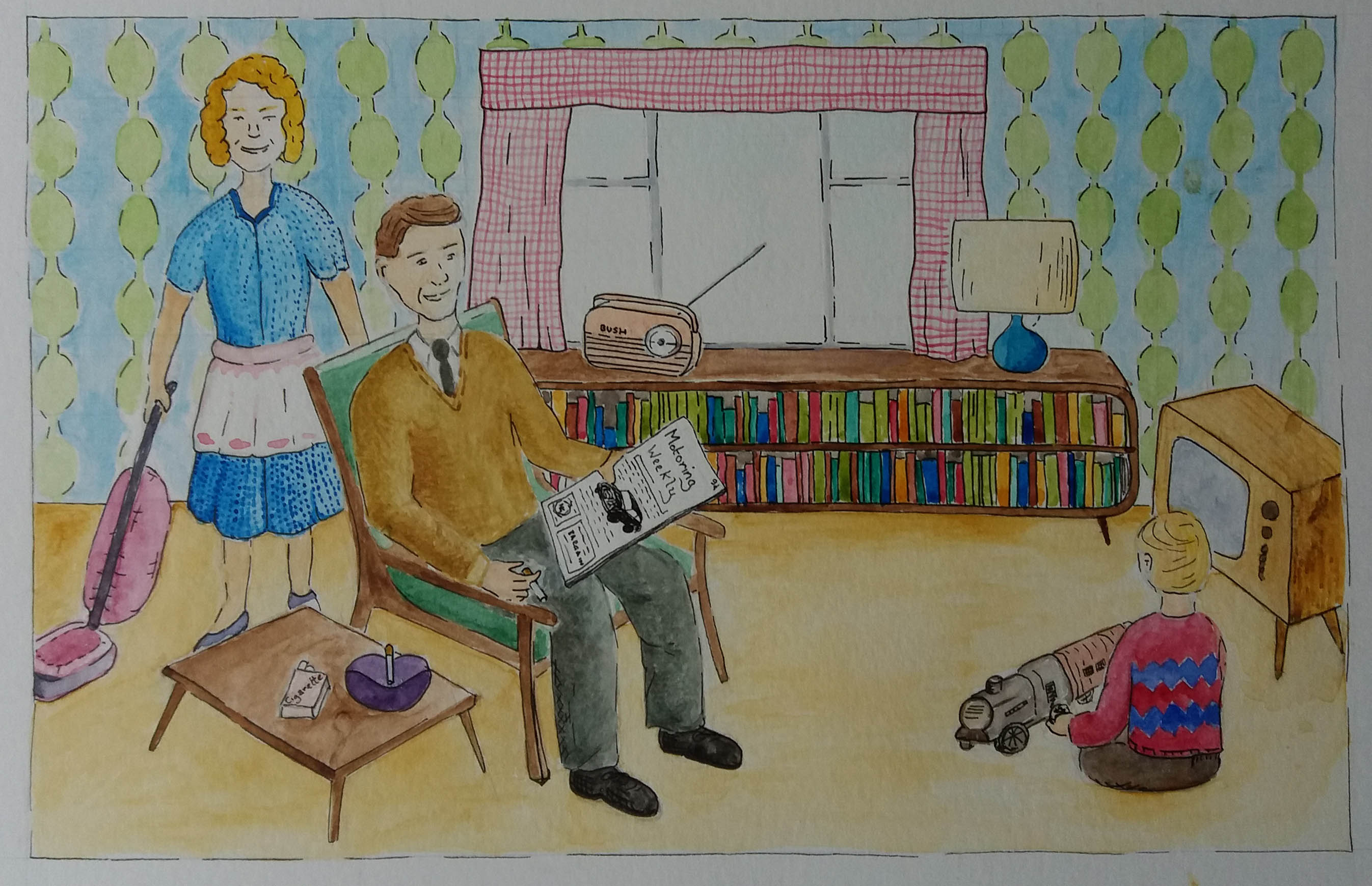
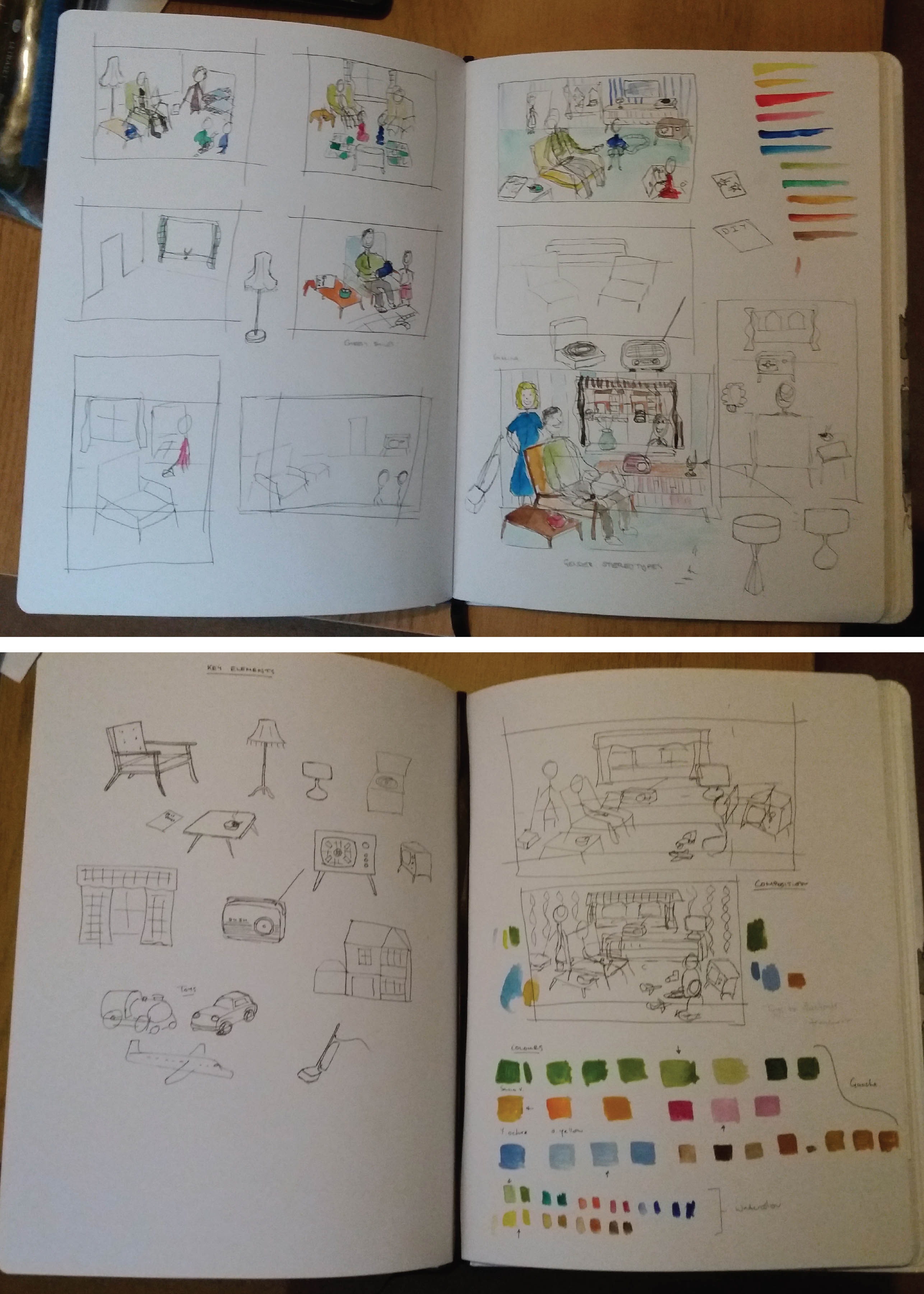
I thought about key objects that I felt represented the 1950s. I considered a range of compositions for the piece. I was keen to include reference to the gender stereotyping that I had discovered in 1950s advertising and the ubiquitous smiling. I considered different ways to illustrate objects from outside the home, for example by showing architecture and transport through the window or having a child play with toy cars and trains. In the end I decided to include the car in the magazine that the man is reading and a toy steam train that the child is playing with. In my draft compositions I also considered getting elements of 1950s art into the illustration by for example including a Hepburn style ornament, or some other artwork. However, this disapeared in the final piece because it felt too busy.
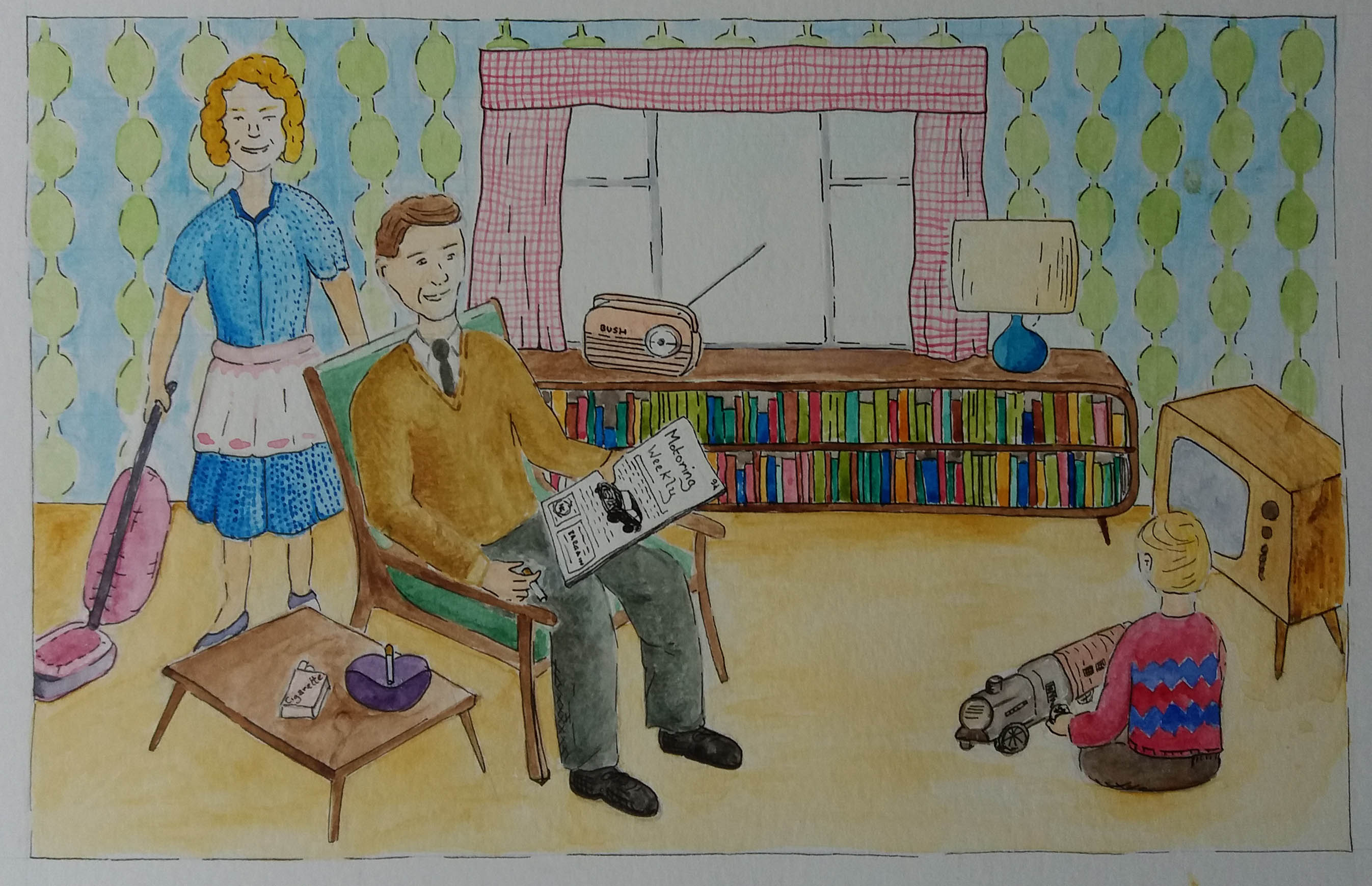
The original brief was to make an illustration of somebody sitting in a chair surrounded by typical artefacts to give a teenager an idea of the 1950s.
I really enjoyed using watercolours for this illustration. Originally I had planned to exclusively use paint; however, I ended returning to my ‘safety net’ of black ink in order to highlight different objects. I think that the illustration probably does a better job of illustrating gender stereotypes than really answering the brief. I think that I should have gone the whole hog on 1950s gratuitous smiling. Retrospectively I’m not sure that this scene would necessarily appeal to a teenage audience and maybe I should have opted for the character to be a teenager in a different setting, maybe their bedroom. If I were to spend more time on the illustration I think that it would be a fun challenge to make the illustration in the style of a 1950s advertising poster.
In this exercise I created a moodboard to further develop the word ‘wild’ from the previous exercise. The moodboard proved particularly useful in quickly developing ideas for colour (vibrant oranges and greens) and textures. I also found it interesting how very different ‘objects’ have similar forms, for example the human hair looks similar to tangled plants. I have not included an image of the moodboard here because it contains images under copyright.
In this exercise I experimented with using pictures, rather than words, to generate ideas. I did this exercise twice because I felt that I learnt a lot about how I could approach this task (i.e. how not to do it) the first time I tried it and wanted to test whether a different approach might work better.
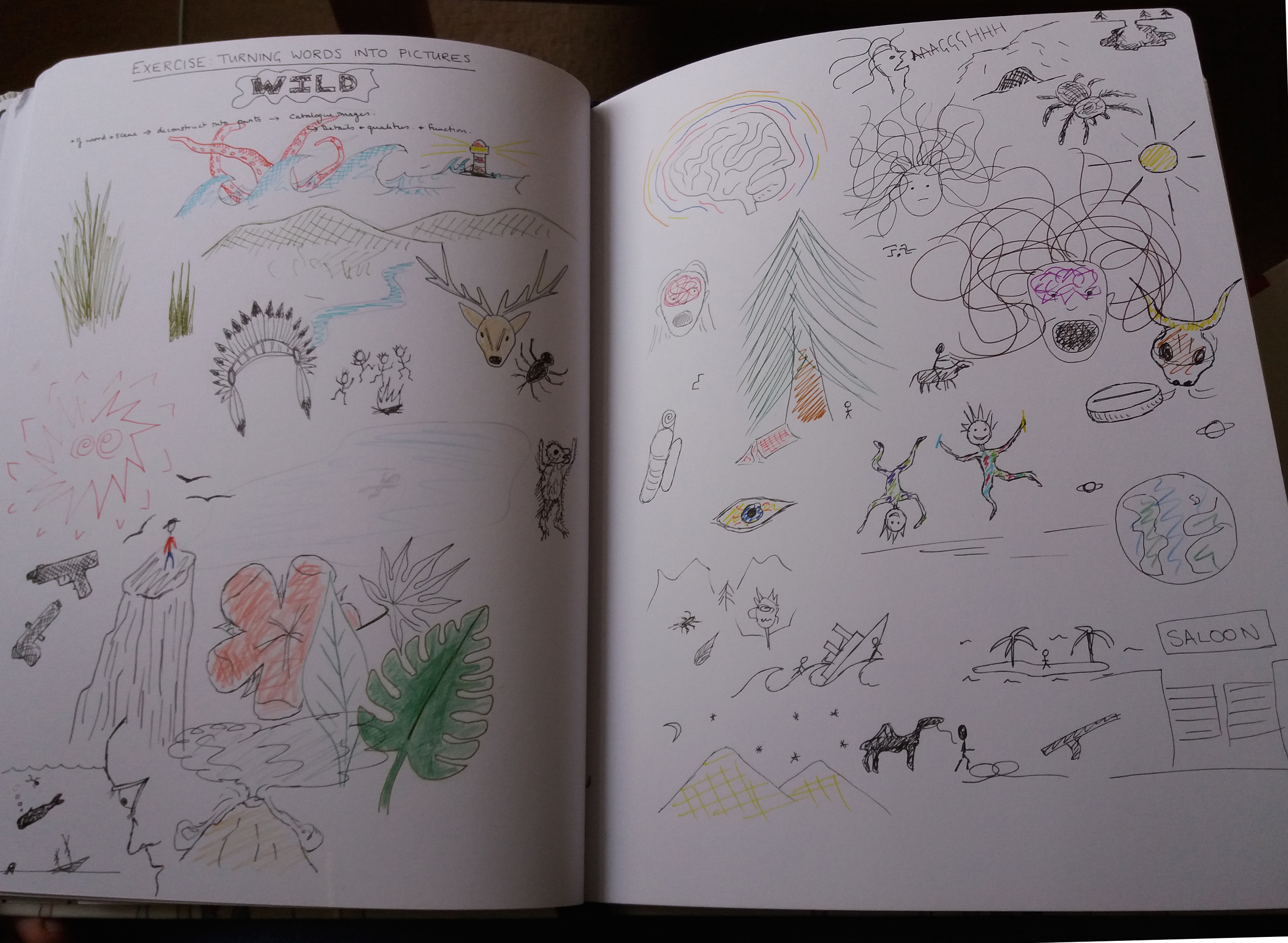
The first word that I chose to brainstorm was ‘wild’. I found that focussing on what my pictures ‘should’ look like was hindering me from developing new ideas quickly. I also found that trying to use different colours and media was interrupting my flow of ideas. Based on this experience I decided to take a different approach with a different word. With the second word I decided to work quickly using black pen for as long as I could rapidly generate new images, and only then to add colour. I decided not to worry how pictures looked and not to allow myself to google, or look anything up. I also decided to put pictures that form natural groups together on the page.
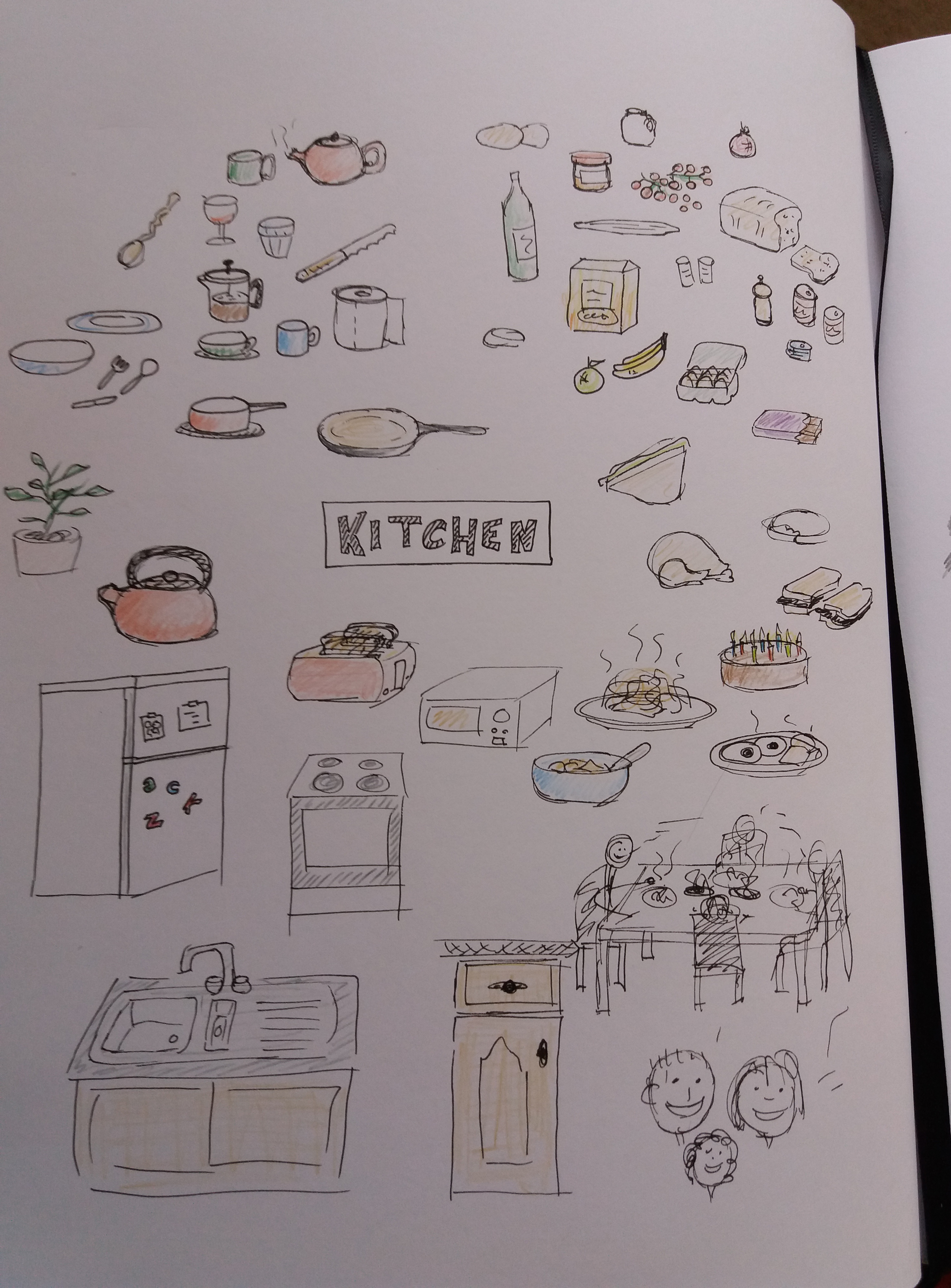
The second word that I chose to brainstorm was ‘kitchen’. Admittedly, ‘kitchen’ is probably an easier word to brainstorm because it is less abstract than ‘wild’. I felt that starting by working solely in black pen helped me to generate ideas quickly. Grouping words together made it easier to come back to different topics as new ideas appeared in my mind. Oddly, I also found that standing up when I got stuck, almost instantly generated new ideas.

This exercise was about generating ideas for different words by creating a spider diagram for each of the following words: ‘seaside’; ‘childhood’; ‘angry’; and ‘festival’. I noticed that my mood changed depending upon the word I was working with; which is something that I was also aware of during a previous exercise illustrating an editorial on knife crime. I noticed that it was much easier and faster for me to generate ideas for words that I interpret as positive words e.g. ‘seaside’ and ‘festival’; rather than words that for me have negative associations e.g. ‘anger’ and ‘childhood’. I also noticed that for words that are more personally significant for me, for example, ‘childhood’ I found it more challenging to go beyond my experiences and explore the word more generally. I found looking up synonyms to words and googling images useful techniques for generating ideas.
 Esther's OCA Blog