A menu card

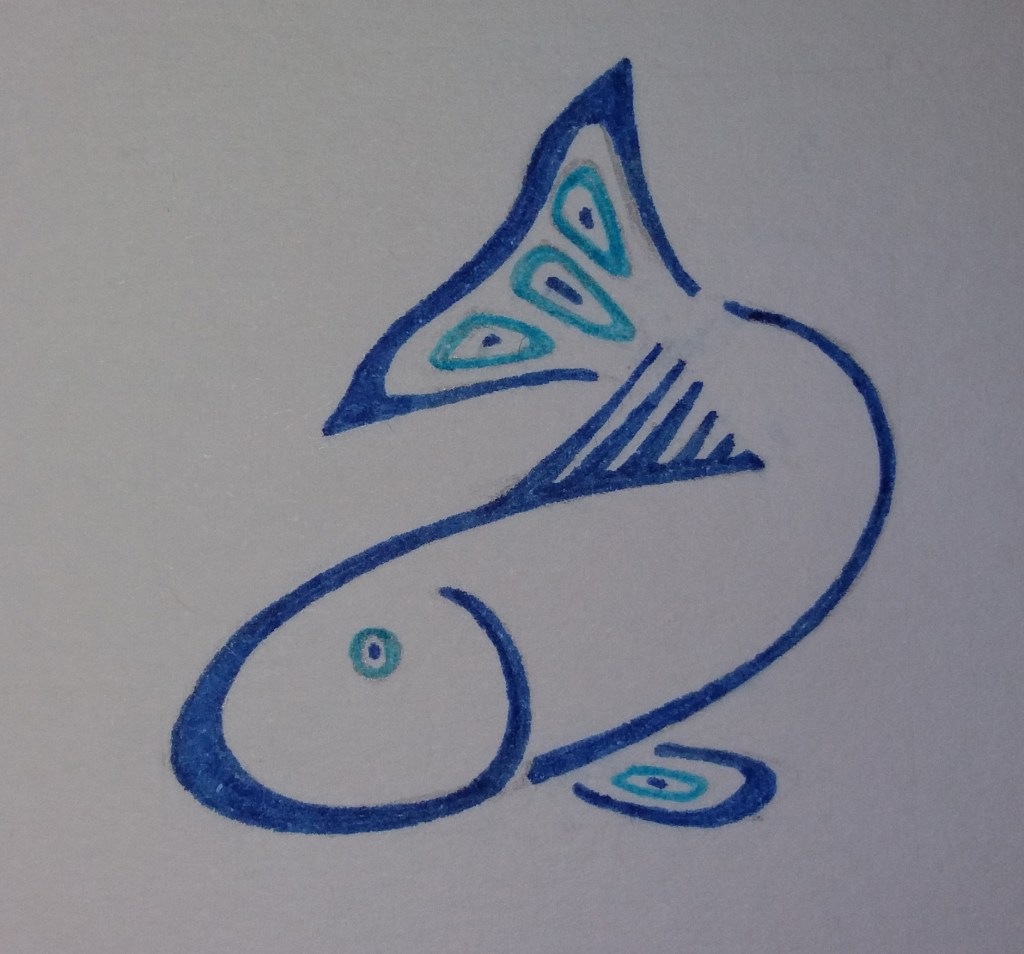
Fish restaurant logo

For this exercise I’ve been asked to produce an illustration for use on the menu of a sophisticated, quality fish restaurant that is part of a chain across several European cities. The menu uses fresh ingredients and the ambience of the restaurant is modern, bright and contemporary in design. The image will initially be used at a small scale on the menu (40 mm x 40 mm); however, if successful it will also be used at a larger scale in stationery and on vans. Therefore, the image needs to be simple and clear.

My initial thoughts on this are that the logo should not include any text as it is going to be used in several countries. The logo needs to convey the message of fish restaurant. I need to think about how you convey the idea of quality with a simple logo.
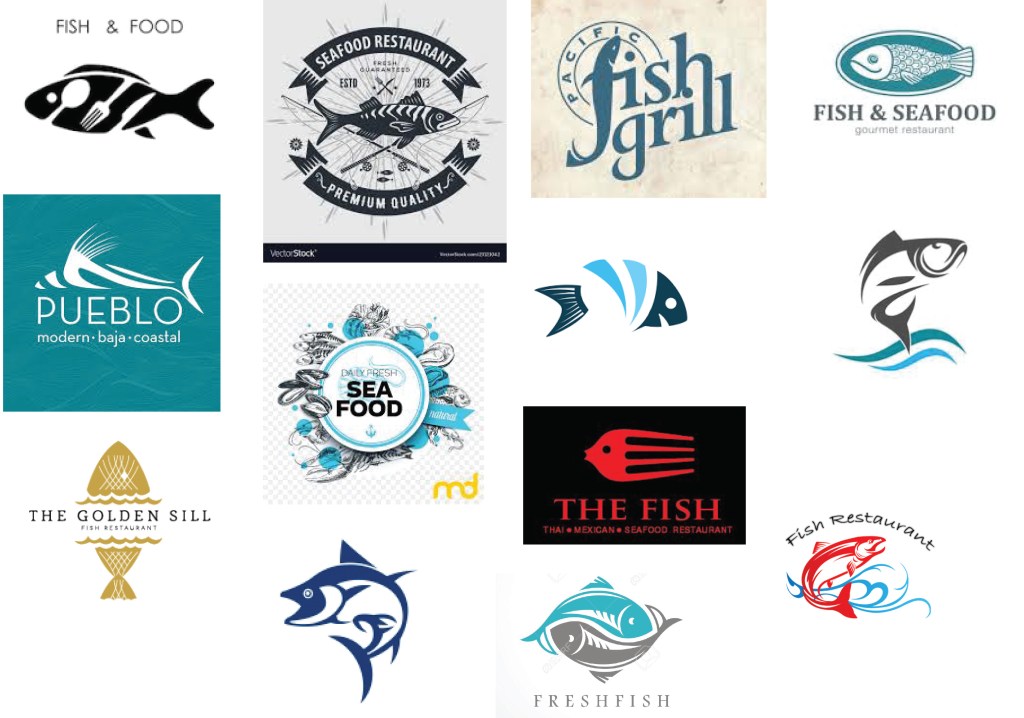
Examples of fish restaurant logos

I collected together a selection of fish restaurant logos. Initial observations are that, not surprisingly, blues are the dominant colour used. Most of the designs are very simple and graphic. I think the cleverest design is the fish that is both a fork and a fish. However, I think that the designs with more detail, whilst potentially less eye catching and practical, somehow suggest quality – attention to detail in the logo implies attention to detail in the food. For me the designs that work best are those that are somewhere in the middle ground with respect to detail – they are graphic, however, they illustrate quality by using a particular species of fish in the logo, rather than a generic fish. With the exception of the little red fish-fork, I don’t think that using cutlery in the design is necessary and for me doesn’t illustrate quality. I am attracted to the fish that appear to be jumping out of the sea – it gives the logo movement. I don’t think people want to see the dead fish that they will eat; they want to see a lively, fresh fish.

Given current concerns for the oceans and over fishing, I will try to use one of the more sustainable fish species in my design. According to the marine conservation society these include mackerel, monkfish, some species of salmon, trout – it’s pretty shocking when you look into it how few fish species are fished at a sustainable level. For my next step I’m going to research images of different types of fish and try to make simplified sketches of them.
Sketchbook images

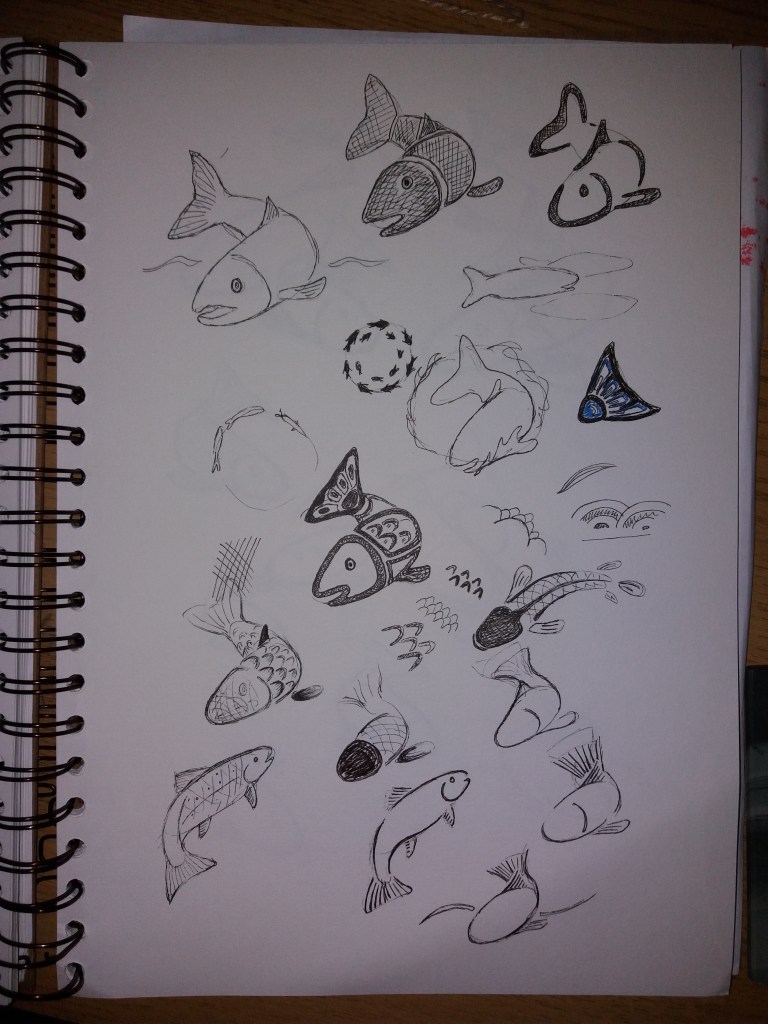
I began with a simplified sketch of a salmon and started playing with making the image more graphic. I started by blocking out solid areas of colour, I then tried reducing the image down to lines. This started to make me think about how fish are depicted in Native North American artworks. I also began to look at some of the textures used in Japanese art and to make sketches of these. I think that Japanese art has more fluidity than the native american designs and might help to give the image movement.
Sketchbook images

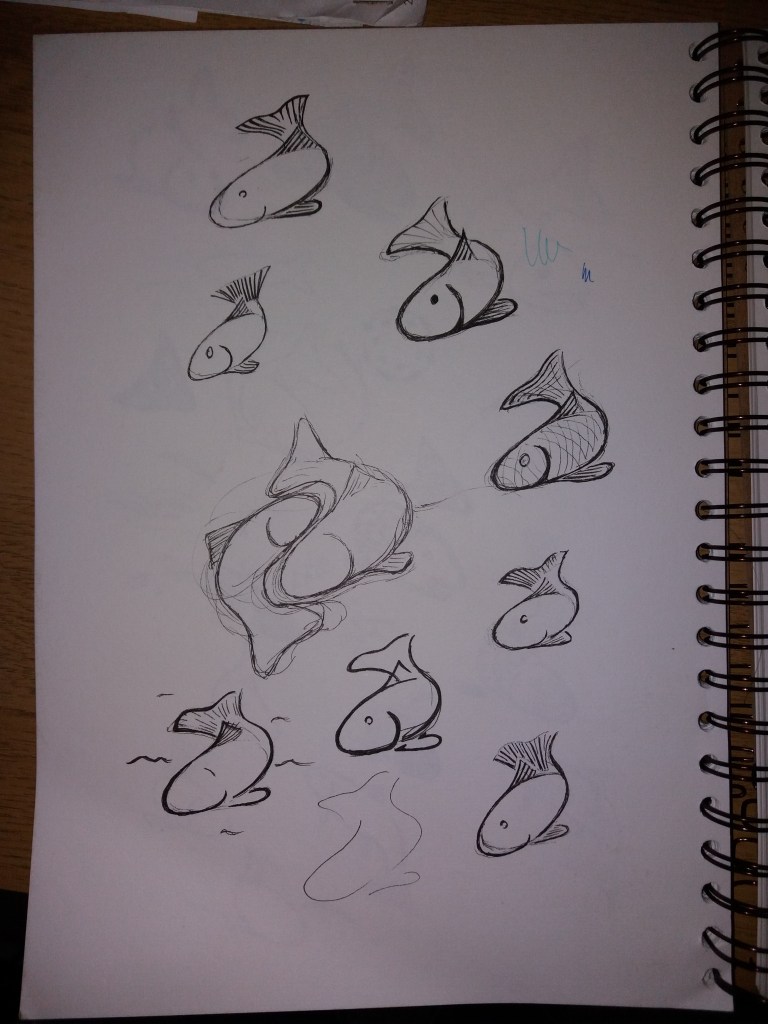
I was getting a bit stuck developing the origniam image, so I decided to find another image of a fish and work from there. I then kept trying to break the fish down into a few simple lines but using the ideas of thickening and thinning of the line from the native american artwork. The fish is still a bit cartoony for a high end restaurant. I wonder about making it more slender and with less well defined edges at the tail. Or maybe I could use colour to give a feeling of depth.
Sketchbook images

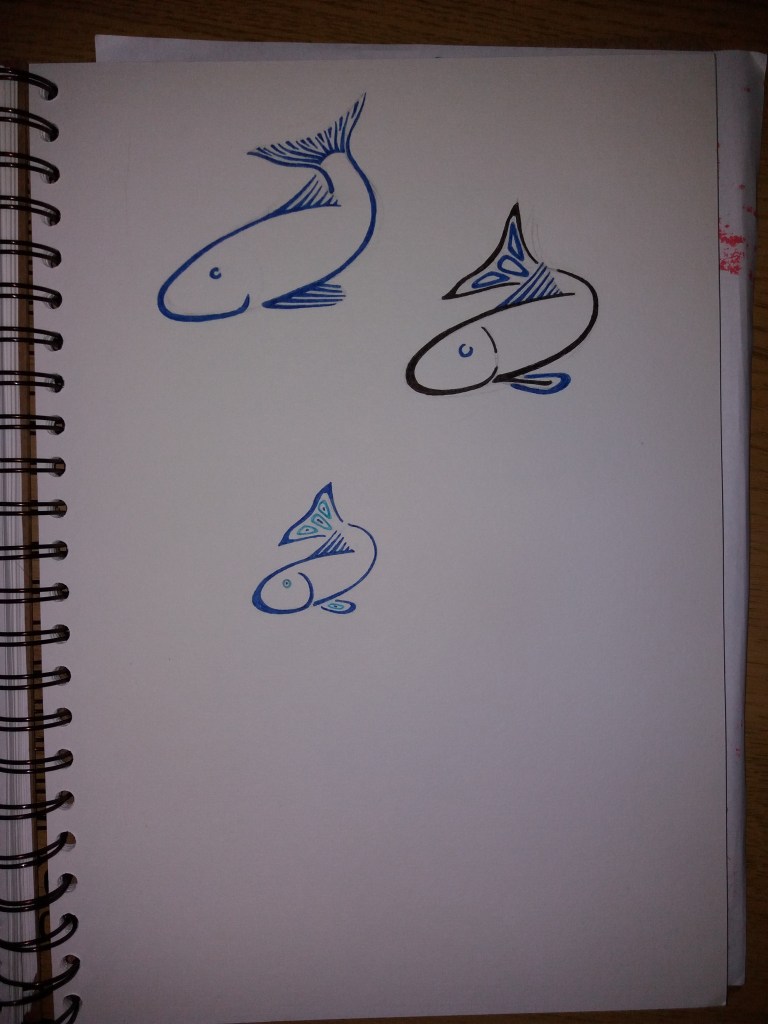
Finally I started to play with colour. My final design at 40 mm x 40 mm is the bottom image on this page. Retrospectively, I think that I prefer the black and blue colour scheme as it’s a bit more contemporary and eye-catching than the two tone blue colour scheme. If I had time, then I would produce this image in adobe illustrator in order to make the lines perfectly clean and the colours perfectly flat. I think the image would work well at a range of scales and fulfills the brief. It would have been good to somehow get more movement into the image – as per usual many of my sketchbook images have more movement in them than the final logo. Maybe it is a little odd to take elements of native american art into the logo for a restaurant chain in Europe, I’m not sure, as there isn’t much information about the restaurant. Maybe, I could tone this down a little.
Museum posters

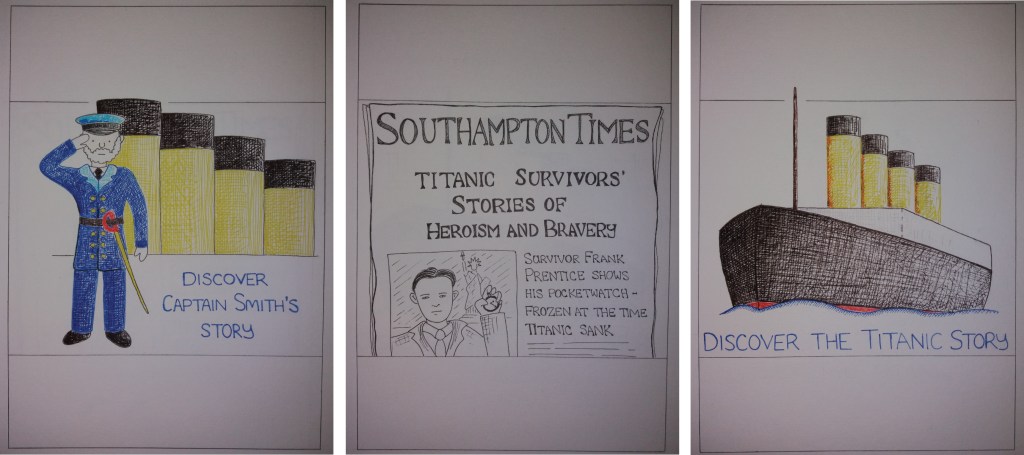
Client visuals for three museum posters aimed at children, teenagers and adults. Space has been left at the top and bottom for museum branding and information.

The aim of this exercise is to produce colour client visuals for three posters that advertise a museum and are aimed at three differentage groups: child (5-9); teenager (13-16); and a general adult audience. Each poster is to be based on an object that has been selected from the museum’s collections.

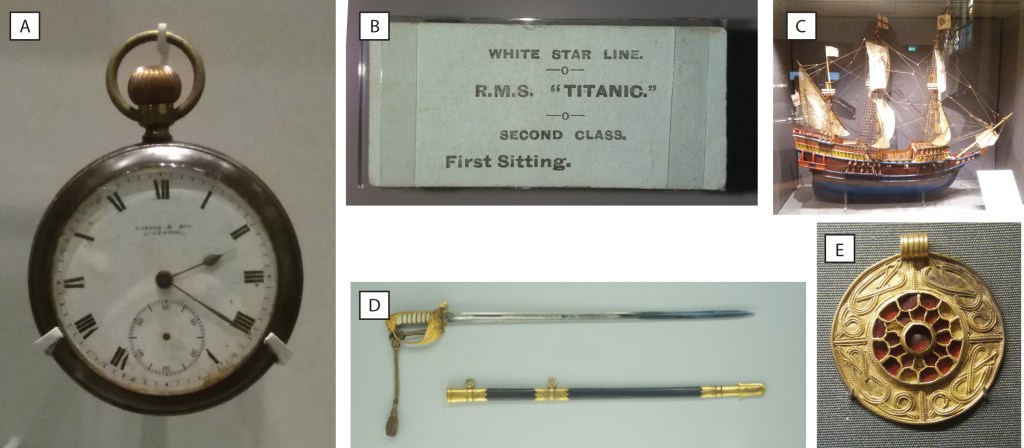
For this exercise I visited SeaCity Museum in Southampton, which has a titanic exhibition and an exhibition about other events in the history of Southampton.

Objects from SeaCity Museum. A) A pocket watch belonging to the Storekeeper on the Titanic. B) A second class dinner ticket from the titanic. C) A model of the Mayflower. D) Sword belonging to the Captain of the Titanic. E) Saxon womans necklace.

In order to have a coherent theme running through the three posters I’m going to use the three objects from the titanic. I think that the sword will be the most interesting object for children. I’m personally drawn to the dinner ticket, I think because of it’s simplicity, therefore I’m going to use this object for adults and then the pocket watch for teenagers. Both the sword and the pocket watch belonged to specific people so I could use characters alongside the objects on the posters.

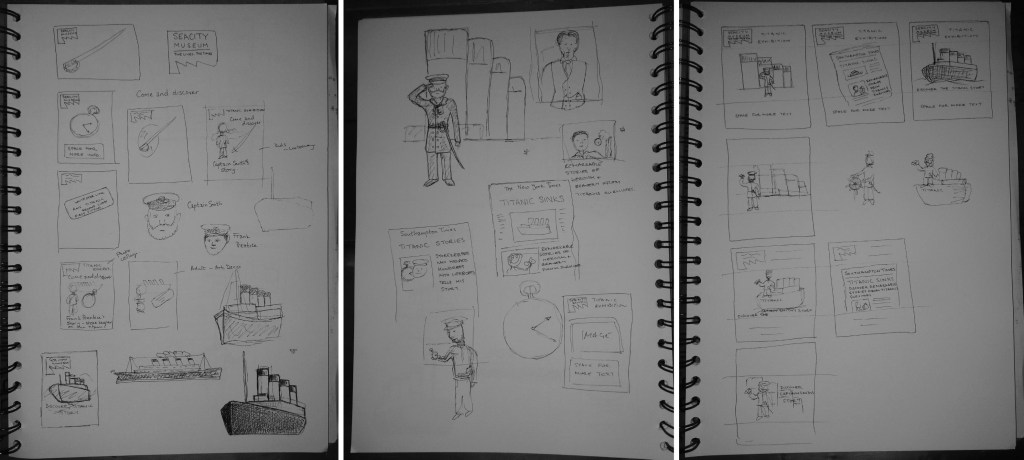
I am a little rushed for time with this exercise so I’m going to jump straignt into drafting some different poster ideas for each of the objects. The museum has a distinctive logo that I will use to help tie the three posters together. In the museum they are keen to tell the stories of individual people who survived or perished on the titanic, so I intend to include this within the posters i.e. to include the person alongside their object. I think that this will be particularly helpful with the posters for children and teenagers. I’m also thinking about including some similar text on each poster e.g. ‘ Come and discover ‘ and the name of the person and their object.

I’m thinking of using a similar layout for each poster but using a different style. Titanic sank in 1912, so for the adult poster I might try to use an art deco style. I’ll make the kids poster in a cartoon style. I’m unsure what style would appeal to teenagers. The tricky thing about all of these posters is that the museum is about a horific event in which 1500 people died so I don’t want the posters to appear flippant or disrespectful.

Poster ideas – objects, characters and thumbnails.

For the poster aimed at children I’ve decided to have a cartoon of the Captain, complete with sword standing on the deck of the titanic. I’ve opted to focus on the character rather than the sword because this is the focus of the museum – telling the story of the people aboard titanic. The challenges that I found with this poster was how to fill the space when you’re using a single character. I thought about including more characters but this distracted from the main character. I also experimented with having the Captain standing on a cartoon titanic but this felt a little too jovial for the topic.

For the poster aimed at teenagers I also wanted to incude a character. I played with showing the character of the storekeeper whose pocketwatch is in the museum. However, the cartoon style felt a little childish for teenagers. I also experimented with using old photos of the pocket watch the storekeeper and the titanic, however, this didn’t look interesting or coherent. However, as I was working in black and white this somehow led to the idea of using the front of a newspaper. Putting text on the newspaper also led me to think about adding a tag line to each of the posters.

For the poster aimed at adults, I started by including the image of the dinner ticket. However, I realised that for a museum about titanic it would be good to show the titanic herself. I decided to try to include an image of the ship on the poster in a simple, bold, graphic style.

I’m presuming that the final posters will be on standard-sized paper. I’ve decided to produce the client visuals at A5 scale as this is the smallest they are likely to be produced. However, my intention is that the poster could be scaled up to A0 or larger.

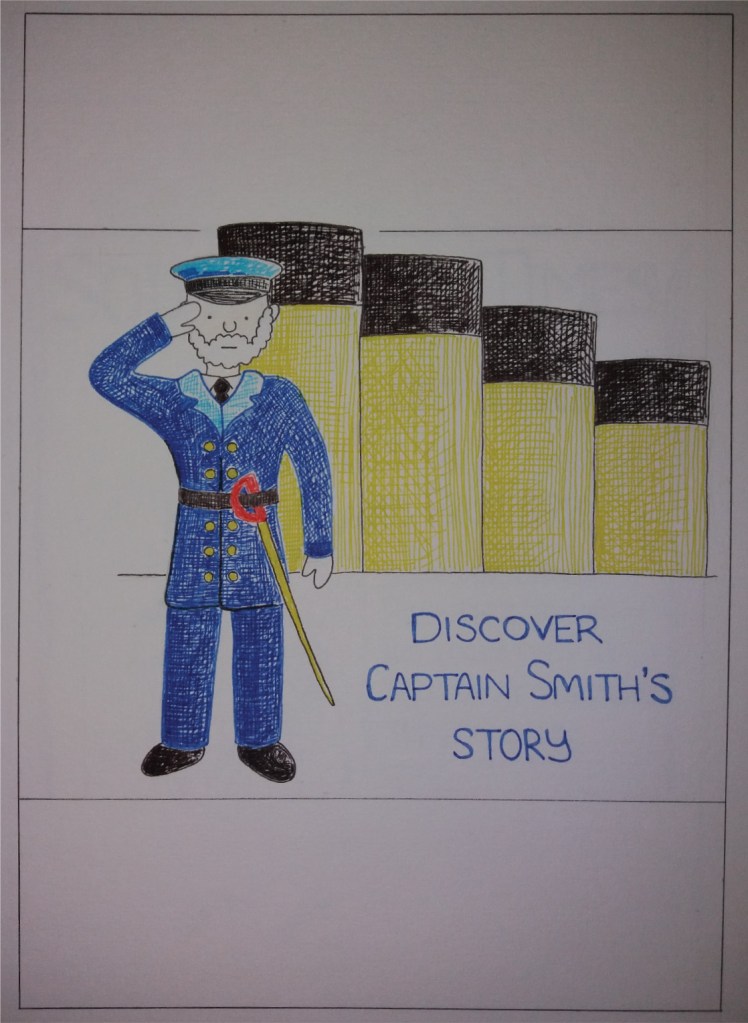
Client visual for the poster aimed at children aged 5-9.

I’m quite pleased with the poster aimed at children; it’s simple and bold. It will benefit from coloured banners at the top and bottom of the page. I do wonder if I could have got more movement into the cartoon, which would make it a little more exciting. I did realise retrospectively that of the characters that I chose for the posters, this person drowned with the titanic, so was maybe an inappropriate choice for the children’s poster. I quite like the funnels in the background and that this is repeated in the adult poster.

Client visual for the poster aimed at teenagers aged 13-16.

The poster for teenagers was the one that I most struggled with. I quite like the final design, although I wonder if it is a little childish. The poster definitely needs some colour in the banners, or the whole of the background to make it stand out.

I like the simple image of the titanic in the poster aimed at adults. I think it would be quite eye catching at a range of scales. I wonder if I’ve made it so simple that it’s not instantly recognisable as titanic; however, I think this would be okay once integrated into a poster with the museum’s branding etc. In the end it’s bold and graphic but it’s not particularly art deco but I’m quite happy with that.

I like using pen to make client visuals as it’s reasonably quick and feels quite free. I think the pen works well for the poster aimed at teenagers. For the poster aimed at children I’d use bolder, blockier colours – I might well make the final version digitally. For the poster aimed at adults, I actually prefer the image of titanic from my sketchbook. I’d consider using a sketchier style that gives the image a bit more movement.

A children’s book cover

Three colour client visuals for the cover of a book entitled ‘Animals of the World’

The aim of this exercise is to produce a cover illustration for a natural history book for children aged 7-11. The book will be entitled ‘Animals from Around the World’. For this illustration, I need to consider that people have expectations of such a cover will look like but also to think aout how to attract a modern audience to the book. I need to produce three sets of coloured client visuals for the book cover and include information on the final size and format and where the type will be positioned.

NB – note in learning log decisions made through the design process.

Book covers from children’s books about animals

I began by researching designs for covers of children’s books about animals. Most books, use simple but realistic depictions of animals. The book covers that really appeal to me are the two covers that break from the mold and have bold, stylised images of a tiger and a wolf on their covers. These two alternative designs would definitely stand out on the shelf of a book shop or library. I’m unsure how appealing these covers would be to children; however they might at least appeal to the adults who are likely to be buying the book. I don’t think that the designs that include maps of the world work particularly well from a distance, although they might be quite attractive to children once up close.

I think that an important choice with the book cover design is whether to include a single animal of many animals. Using a single animal is visually eye catching, however, it doesn’t represent the content of the book particularly well.

Colours is also important in these book covers. Most of them use bold, bright colours with greens and blues dominating.

I decided to begin by loosening up and sketching lots of animals to help me to start learning how to draw animals and to think about what animals to include. I also sometimes get a bit frustrated at the research stage that I want to be drawing. At the same time I started sketching thumbnails as they came into my head. I tried to choose a range of animals that are distinctly representative of different parts of the world.

Animal sketches

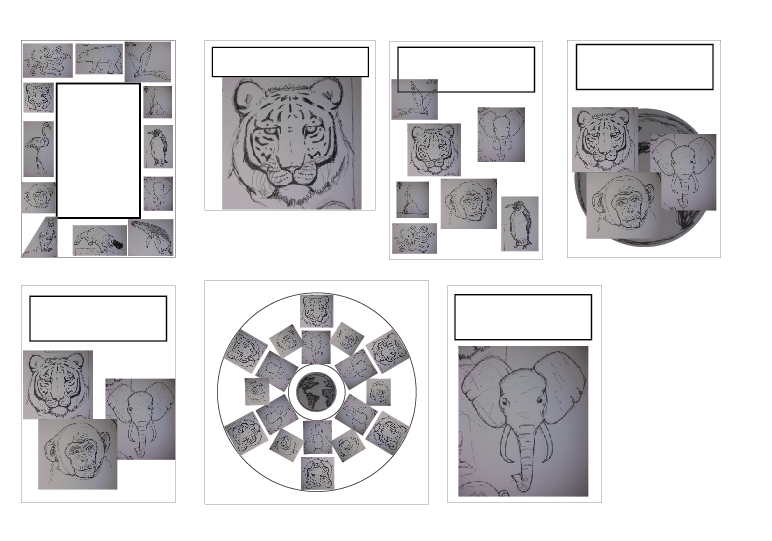
I started thinking about the cover design in my sketchbook using thumbnails. However, I next decided to take a different approach to previously. I decided to digitally ‘cut out’ my sketches and play around with different designs in adobe illustrator.

I found thumbnailing in illustrator a bit limiting because I could only move the existing ‘characters’, change their position on the page, scale them and rotate them. I couldn’t play with what the characters were doing, where their legs are etc, which I can do in my sketchbook. This also led me to do a bit of research into graphics tablets as I think that these could be a really useful tool for this part f the design stage. I also found working electronically frustrating because the file sizes quickly get big and it takes a lot of time to save images.

I liked one of the designs from my illustrator thumbnails – the one with three animal faces in front of a globe. I think that having eyes looking out from the cover of a book grabs attention.

Thumbnails

At the thumbnail stage I experimented with books of different shapes and sizes. For the three final images I decided to go with an A4 book cover as this seems to be a fairly conventional size for this type of book.

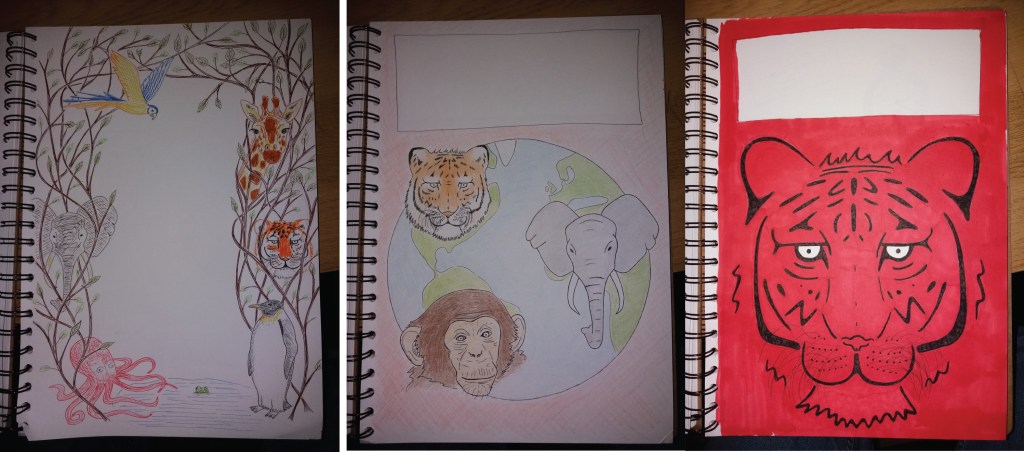
Cover 1

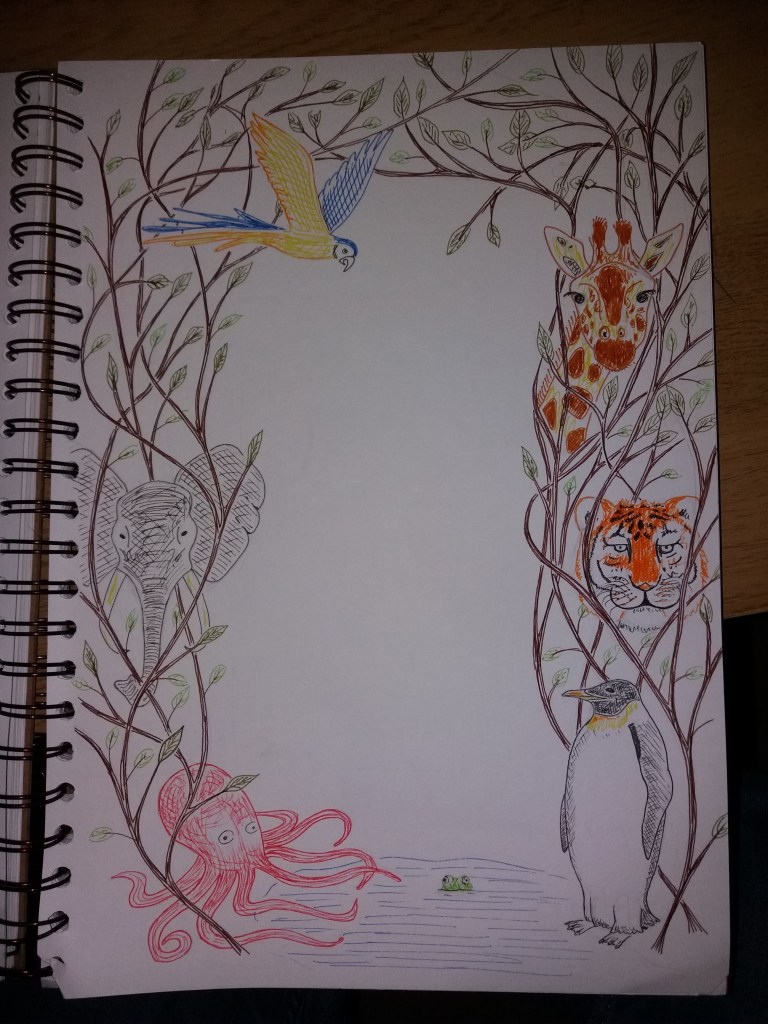
My first book cover is a bit of a rebellion against the constraints I felt trying to draw thumbnails in illustrator. I decided to draw freestyle animals as a border around the book title, with the animals entwined in some sort of plant. I decided to sketch this in coloured fineliner, both because this is relatively quick for producing client visuals and also because they are vibrantly coloured. I think that the design is fun; however, it probably isn’t particularly striking from a distance. If this design were used for the final book cover then it would benefit from a different colour background and maybe more animals and plants. This cover does give the impression that the book is about many types of animals. However, it is a bit boring and conventional in its design.

Cover 2

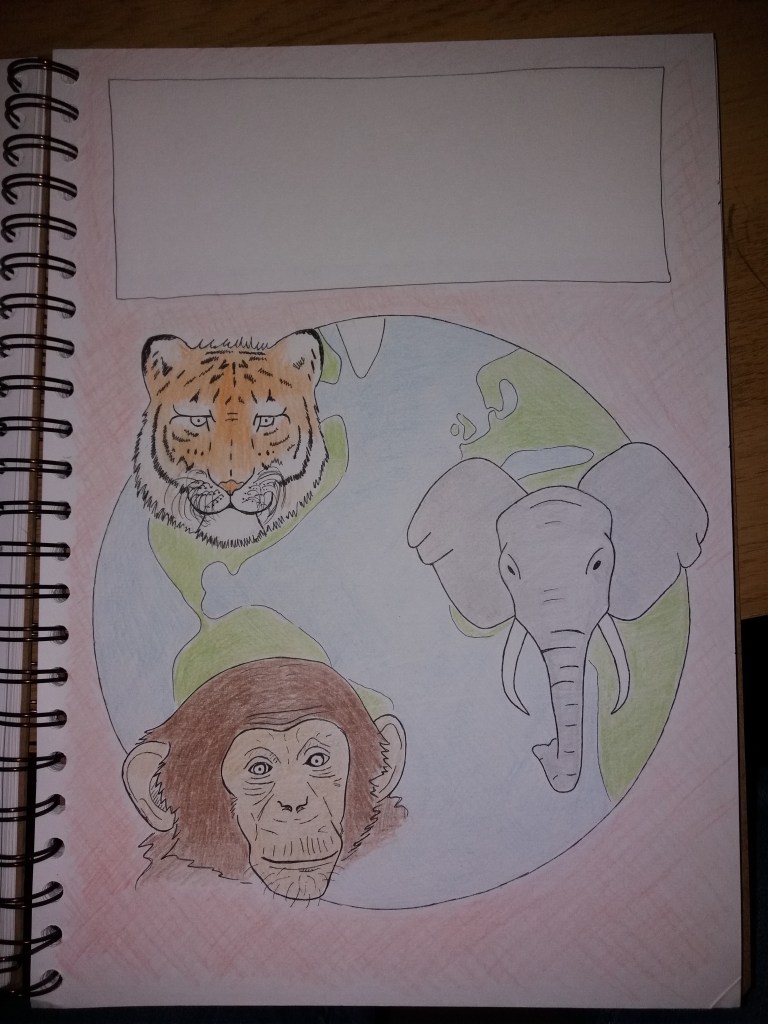
For the second cover design I decided that I wanted to better explain that the book is about animals from around the world. I also wanted to have several animals staring out from the cover. I originally drew the cover in black fine liner and then quickly added some colour with pencil crayon. I think that this design explains the content of the book well. I also like that by making the animal heads larger than in the first cover design, it’s possible to include a bit more detail and realism. If I were to take this on to a final cover design then I’d consider ,making the animal faces larger and also positioning appropriate animals on different parts of the globe.Whilst I’ve broken away from the traditional blues and greens with the colour of this book, I think that it would work well in attracting attention. The disadvantage in quickly shading in pencil crayons for this image is the lack of vibrancy in the colours. I think that if I used this design for a book cover then I might stick with pencil crayons but make the colours much deeper. This design is quite conventional but I think that in a modified form it would work well.

Cover 3

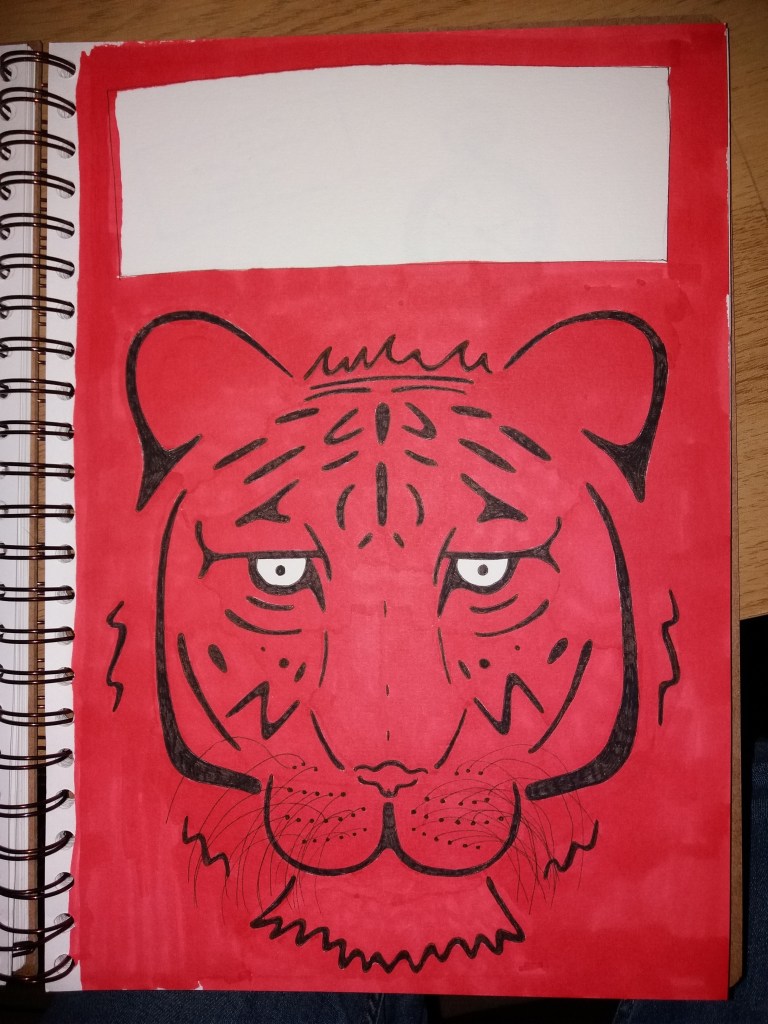
For my final design I decided to break from convention and go for a simplified graphic image of a tigers face. I think that it’s quite a striking image; however, it seems wholey inappropriate for the book. It doesn’t really explain what the book is about and if anything might be a bit scary – it’s a bit of a demonic tiger, particularly with the red background. I think that the image could be improved by leaving more areas of white on the tiger and using a less vibrant red for the background. I made this design using romarker and black fineliner. This didn’t work particularly well as the promarkers bled on the paper I was using. This would be a relatively easy design to create in adobe illustrator. This would have been a better approach as I could also play with the colour and tone of the background colour.

If I were the client I would opt for a modified version of the second cover design, with larger animal faces and in more vibrant colours.

This exercise has led me to wonder about how it’s best to put together colour client visuals – how much time to put into them, how rough and sketch they should or shouldn’t be

Identifying tools and materials

Windmill collages

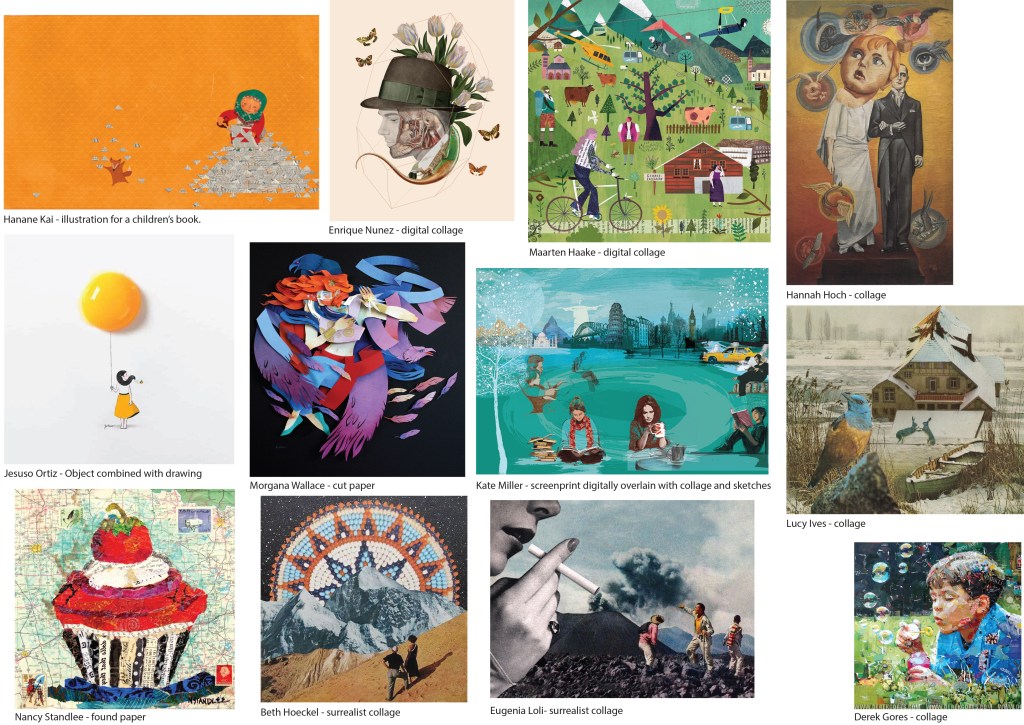
The aim of this exercise is to study and develop illustrations that use a particular medium. I have chosen to look at collage. To begin, I collected together a variety of illustrations that use collage (both traditional and digital).

Examples of collage

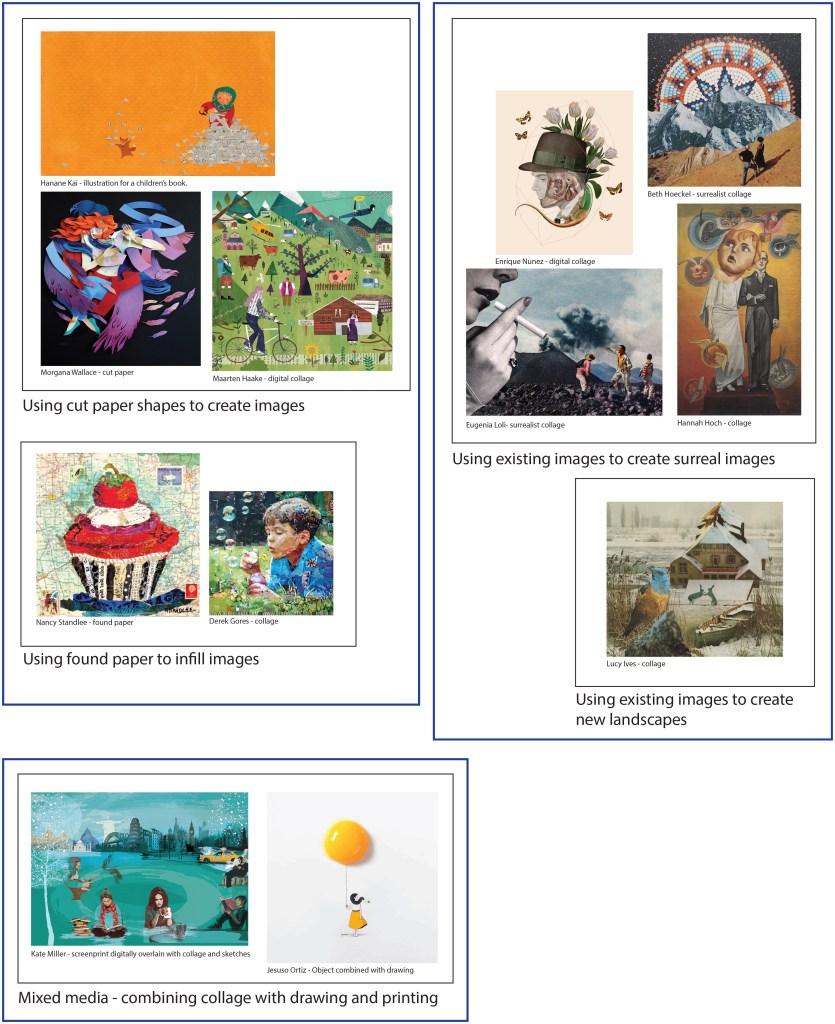
I then catalogued the images according to style. I identified two main styles. The first style uses swatches of colour to create new images; whereas the second style uses existing images to create a new image. The latter is commonly used to create surrealist images. In addition some of the examples that I chose used collage alongside other media such as printing and drawing.

It seems quite effective in the surrealist images to use some of the found images to represent themselves e.g. the people in the image by Hannah Hoch; but then use other images to represent something other than themselves e.g. the ‘angels’ in the Hoch image are made from eyes, babies, plants etc. The surrealist images also play with scale, for example the smoking woman in the Loli collage.

Categorised collage images

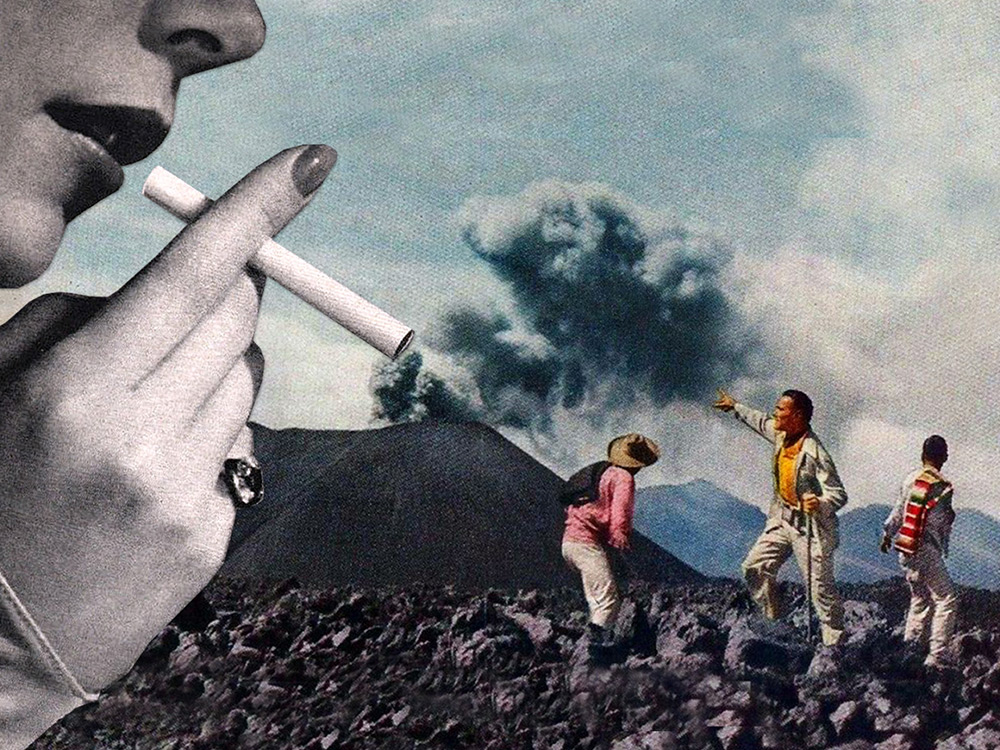
I chose to look at the image by Loli in more detail. The image shows three characters observing an erupting volcano; then from the side a giant woman apprarently creating the smoke from the volcano from a cigarette. The image appears to have been made by taking a background image of a landscape and adding a layer of rock rubble in the foreground. Then the characters have been added, all of whom have are in quite dynamic positions. Then finally the giant woman smoking the cigarette comes in from the side.

All of the layers have a vintage, 1950s feel, from the colour tones in the landscape image, to the clothing that the characters are wearing, to the image of the woman smoking. This helps the image to hang together. Interestingly all of the images are in colour apart from the woman smoking. The eye is drawn to the three characters in the foreground because they are in the brightest colours.

Collage by Eugenia Loli

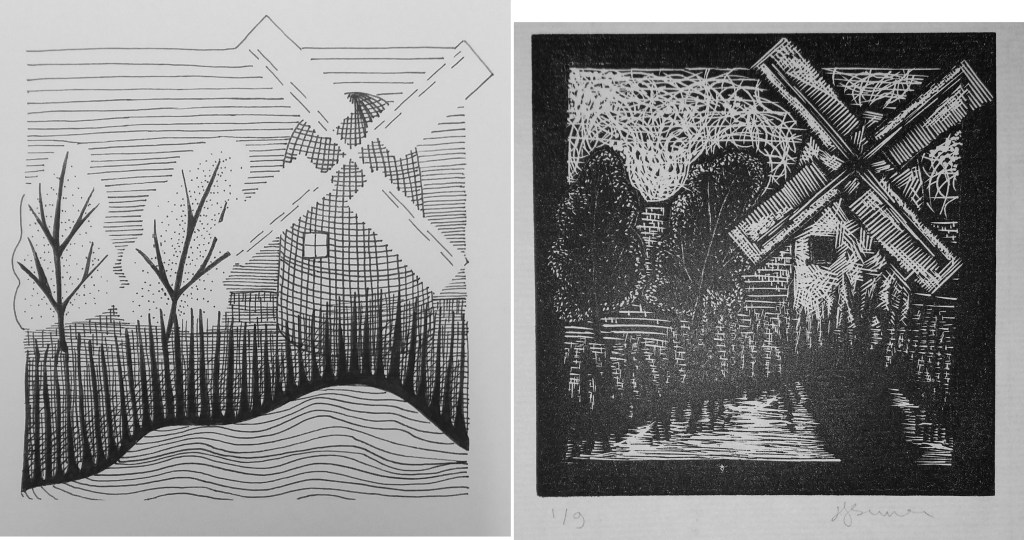
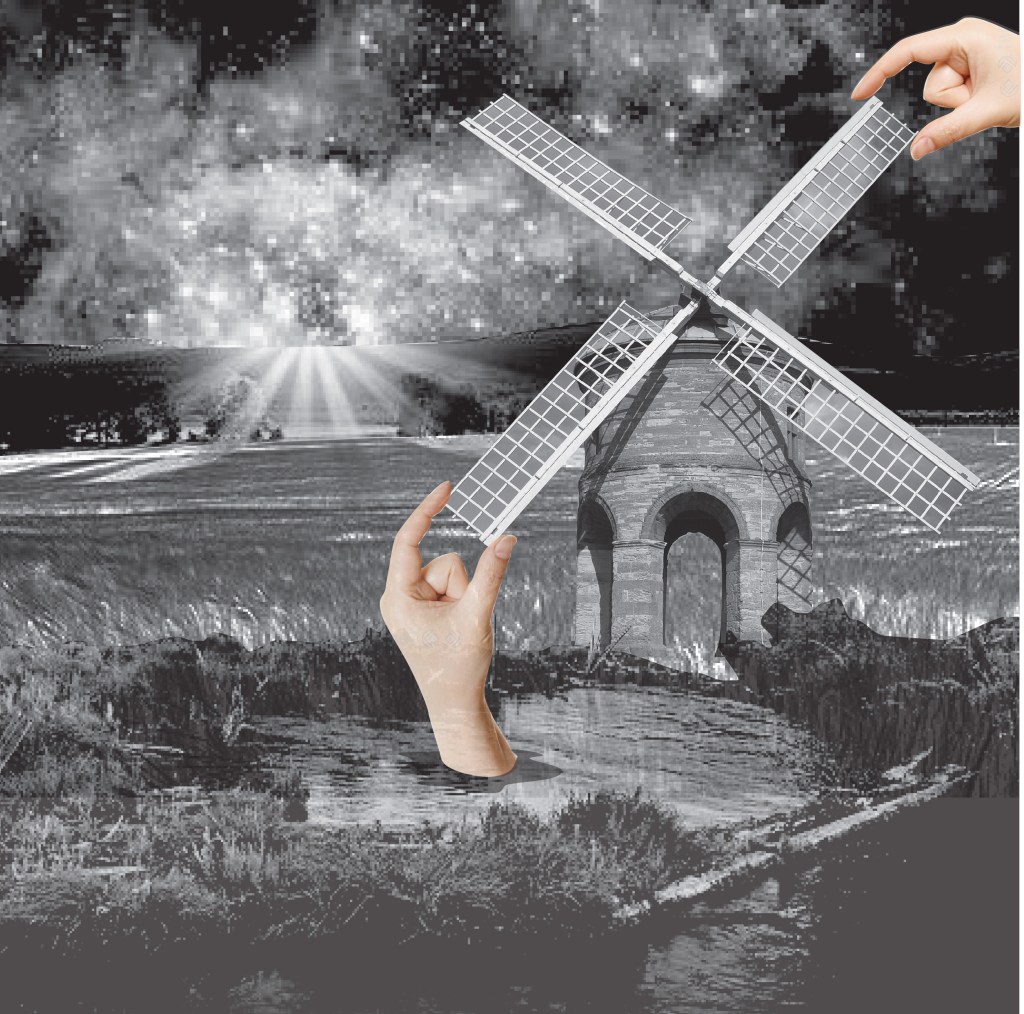
The next part of this exercise is to take an image from a previous exercise and render it using ideas from the above image. I’ve chosen to continue developing my windmill image from the first exercise of this illustration module. I decided to begin by using digital collage.

Original drawing and woodblock print
Windmill – collage

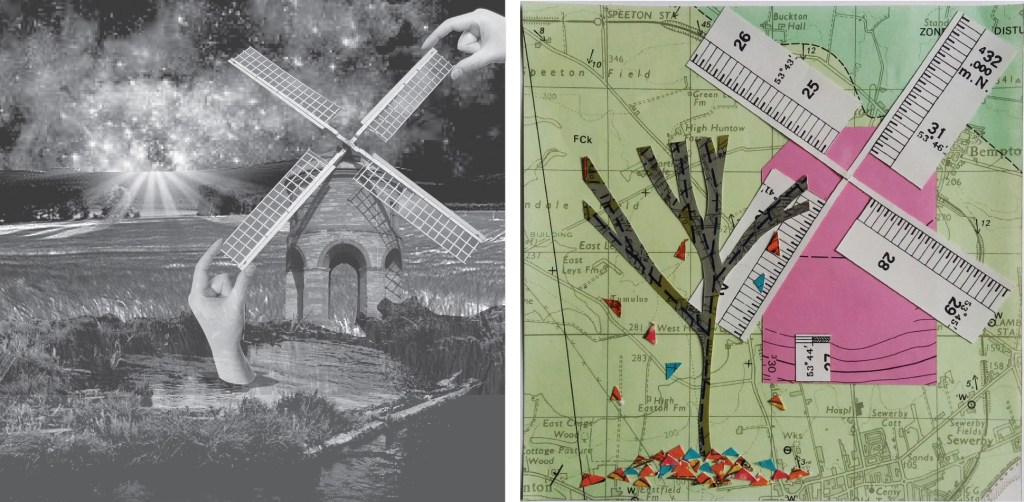
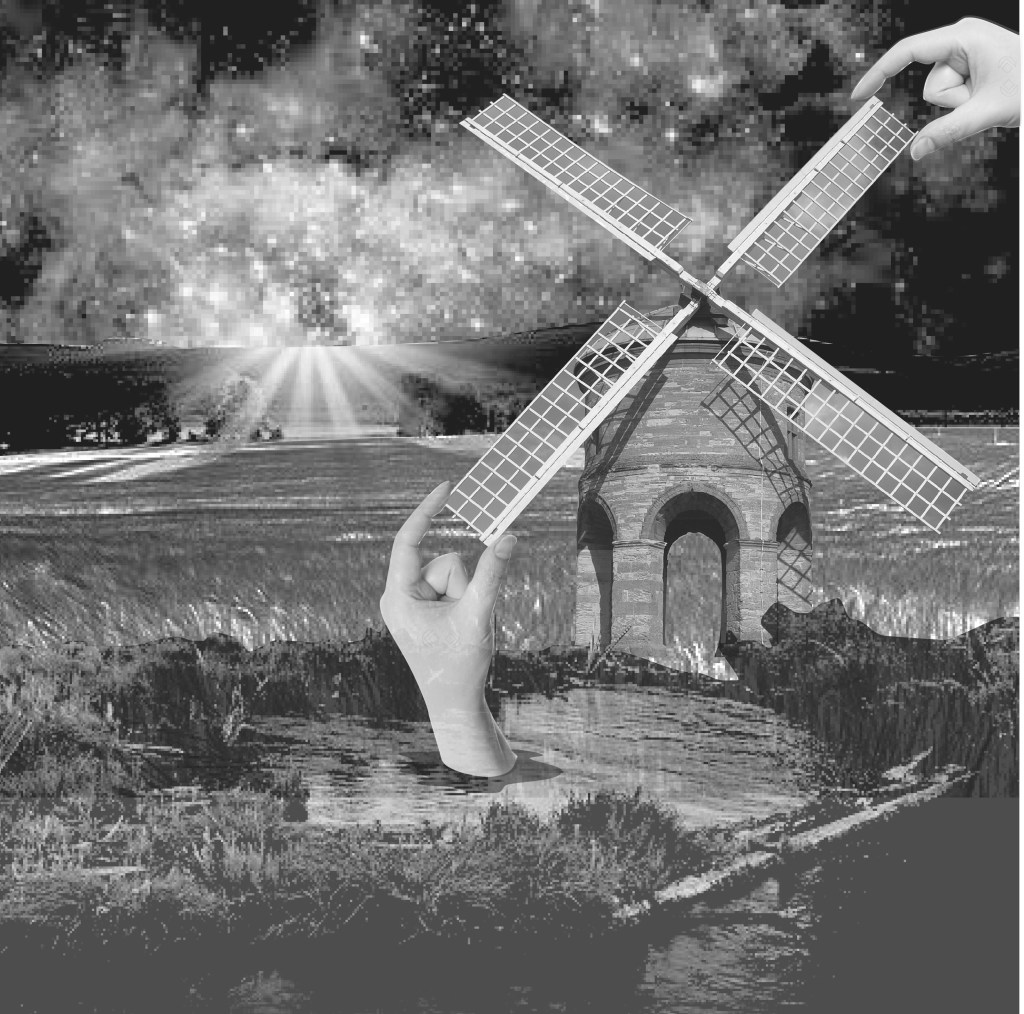
In my new collage image I chose to use black and white for everything apart from the hands. For the sky I chose to use an an image from space but to tone it down by making it greyscale. I then combined three images for the landscape to make the hills, fields and pond, and then added the windmill. I decided to convert all of these images to greyscale. I then added the hands that are placing the windmill in colour. I don’t think that my use of colour only on the hands works particularly well. I think that either the windmill needs to be in colour, or else the hands in black and white.

I prefer the image all in greyscale – the hands are less gratuitous. I do like this element of digital media – being able to make adjustments very quickly and easily and convert them back again if they don’t work. I like that scale is unclear in this image – is the windmill a toy, or are the hands giant.

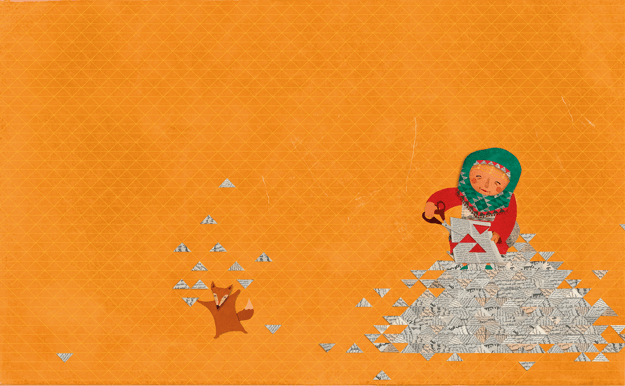
Next I decided to try the same image with a totally different form of collage – to use something like the simple, colourful style of Hanane Kai which uses cut shapes in colourful paper to create the image. The image from Hanane Kai below is from a children’s book.

Image from children’s book – Hanane Kai.

I really like the simplicity of this image – a plain background with no distractions that makes you focus on the characters. Putting the main character in the corner of the image somehow makes the composition more interesting than if the character were centered. I think that the positioning is also quite important to prevent the figures from floating around the image. The colour scheme of this image is also very simple – a few shades of orange and red, green and white.

Windmill collage

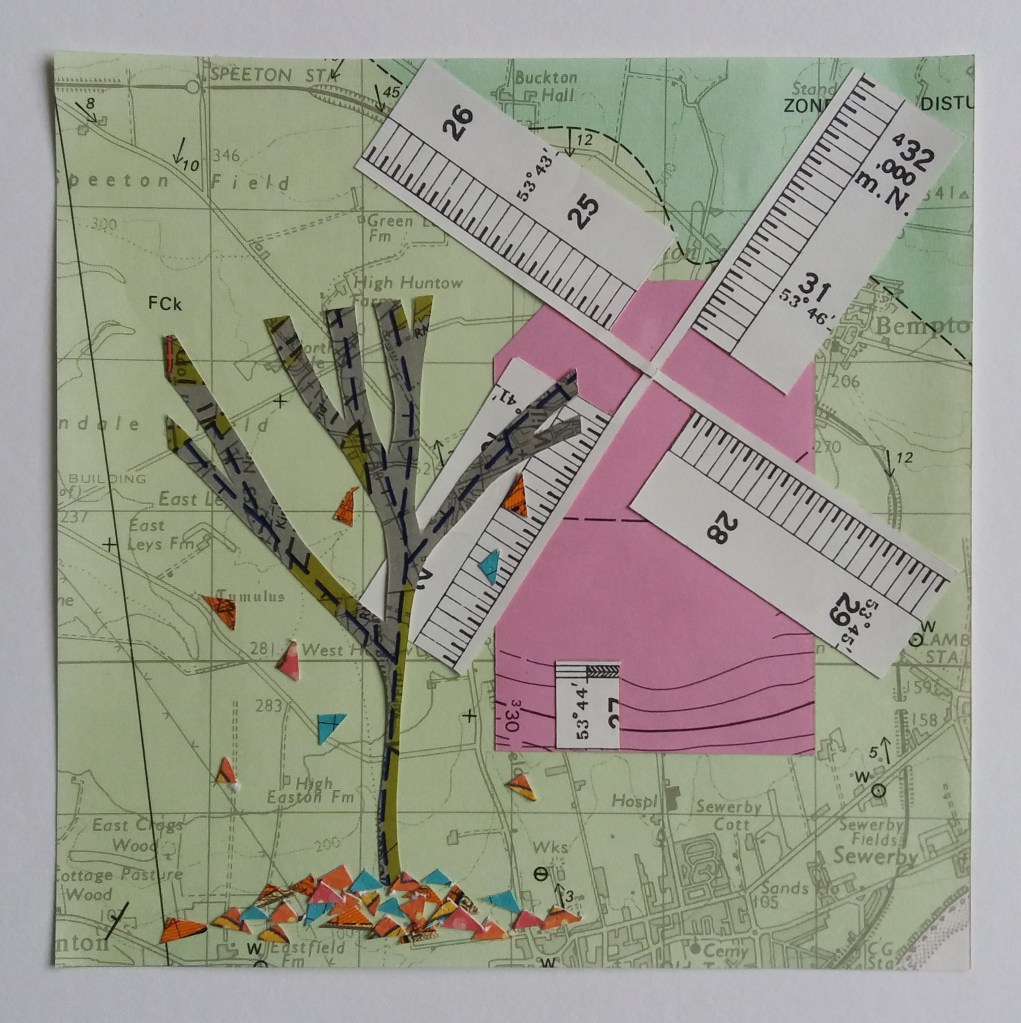
My windmill image is made from pieces of old geological maps that were being thrown away at work. I thought that I was being clever using the scale on the border of the maps for the windmill sails; however, I think that this detail detracts from the tree in the foreground. I don’t think that I had really decided what I wanted the focus of the image to be before I started making this image. I had a play in photoshop at making the colours a little more vibrant, which I think improves the image. If I were remaking the image, I think that I might make the windmill less bright, maybe a more natural grey or brown colour, so that the tree, with its brightly coloured leaves would become the focus of attention.

Windmill collage with enhanced contrast

Making a mock up

Final piece

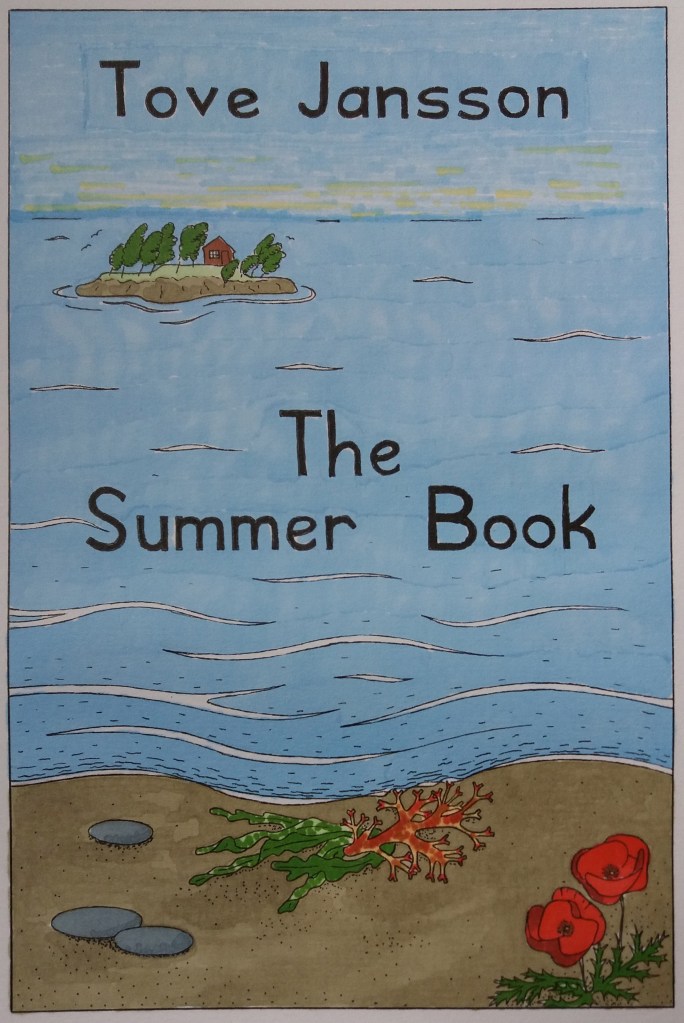
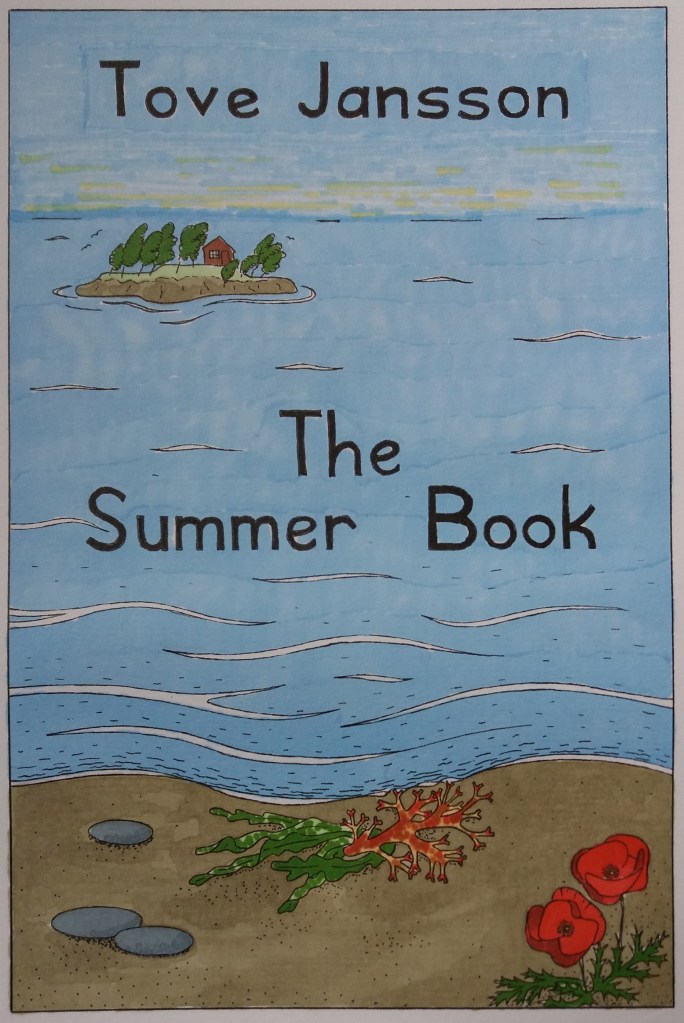
In this exercise I will create a mock up for the cover of a book called ‘The Summer Book‘ by Tove Jansson. This is a book that I enjoyed reading recently. The book is evocative of summer, there are two main characters – a grandmother and grandchild, and most of the book is set on a small Finnish island. The blurb on the back of the book is as follows:

An elderly artist and her six-year-old granddaughter while away a summer together on a tiny island in the gulf of Finland. Gradually, the two learn to adjust to each other’s fears, whims and yearnings for independence, and a fierce yet understated love emerges – one that encompasses not only the summer inhabitants but the island itself, with its mossy rocks, windswept firs and unpredictable seas.

Full of brusque humour and wisdom, The Summer Book is a profoundly life-affirming story. Tove Jansson captured much of her own experience and spirit in the book, which was her favourite of the novels she wrote for adults. This new edition sees the return of a European literary gem – fresh, authentic and deeply humane.

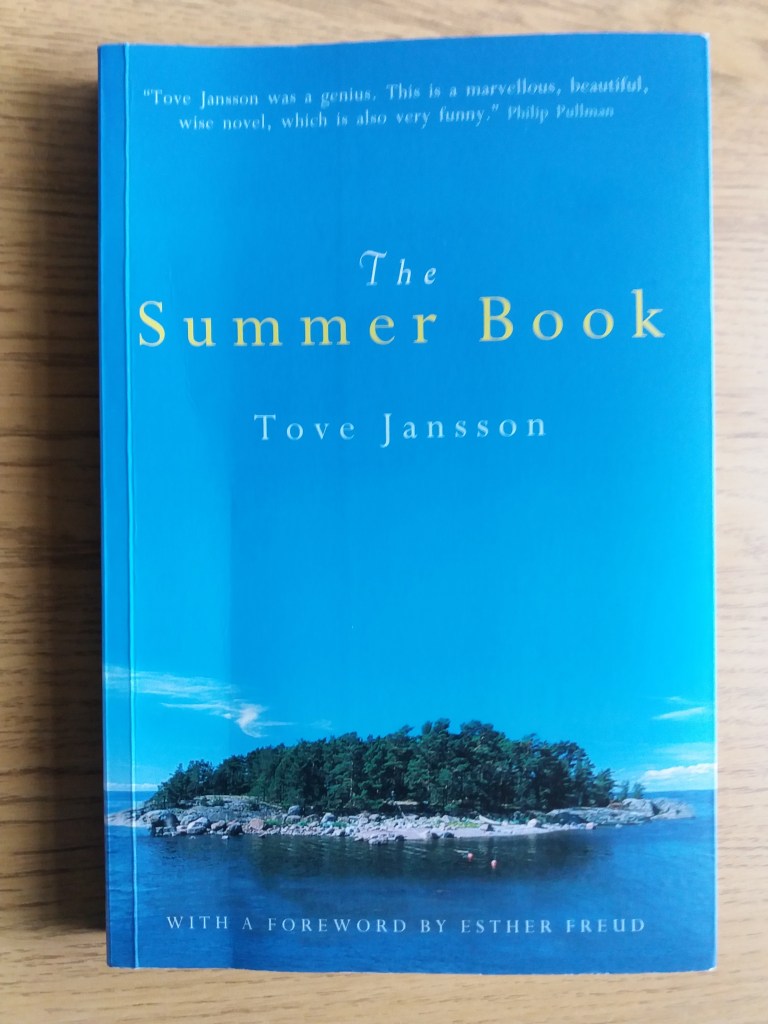
The book cover on the edition that I own is very simple; it comprises a simple photograph of the island on which the book is set.

The Summer Book – cover.

If I were writing a brief for this existing cover, it would go along the lines: The illustration will be on the front cover of a new edition of ‘The Summer Book’ by Tove Jansson. The cover should include the text: ‘The Summer Book’, ‘Tove Jansson’, ”Tove Jansson was a genius. This is a marvellous, beautiful, wise novel, which is also very funny’ Philip Pullman’ and ‘with a foreward by Esther Freud’. The target audience is adults. The illustration should capture something of the tranquility and calm of the book. There are no restrictions of colour use.

For my own illustration I want to modify this brief slightly. I am going to limit the text on the front cover to the book title and author. I want to include the book’s main caracters – the island, the grand mother, the granddaughter. I also want to communicate something of the essence of the book – summertime with gentle adventures.

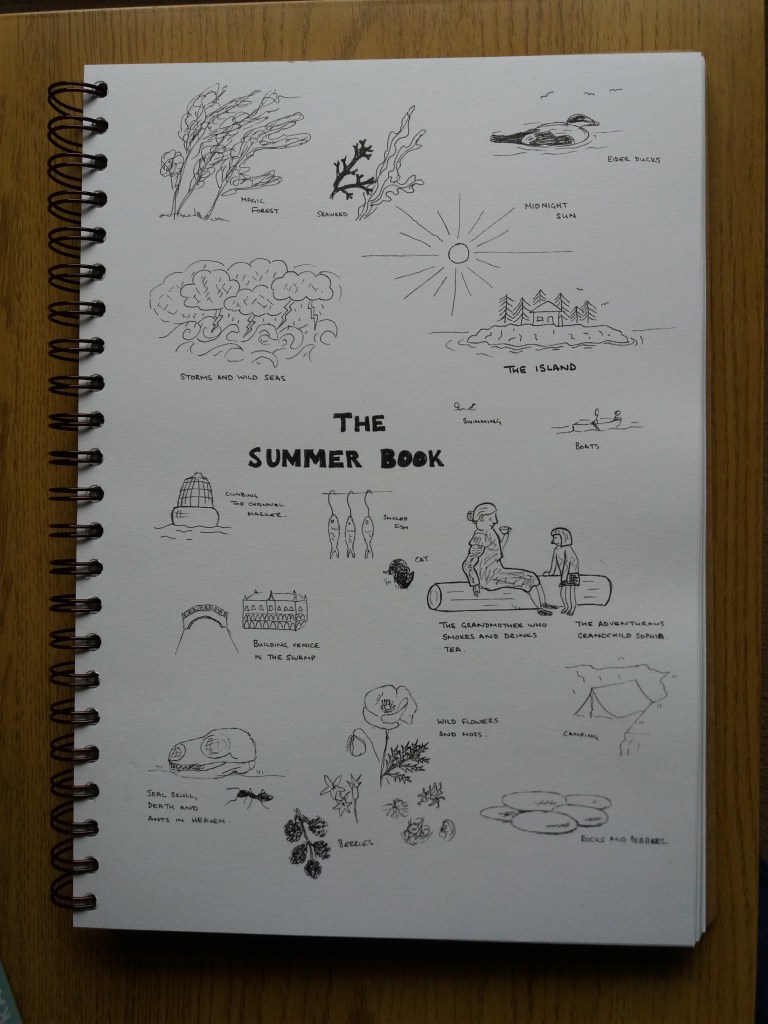
I began by brainstorming in words and pictures what I remember of the book from when I read it a couple of months ago.

Memories of the book.

I found it easy to brainstorm images from my memories of reading the book. I noticed that a lot of my memories were about a sense of place – rocks, flowers and seaweed, rather than about the stories in the book. A thought that came to me while brainstorming is that each chapter in this book is a different story, so you could have lots of small images on the cover hinting at some of these stories. I was reminded of the original dustcovers of Arthur Ransome books. Alternatively, I might have a single image trying to give a sense of the characters and place. I think the rough, fluid style of these initial sketchs might work well on the book cover, although a book cover needs to be appealing from a distance, and this might work better with a simpler bolder imager.

Dustcover of an Arthur Ransome book.

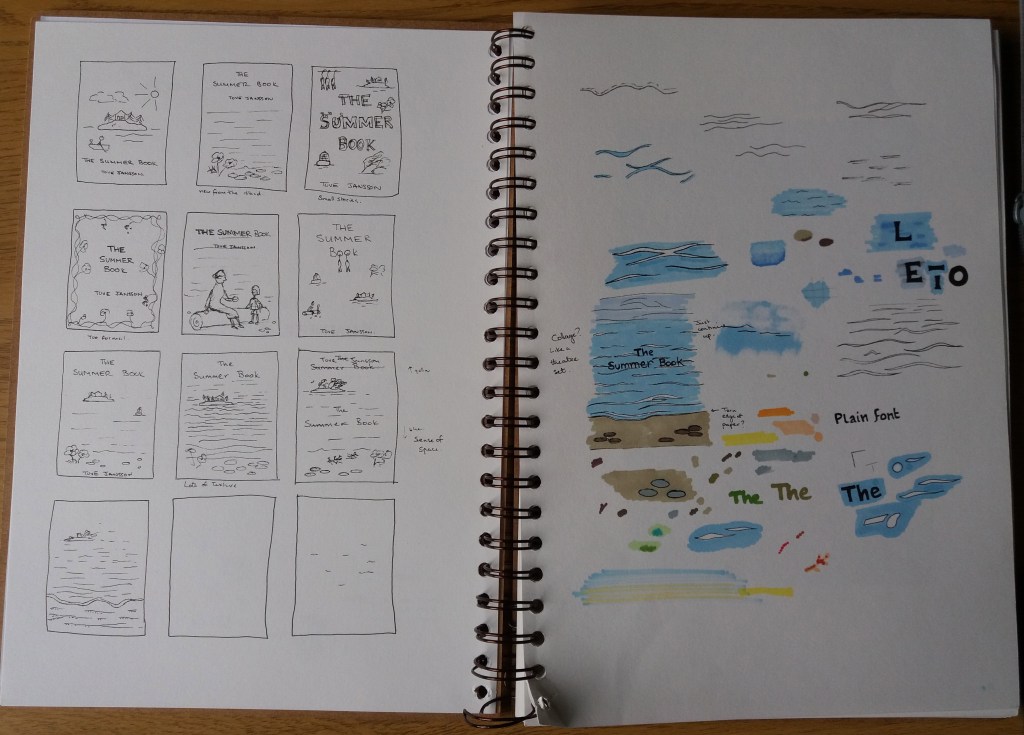
My next step is to start thinking about colour and composition. I think that the original cover demonstrates that blues are important for sea and sky. Also greens are important for plants and sea. Then there are the greys of rocks and clouds.

Thumbnails and rough work

I experimented with a range of designs for the book cover. I decided that having a single image of the landscape, with some detail in the foreground reflected the sense of place that runs through the book. I considered using collage for the design to give a slightly whimsical, theatre set-type design, however, I was a bit limited on time and so instead used promarkers. Unfortunately whilst making the final design the main marker that I was using began to run out. This is why the colour is in clean blocks towards the base of the image and gets increasingly ‘liney’ towards the top. The yellow streaks are an attempt to mask this a little.
I think that this design gives both a sense of the place in which the book is set. I think that the detail in the foreground also reflects the book. The two main characters spend quite a bit of time focussed on details such as objects that have washed up on the beach. I am a little disappointed with the finish of the cover. Retrospectively, I realise that I haven’t met my own brief as I had intended to include images of the characters within the book cover.

Client visuals

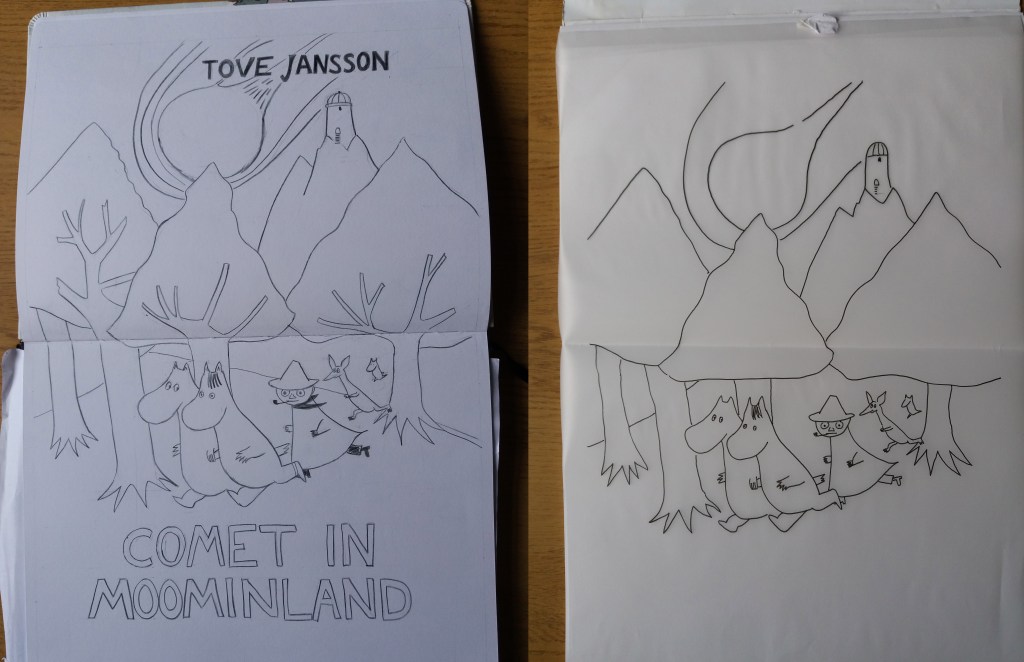
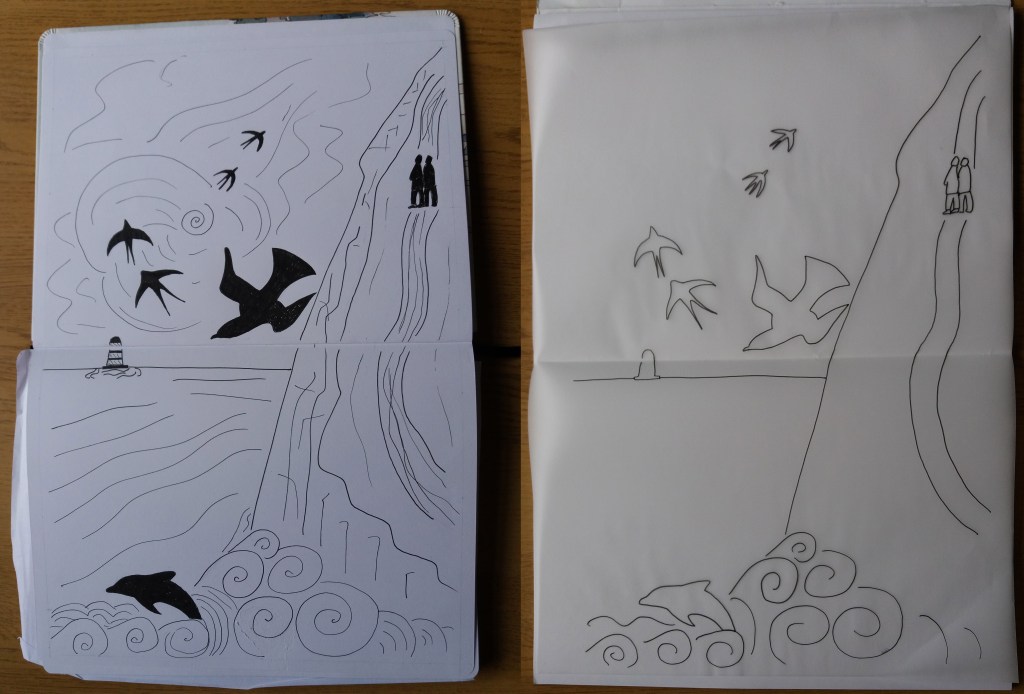
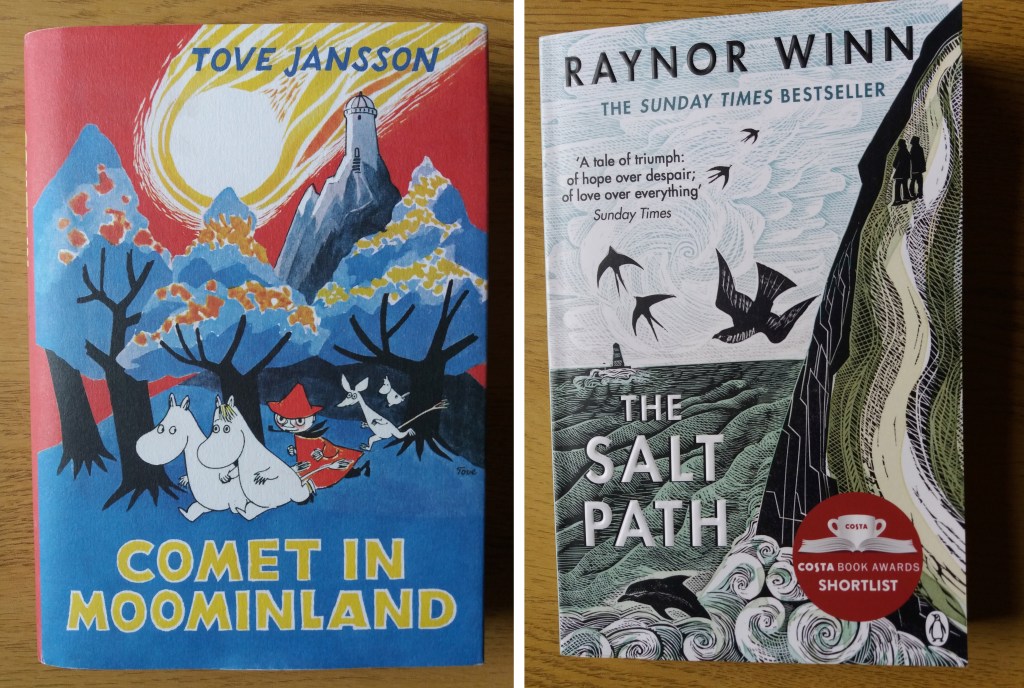
The aim of this exercise is to understand how to create clear visuals that break an image down into its most important, structural elements. I chose two book cover illustrations and tried to break them down into their fundamental structural elements.

Book covers.
Line visuals – Comet in Moominland bookcover.

I think that some of the detail in the first image isn’t necessary – for example the tree branches. However, I think that the second image loses some of the movement of the image by oversimplifying the comet, which is a key element in the image. In the first image I used black pencil crayon for the lines, however, in all subsequent images I used a thick fine liner, which was easier to work with and produced cleaner lines.

Line visuals – The Salt Path book cover.

I really like the linework in the Salt Path book cover. I don’t think the very simplified image on the right works very well. The silhouetted birds, dolphin and figures somehow give the first image depth. A key element of the final illustration is the detailed linework, therefore it makes sense to show some of this in a visual aimed at clients.

Viewpoint

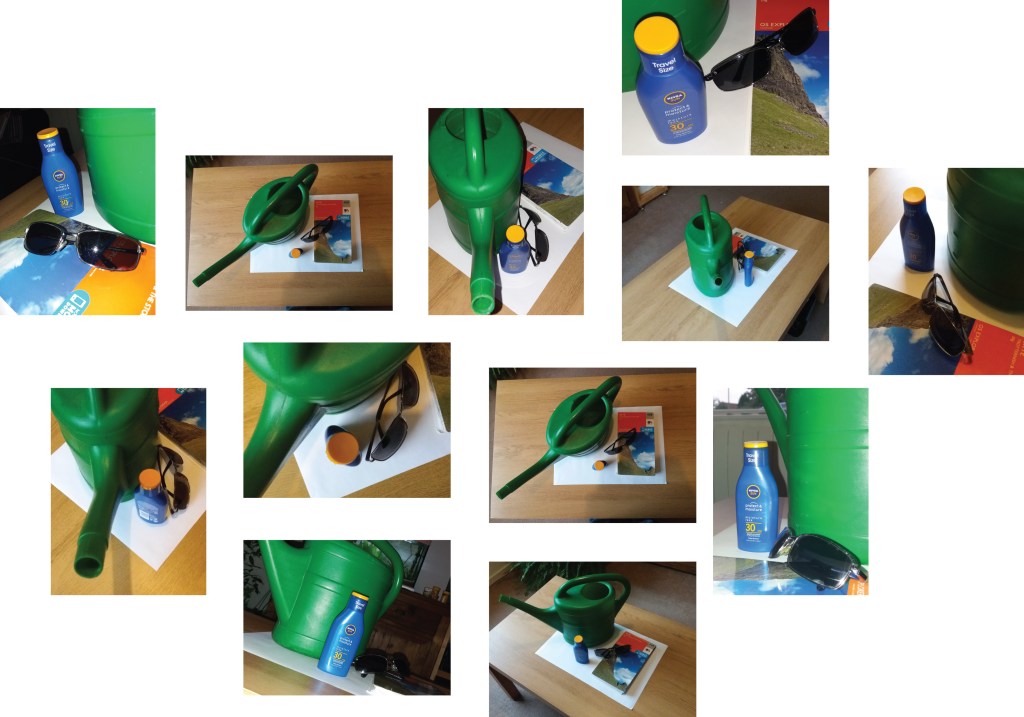
I this exercise I collected some objects that shared the theme of summertime. I then took photographs of them looking at them from different perspectives.

Photos of objects from different perspectives.

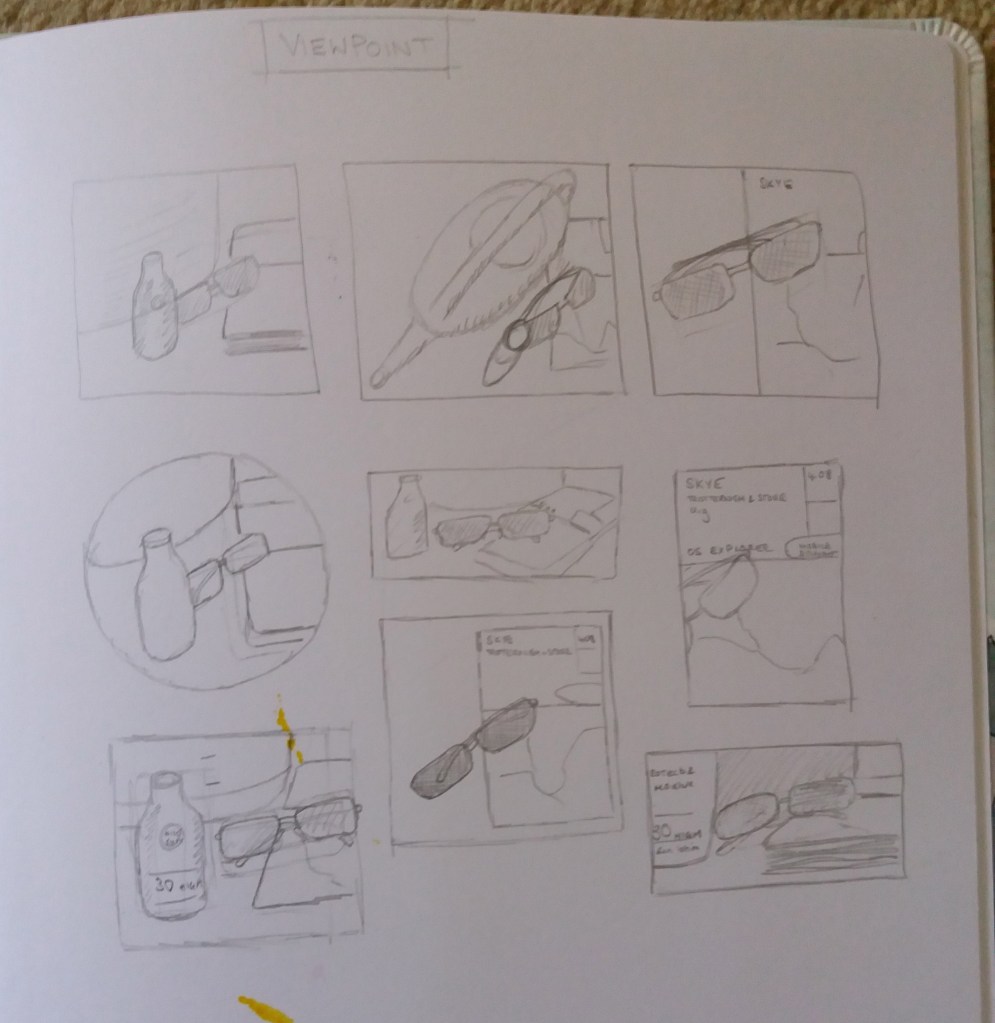
I then comleted a similar task by drawing, rather than photographing the objects. This gave a bit more freedom in terms of the shape of the ‘viewfinder’.

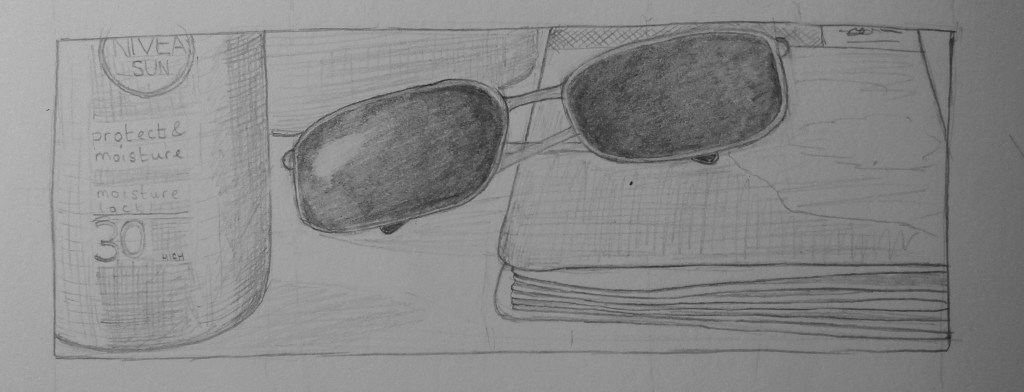
In general I found the photographs and drawings that focussed in on one or two of the objects more engaging to look at. The process of photographing and drawing the images also made me think about which objects best represented summer – for me the sunglasses and suncream. I therefore chose to further develop an image that focussed on these two items.

I think that the image works reasonably in representing summer. My eye is first drawn to the bottle of suncream in the foreground and then the sunglasses. I’m not sure that it is entirely obvious that there is a map underlying the sunglasses.

I found this a useful excercise for exploring different possible viewpoints,and shapes of viewfinders, before focussing in on a final design.

Giving Instructions

The aim of this exercise is to produce a visual set of instructions for making a cup of tea. I began by collecting examples of tea making instructions and relevant images.

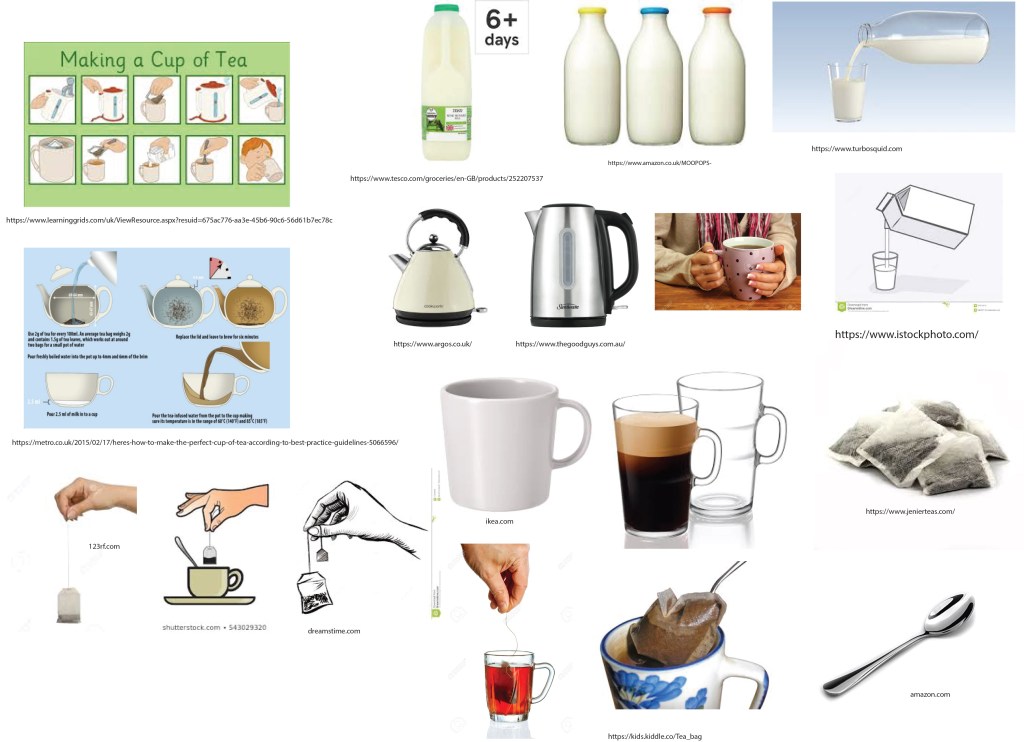
Reference material

My reference material includes two sets of visual instructions for making a cup of tea. The top image provides a very clear set of instructions without using words; however, the layout is a little plain. It does also miss out some information such as how long the tea should be brewed for. The bottom image is very specific – including appropriate dimensions for the tea pot! This image requires a lot of reading to absorb all of the information.

Based on my research, how to make the perfect cup of tea is a somewhat controversial topic! To avoid all of this controversy, for the purposes of this exercise I decided to illustrate how I typically make a cup of tea. I began by thinking about how many steps need to be illustrated in order to instruct somebody how to make a cup of tea. I then started making sketches of the different objects that are used in the tea making process.

Sketchbook ideas.

This process made me think about how to make objects easily recognisable. For example, kettles come in all sorts of shapes and sizes, as do bottles and boxes of milk. In order to maximise the accessibility of my illustrated instructions I chose what I think are the most recognisable forms of these objects. I also decided that I should include a few key words in the image e.g. a box of tea bags including the word ‘tea’, a label on the ‘milk’ bottle and the words ‘4 minutes’ alongside the timer. These words increase the clartity of the instructions without cluttering it with text. I also began to think about the use of colour. For now I have only coloured key elements within the drawings e.g. the switch on the ketlles, the tea bag etc. However, I am wondering if this might lead to quite a boring looking diagram. An alternative may be to lightly colour all of the objects but have key parts of those objects e.g. the switch on the kettle in bold colours.
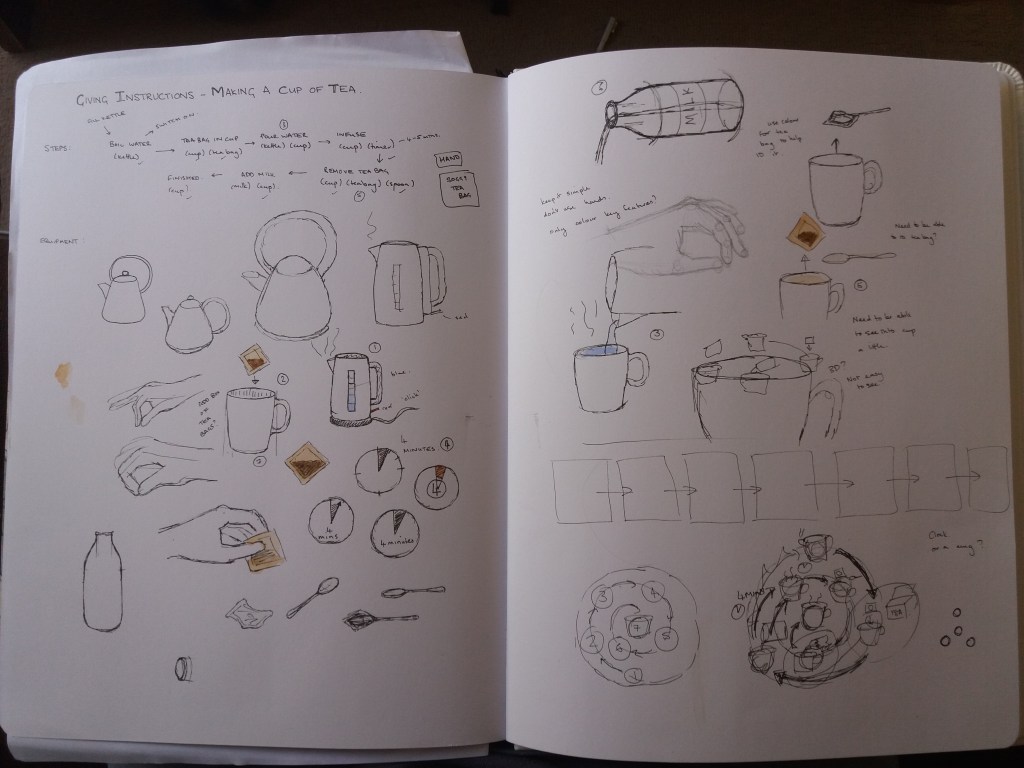
I began to think about the layout of the instructions. I didn’t particularly want to have a linear set of panels as this is quite boring. I quite quickly liked the idea of the panels spiralling to a central cup of tea – the end point of the instructions. This shape is reminiscent of a clock (‘time for tea’) or looking down on a cup of tea. I thought about making the image 3D with the steps sitting on top of a cup but decided that it would be difficult to clearly illustrate the steps if I did this. The focus might also end up on the tea cup rather than the instructions.

Final piece

In the end I decided to use colour throughout in order to make the illustration visually attractive. I’m not particularly satisfied with the end result. I think that the layout is a little confusing to follow. There are also endless red cups of tea such that the final cup, in the middle of the diagram, does not stand out.I considered giving the middle cup a coloured background, to help it stand out, however, I think this could make the image even busier. If I were to redesign this, I might have a much larger cup of tea in the middle. I might also have make the image larger and have more white space between the different elements of the image. I might also put a boundary around each diagram and have a more geometric/ formal layout for the positions of the image representing each step in the process.
It was also challenging to use watercolour on this paper. The water was ripping up the surface of the paper. I’m enjoying working with paint, however, I’m sort of making it up as I go along in terms of technique, which in some cases is more succesful than others.

Abstract illustration

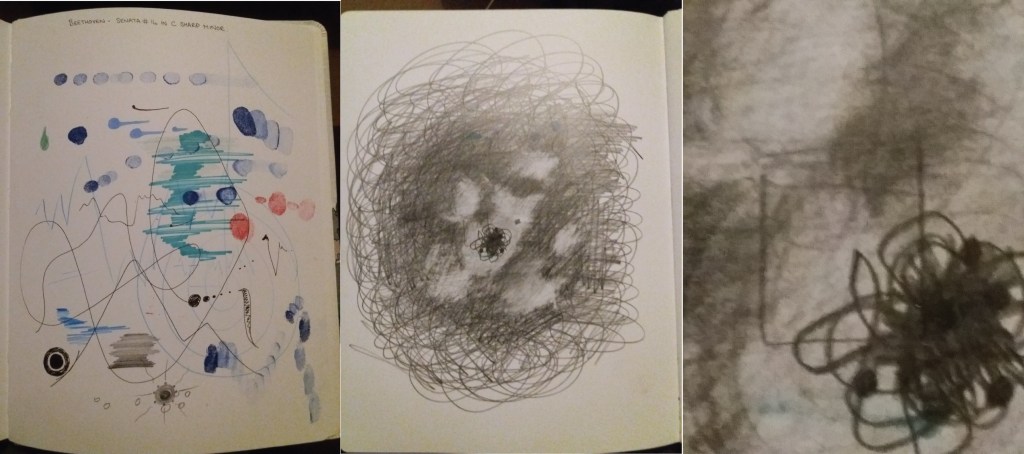
In the first part of this exercise I listened to Beethoven, senata number 15 in C sharp minor and tried to create marks that I thought conveyed the essence or mood of the piece. I found this exercise frustrating. What I created on the page looked like a mess that in no way represented the music. I started again and tried to illustrate something that for me gave a feeling of the music. I had forgotten from my childhood that I dislike this type of piano music – I find it horrible and frustrating to listen to.

Marks

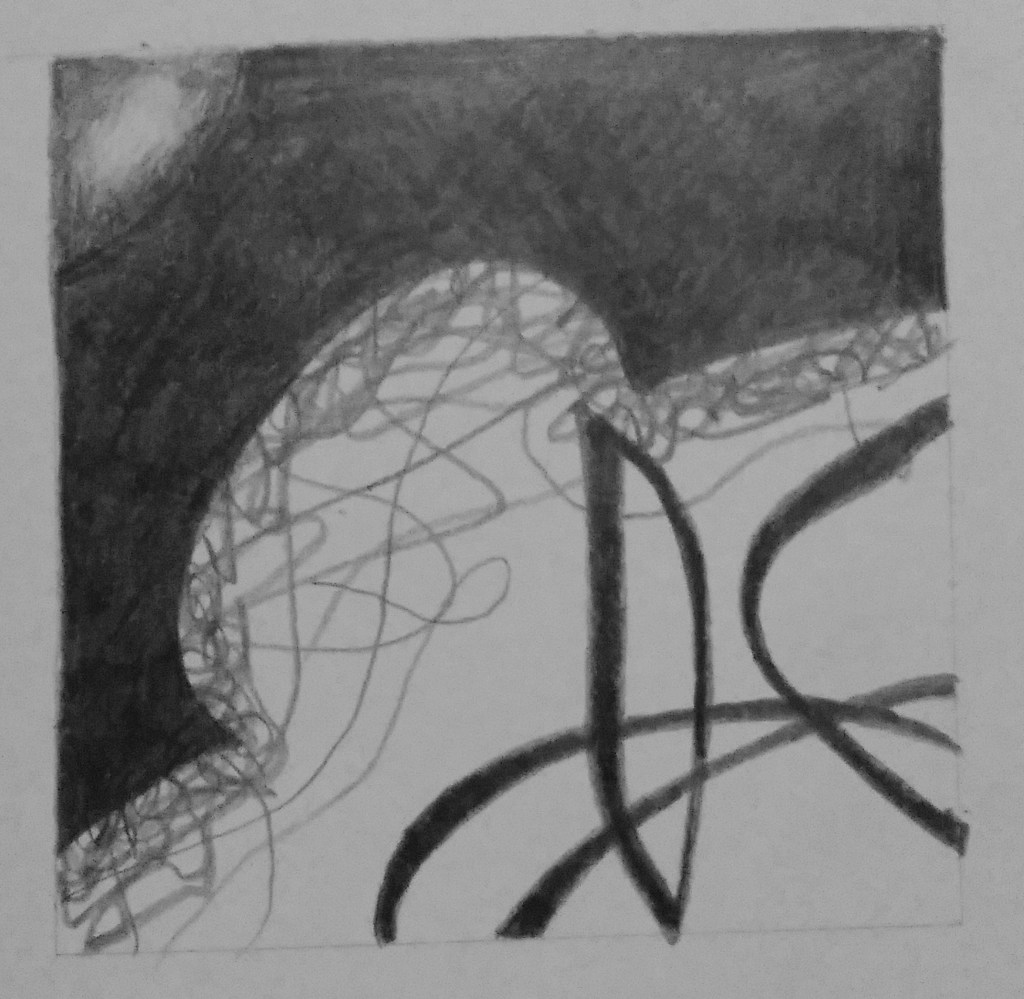
In terms of an adjective that describes the tone of the piece – I think that I would choose ‘irritating’. I think that the central part of my image best illustrates the word ‘irritating’ – where the cloudy grey meets solid lines. I chose to develop the image sticking with the same media – 5B pencil.

‘Irritating’

I think that the final piece is interesting. I don’t think that it is suitable for a CD cover – at least not if you want to sell any copies of the CD. I think that the final piece lacks the energy and emotion of the earlier markmaking, it’s become too stylised.

Image development

This exercise involves taking an existing image that has a range of content and then using blank L-shapes to crop the image. Then analysing the impact that cropping has on the focus of the image and choosing a word to represent each new image.

Experiments in composition

Next, I chose one of the images and developed it into a poster.

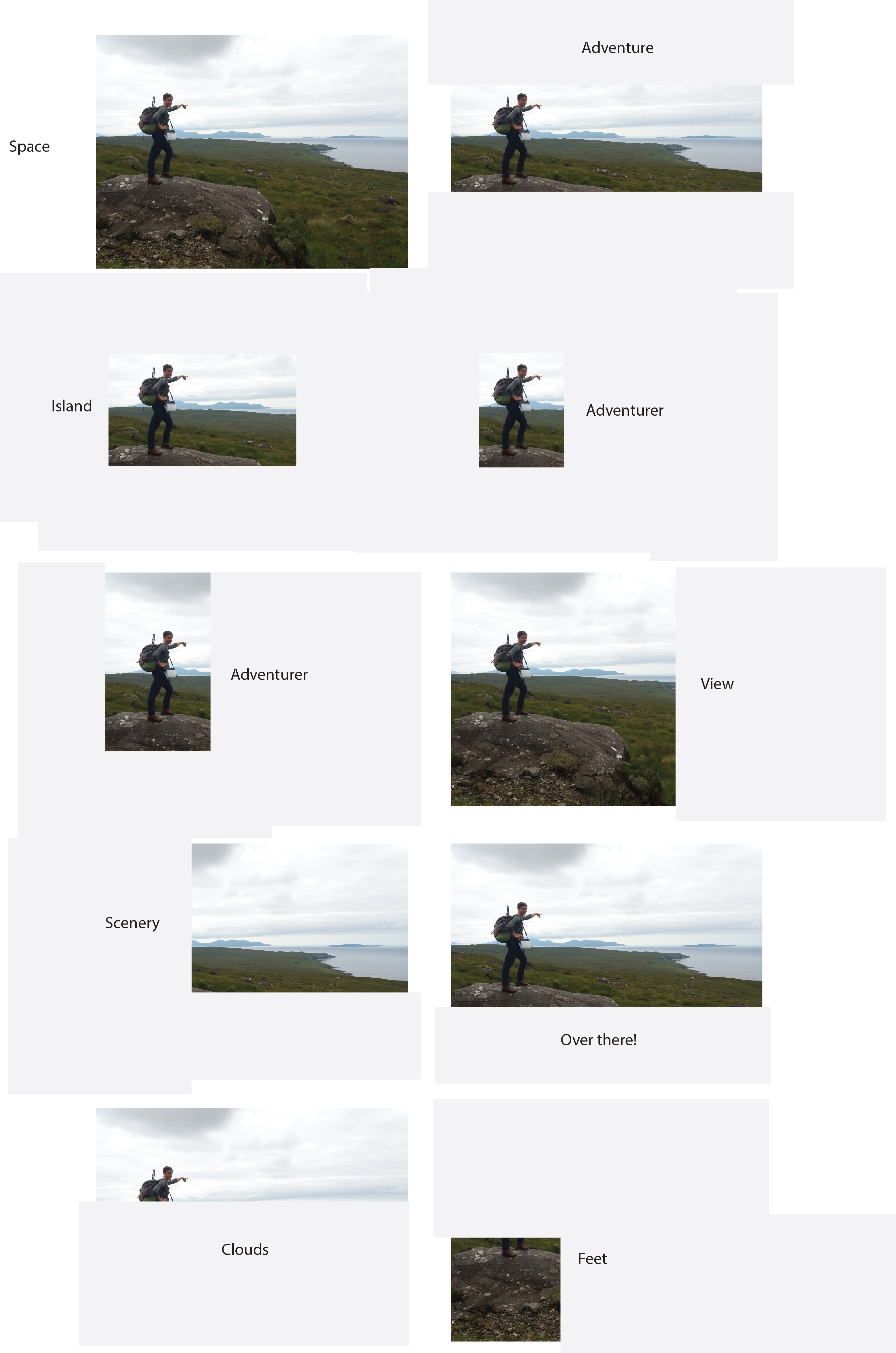
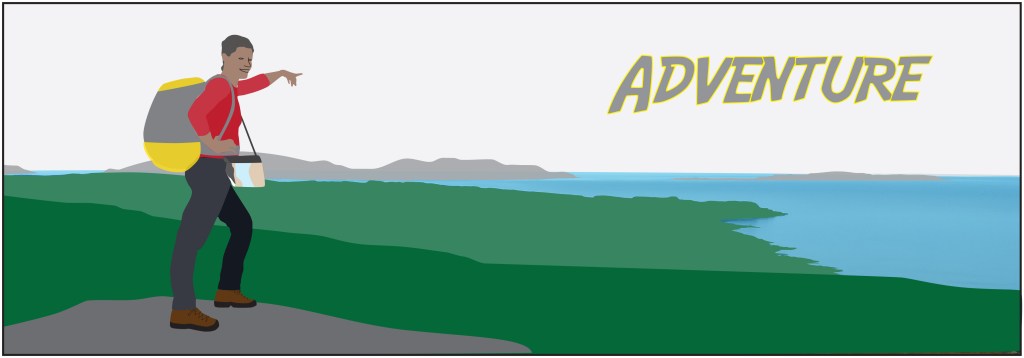
I think that I was a little too cheesy on my choice of font and should have gone with something plainer that fits the content of the image better. Otherwise I think that it’s quite an effective graphic image suitable for a poster. I had intended to use bold solid colours throughout the image. However, I like the different shades from the underlying photograph coming through from beneath the sea.