For this final assignment I need to write my own brief around the theme of seven days. The brief needs to be clear and challenging but manageable.
My brief
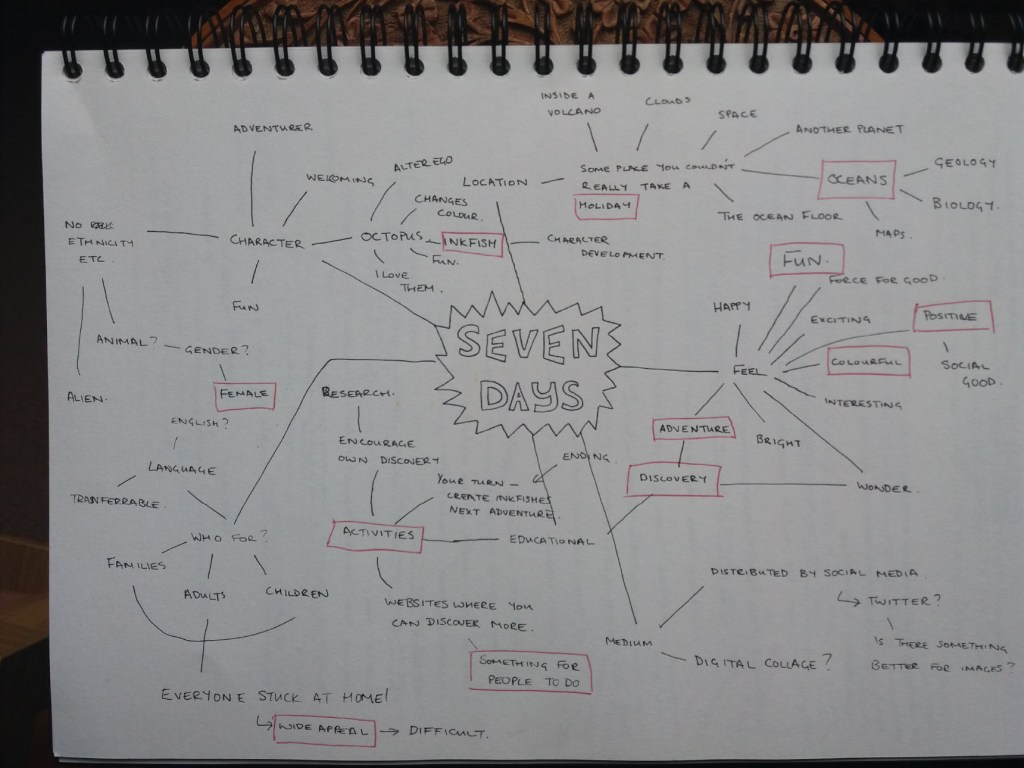
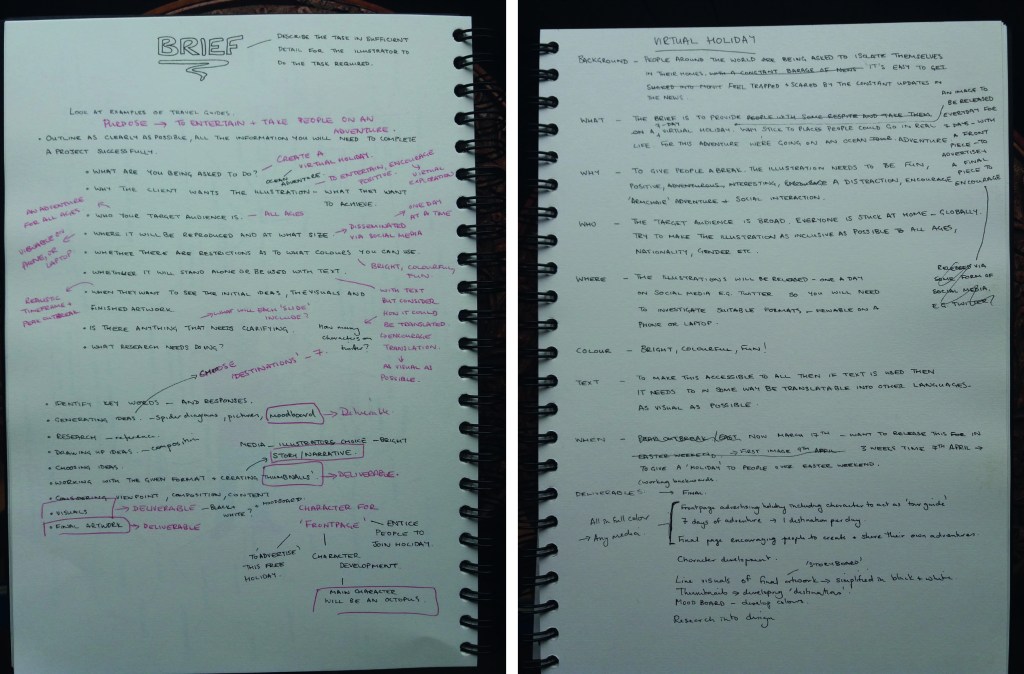
People around the world are being asked to isolate themselves in their homes. It’s easy to feel trapped, lonely and anxious.
My brief is to provide friends with a 7-day virtual holiday. As this is a virtual holiday, we’re going to abandon the usual tourist trail and instead dive into the world’s oceans led by our friendly tour guide inkfish.
The aim is to give people a happy distraction. So the most important thing is that the illustrations are fun and encourage ‘armchair’ adventure and social interaction.
The primary target audience is going to be adults, however, I would like to try to make the illustrations of broad appeal. Therefore the illustrations should be as inclusive as possible and strongly focus on visual communication.
The illustrations will be released one per day on social media e.g. twitter, so I’ll need to investigate suitable formats that are viewable on a phone or laptop.
The illustrations should be bright, colourful and fun! There are no colour restrictions.
To make my virtual holiday as widely accessible as possible if text is used then it needs to be in some way ‘translatable’ into other languages.
The holiday will take place across Easter weekend, which gives me three weeks to put together the holiday.
The deliverables are as follows:
- Research to provide a ‘destination’ for each day of the holiday.
- Thumbnails that develop these destinations.
- Sketches to develop the character of inkfish.
- Moodboards to develop colour and style.
- Thumbnails to develop a storyboard.
- Simple, black and white client visuals of the final artwork.
- Final pieces, published on social media, which should include: A ‘frontpage’ advertising the holiday and illustrations for 7 days of adventure, one to be published each day.
Generating ideas
In order to make this a social activity I used existing whatsapp groups to ask friends ‘if they could visit anywhere, or anyone in the oceans where would they go and who would it be’. My plan is to select seven of the destinations and join them together into some kind of logical itinerary. Here is the list that I received:
- An underwater frozen waterfall – brinicle.
- The Galapagos – to meet Darwin – natural history.
- The island of Loihi in Hawaii to witness the birth of a new volcano – hiking?
- Borabora – to meet mantaray, leopard eels and happy little crabs. – relaxing.
- Mermaids.
- Kraken.
- Underwater skiing on marine snow – downhill on canyon sides and cross country over the abyssal plane.
- Giant squid.
- whale shark.
- narwhal – arctic.
- metallic scaly foot snail.
- Atlantis – historical day out.
- Hydrothermal vent e.g. the lost city.
- Tropical islands.
- Sponge gardens of the Aleutian Islands.
- Beagle Channel.
- Easter and Christmas Islands.
- Sea dragons.
- Sea Pangolins at hydrothermal vents.
- Icebergs and penguins.
- Kelp forests.
- Moonfish.
The itinerary
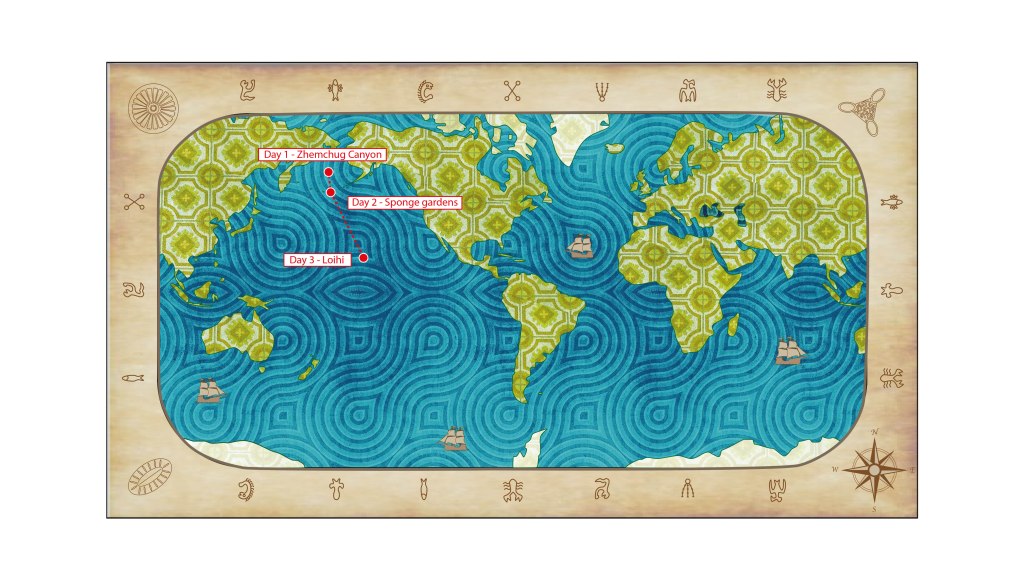
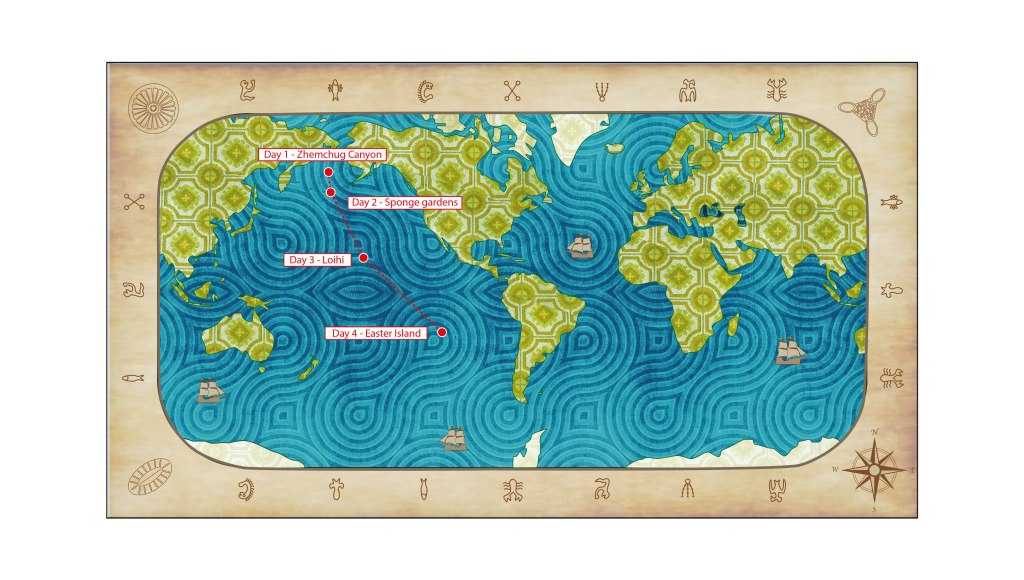
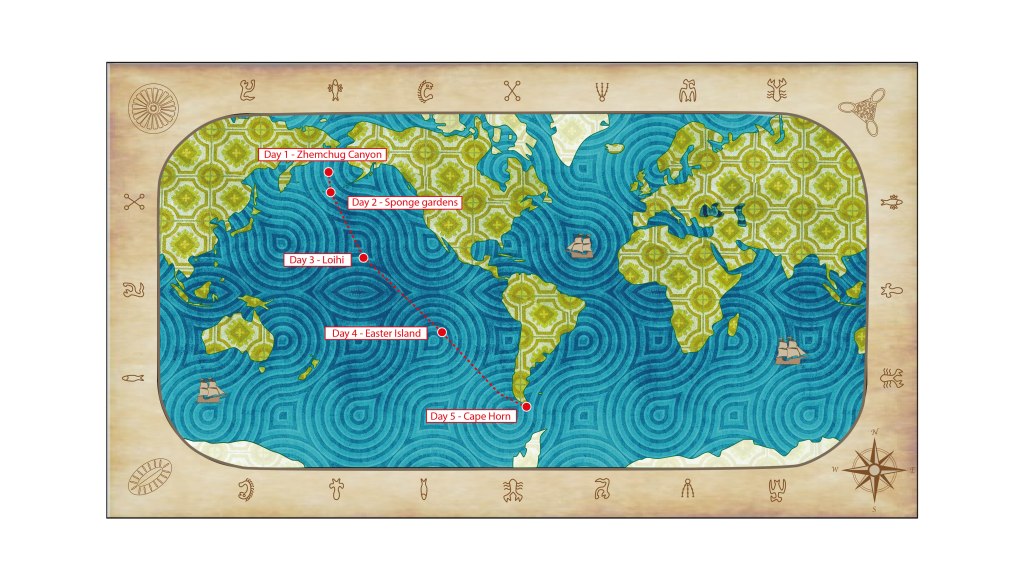
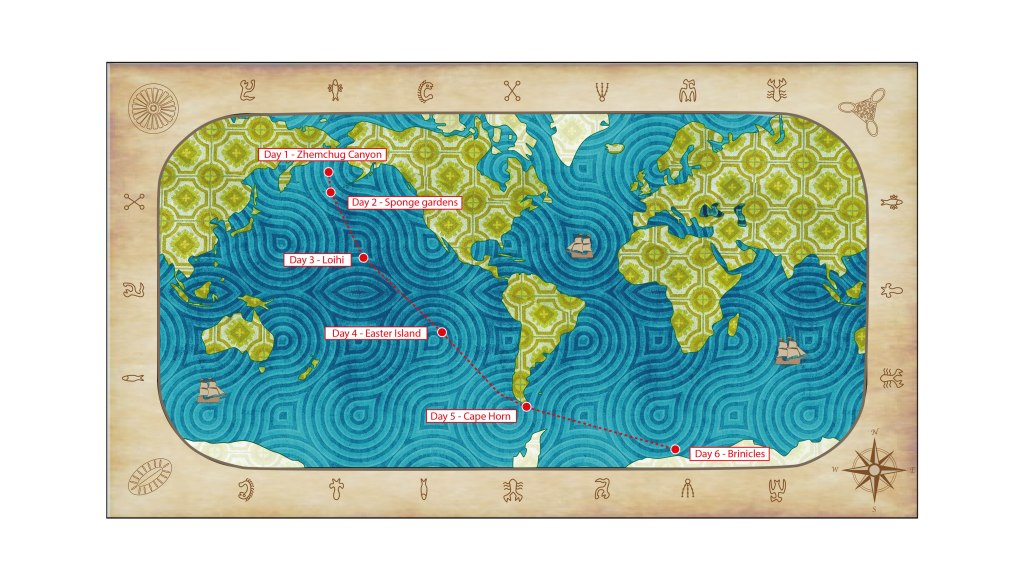
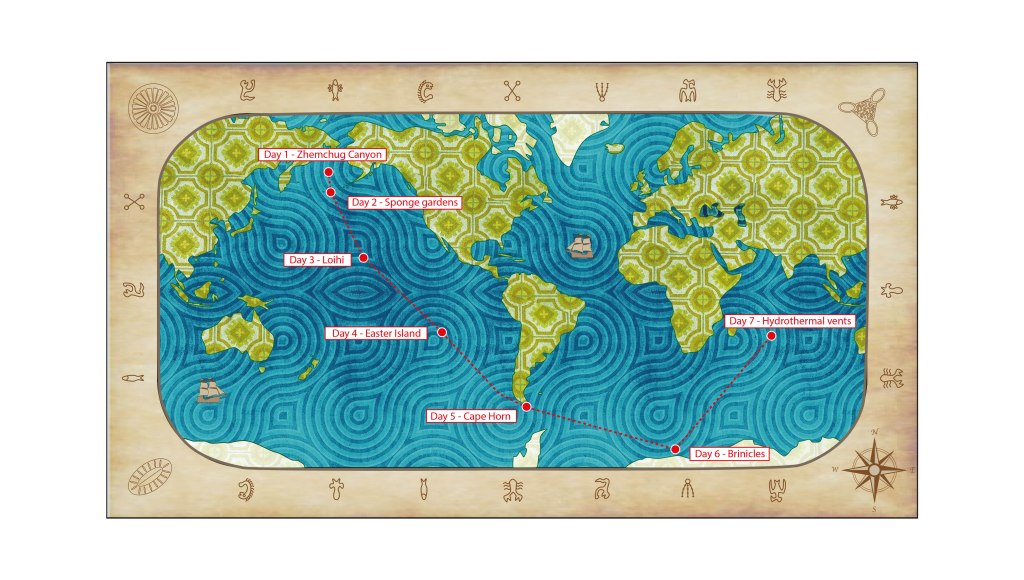
I plotted the locations of the suggested destinations onto a map. I gradually whittled it down to seven destinations that follow on from one another in terms of location and also are varied in their activities. I think that this hangs together as a ‘story’ much better than visiting random destinations on each day.
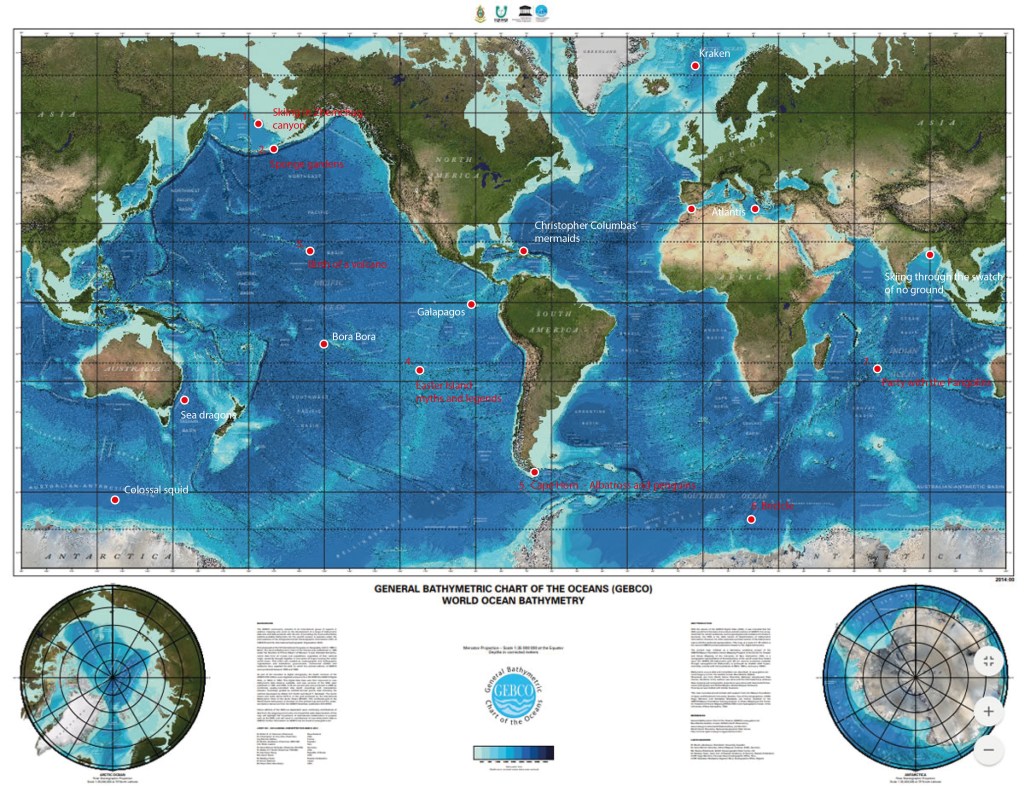
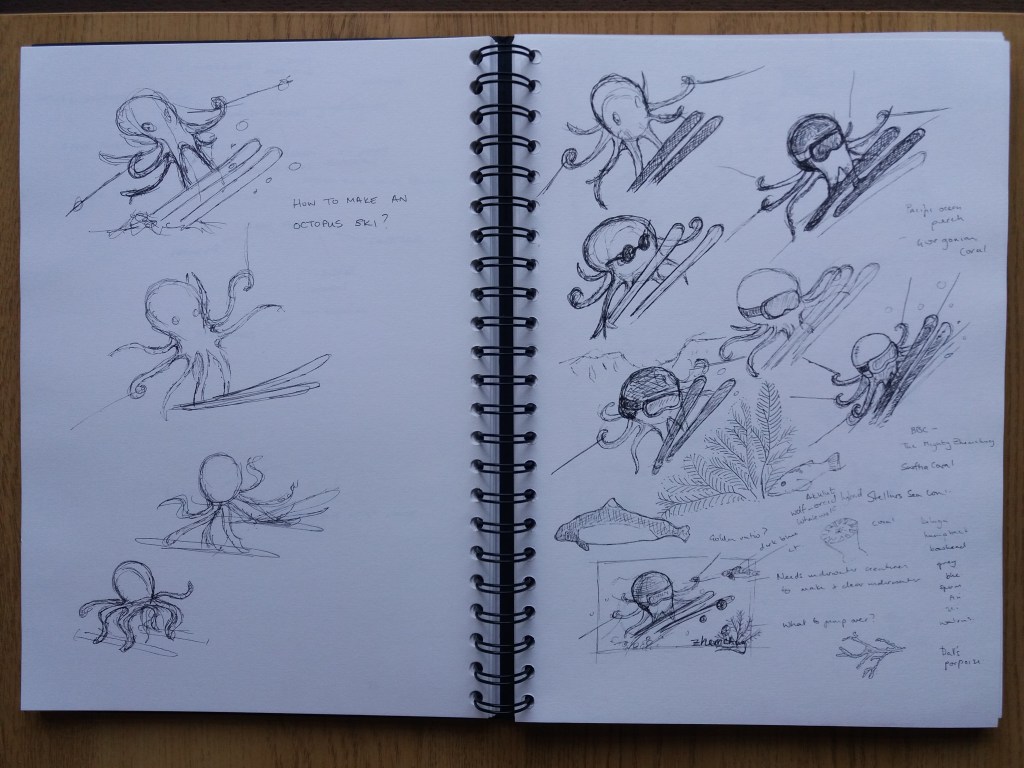
- Day 1 – Downhill skiing through Zhemchug Submarine Canyon.
- Day 2 – Afternoon tea in the sponge gardens of the Aleutian Islands.
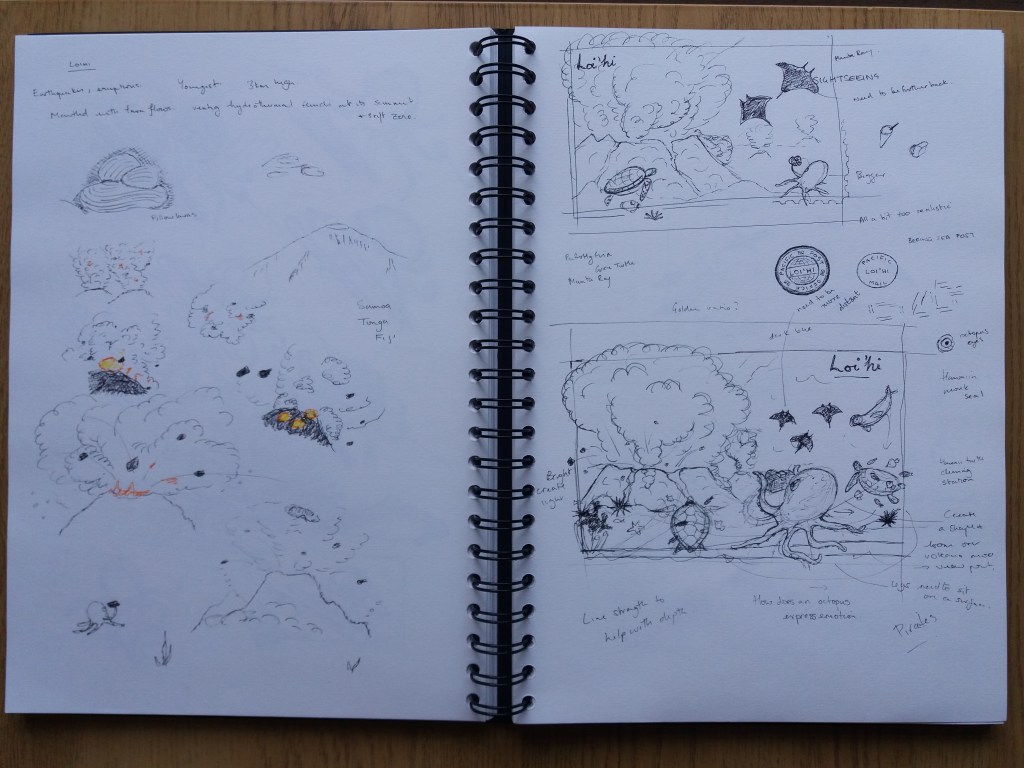
- Day 3 – Witnessing the birth of a new volcano at Lo’ihi Seamount, Hawai’i.
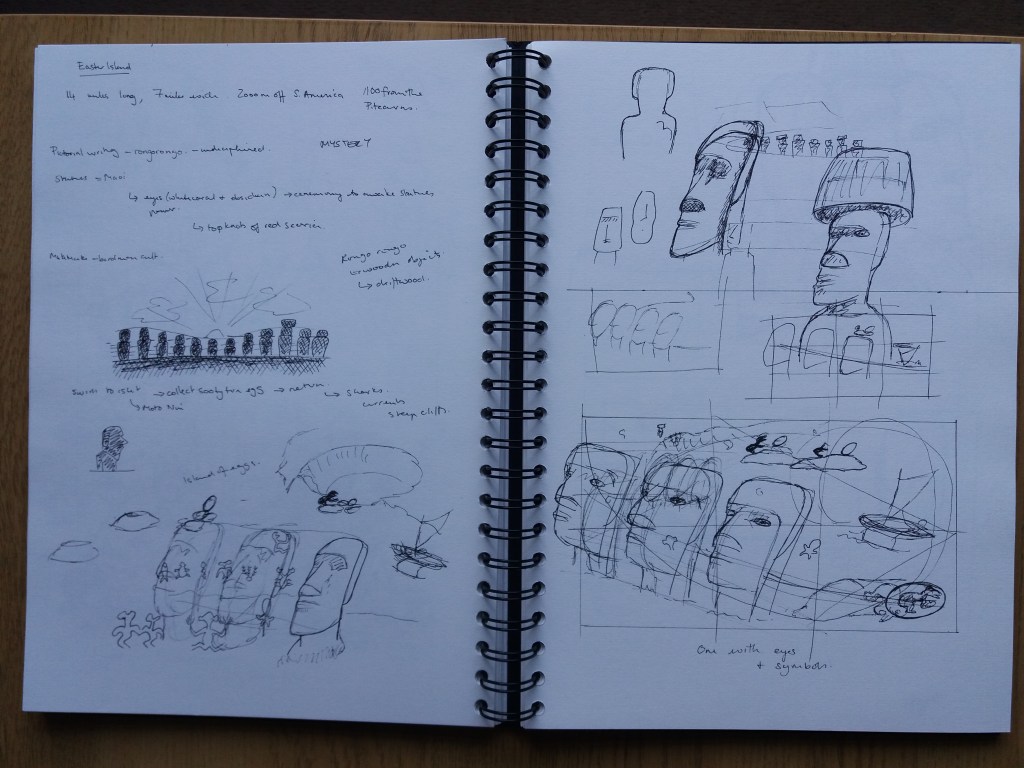
- Day 4 – Myths and legends of Easter Island (Easter Day).
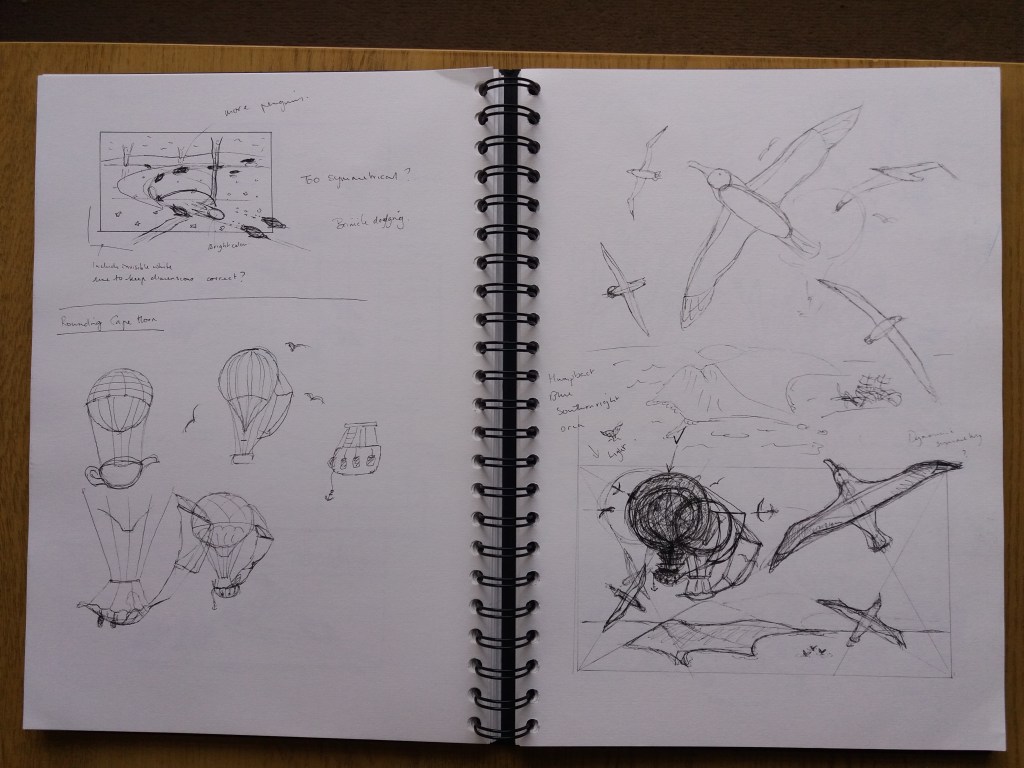
- Day 5 – Rounding Cape Horn with albatross.
- Day 6 – Diving beneath the Antarctic sea ice.
- Day 7 – Party with the pangolins at a hydrothermal vent.
Moodboards
In order to start thinking about colour and I decided to start drawing together images from the different destinations.
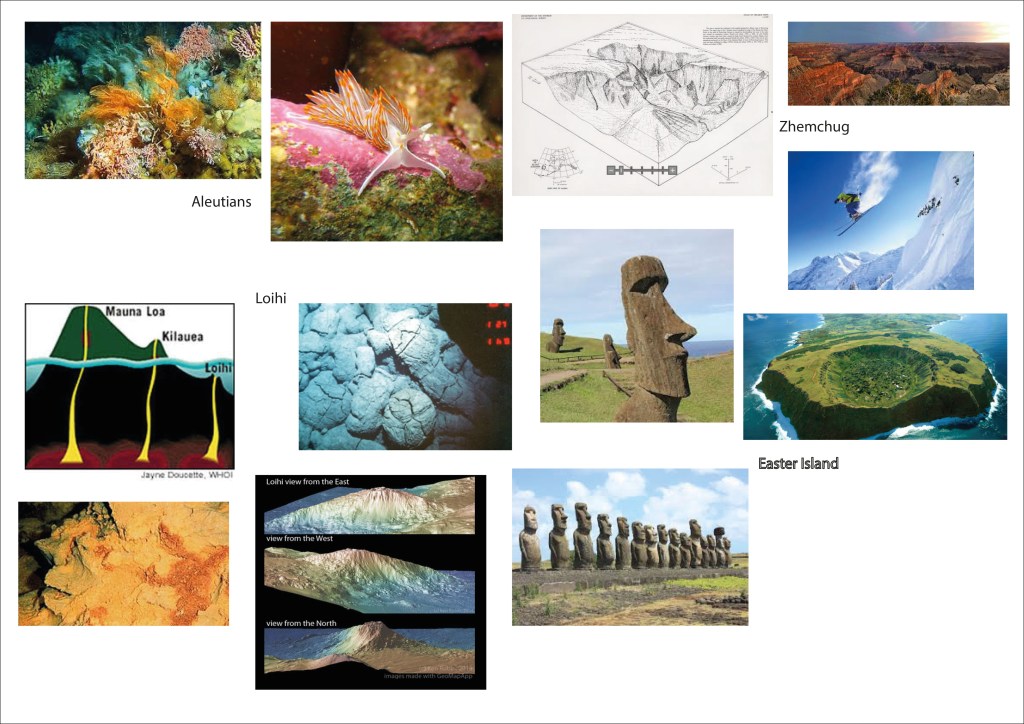
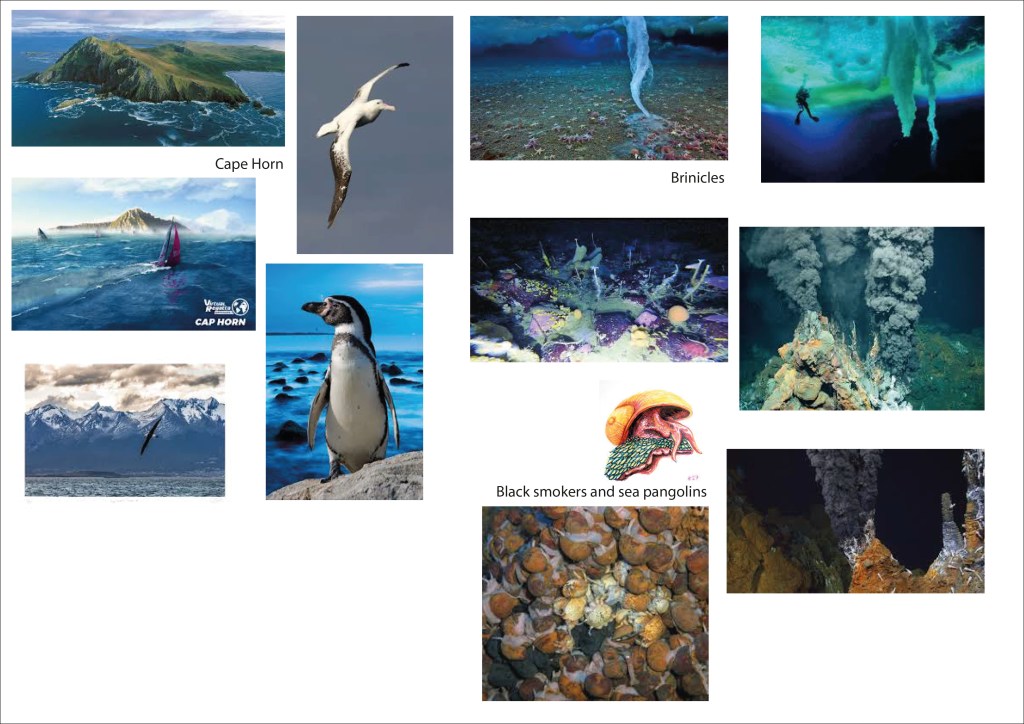
The key colours are blues, greens and oranges, albeit theres quite a bit of variability among destinations. I also started looking through my own past images to think about style.
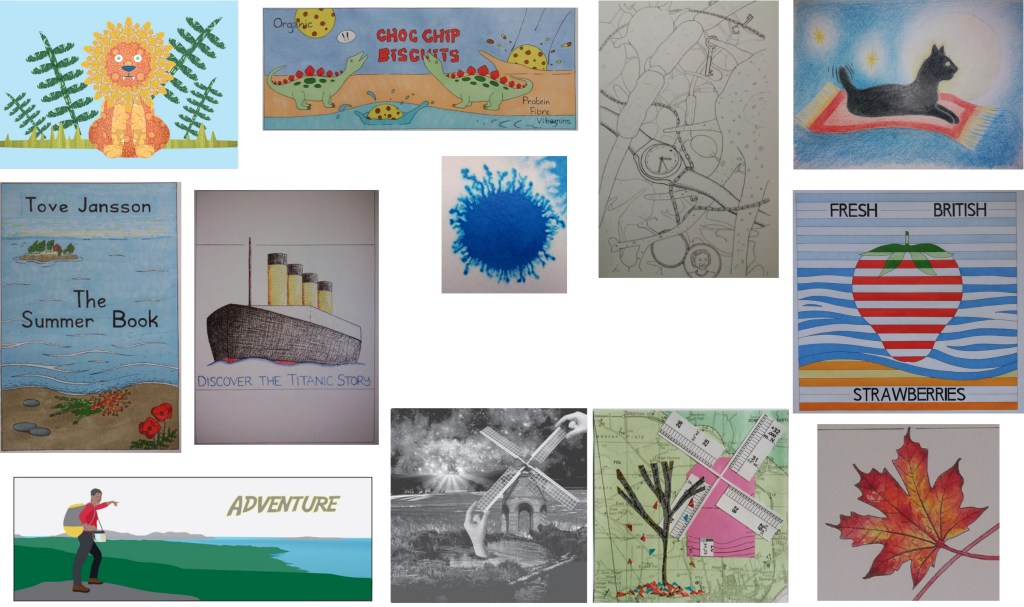
I think that digital collage might work well for this assignment. This also means that I won’t need to try to access new materials during this coronavirus epidemic – everything that I need is available online. However, I want to get some better ideas about how to create images using digital collage.
I did some research about creating interesting images with digital collage and in particular how to create depth in the image. Things that I need to consider are composition. One of the great things about digital collage is the ability to distort in interesting ways; however, the image has to hang together. It can be interesting to combine contrasting elements for example big and small or sharp and blurry. I think that I will spend time with pen and paper working out compositions before creating the digital collages for each image. This should also help me to create a unifying theme across all of the images. The choice of materials is important too – trying to create unity, or purposeful contrast, so that it doesn’t just look like a randomly thrown together collection of objects. Lighting is also important in order for the image to hang together and also to draw the eye into certain parts of the image. I also need to think about depth, which can be created by varying the sharpness and tone of objects. I have a lot to think about I’m keen to start playing but I think I need to begin by thinking about composition and how the images will hang together.

During my research I looked at many images. A style that I think could really work for my adventure is something inspired by the Springetts Monty Bojangles truffle packaging. This design was apparently inspired by Terry Gilliams Monty Python illustrations. I’m not sure how these images are made. They look like digital collage bit I’m not sure that they are. I’m wondering about doing something similar – using brightly coloured collage objects and then illustrating over the top of them to create light and shade and texture. The above image makes great use of space and a plain background. The above style would work fabulously for afternoon tea in the Aleutian sponge gardens and party with the pangolins.
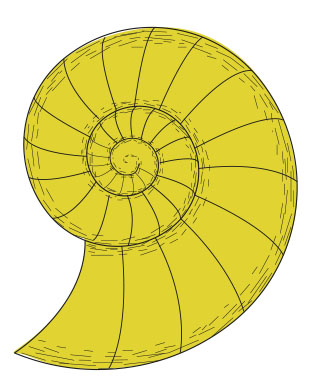
I had a quick play in adobe illustrator with drawing lines over plain colours. For my illustrations I’m wondering about using digital ‘found’ materials with overlain drawing in illustrator. This should also be a relatively quick and easy way to create shadow and add volume to the images.
Social media
I had to decide which social media platform that I will use to ‘provide’ my holiday. I have very little experience of social media. After a bit of googling it seemed like either twitter or instagram could be appropriate platforms to use. In the end I have decided to use twitter because within my community I am aware of more people who use twitter than instagram. Given that I have made this project primarily to share with my friends then twitter seems the better platform to use. This helps to further constrain my brief. A tweet can contain up to four images and 280 characters plus links. So this is the maximum length of caption that I can include with each of my images.
Thumbnails
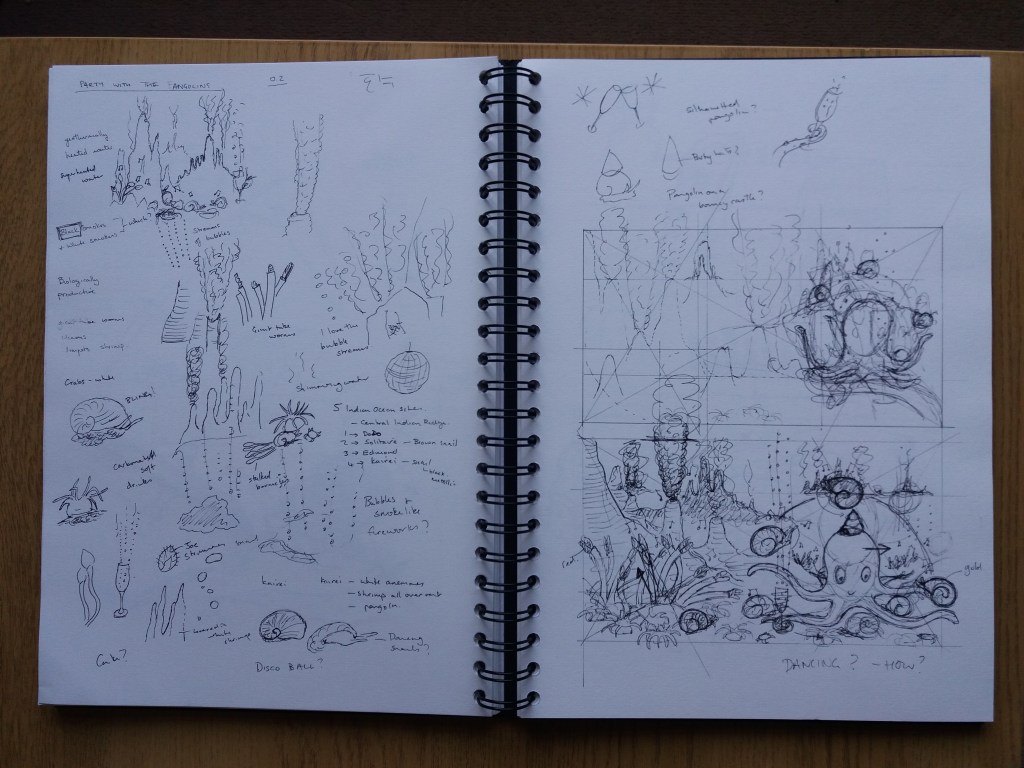
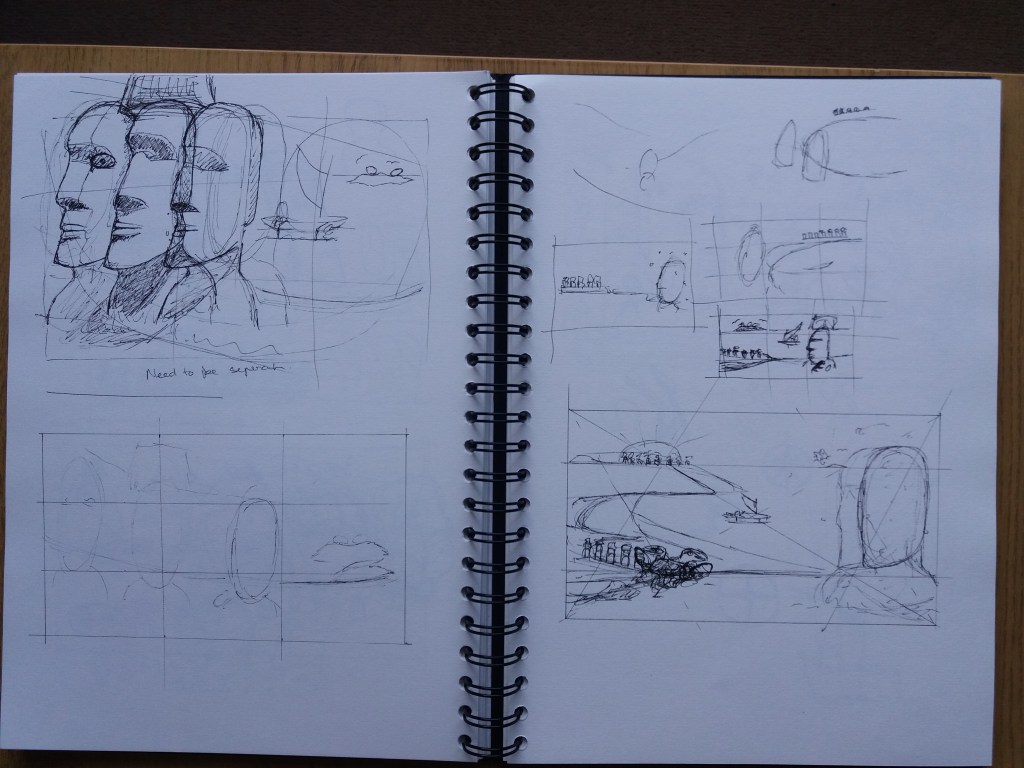
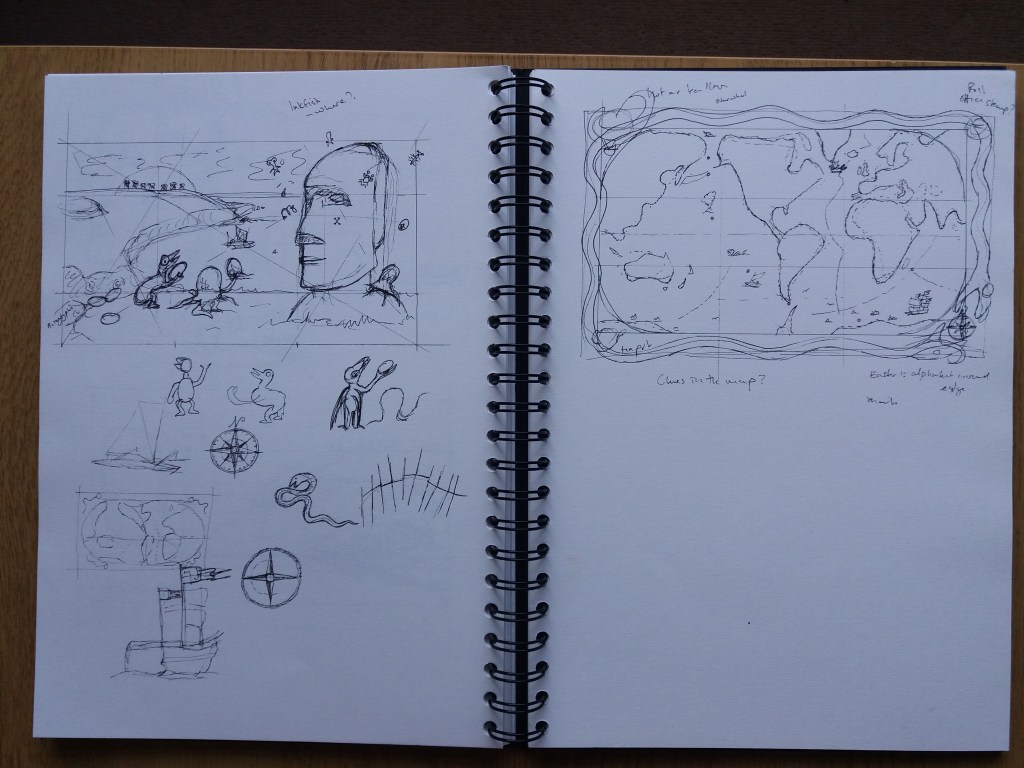
I began the process of creating images by researching each of the destinations, noting down key words and sketching key images. For each destination this evolved into an image. This was a fun process, it felt like I discovered the images rather than creating them. With the exception of the ‘afternoon tea in the sponge gardens’, I didn’t have a preconceived idea about what the image should look like.
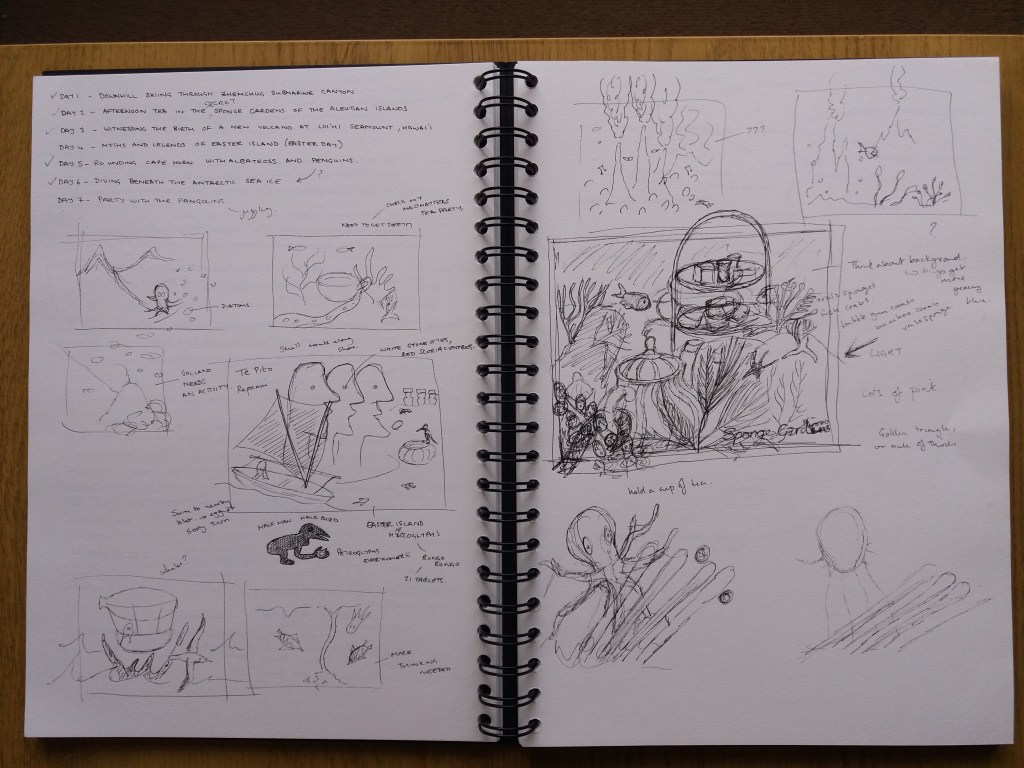
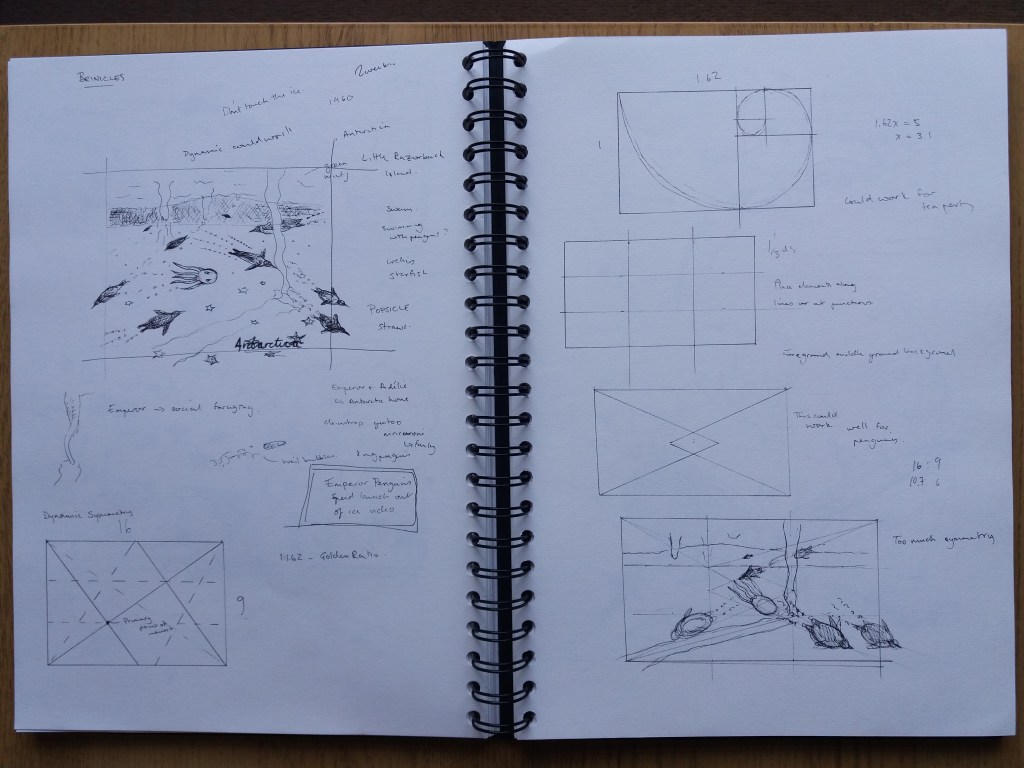
Part way through the thumbnailing process – when I was working on the Brinicles image, I decided that I should learn a little more about composition. One important thing was to decide on the size of the final images, so that I could start thumbnailing images with the correct dimensions. A little research revealed that the ideal size for a twitter image, in order to avoid cropping, is to have an aspect ratio of 16:9.
I also need to think more about the hierarchy of elements within the image i.e. which elements are essential to telling the story and which are supporting elements and then position them and colour them appropriately.
I learnt about different ways for positioning the elements within images – dynamic symmetry, golden ratios and rules of thirds. I hadn’t realised that the purpose of these techniques is to create imbalance in images and thus force the eye to wander around the image. As well as positioning elements according to hierarchy, I learnt about using distinctive colours to draw the eye to the most important elements in the image and reserving pure blacks and whites for focal points. Apparently, high contrast works well for small images (as these will be) and using different tones and sharpness in the foreground, middle ground and background to create depth.
Client visuals for each day
Once I had ideas for each of the days, I created my client visuals. I generally prefer my initial sketches to the client visuals. The initial sketches have more energy; the client visuals look a bit like pictures from a colouring book. However, the client visuals are also going to be useful templates for creating the digital collages. Hopefully I can inject energy back into the final images.

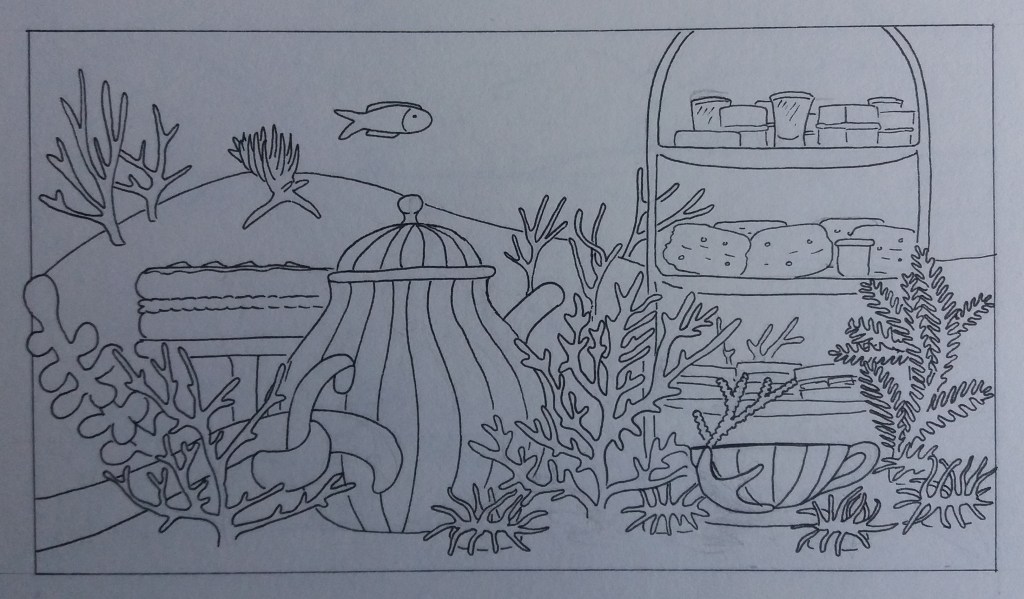
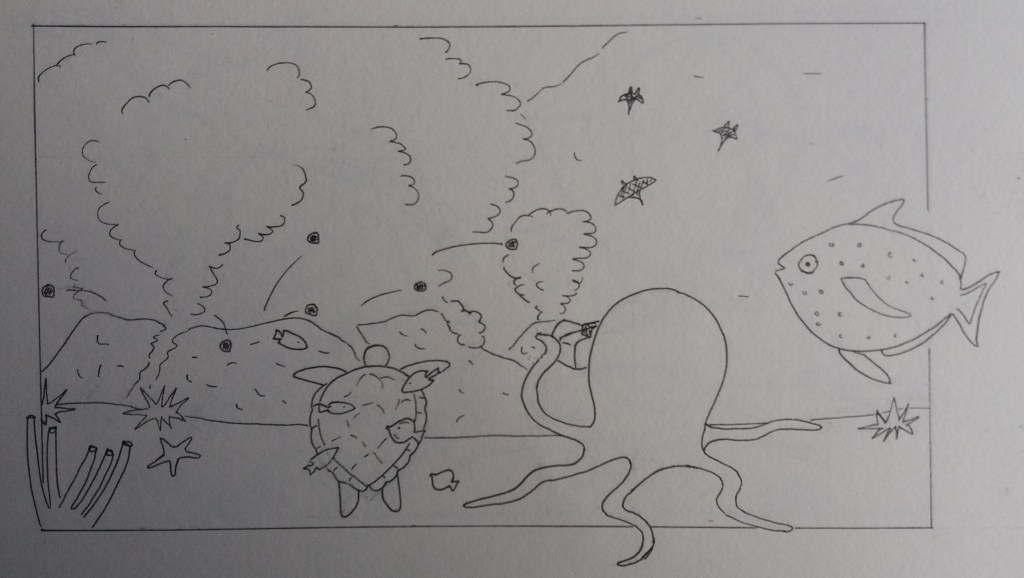
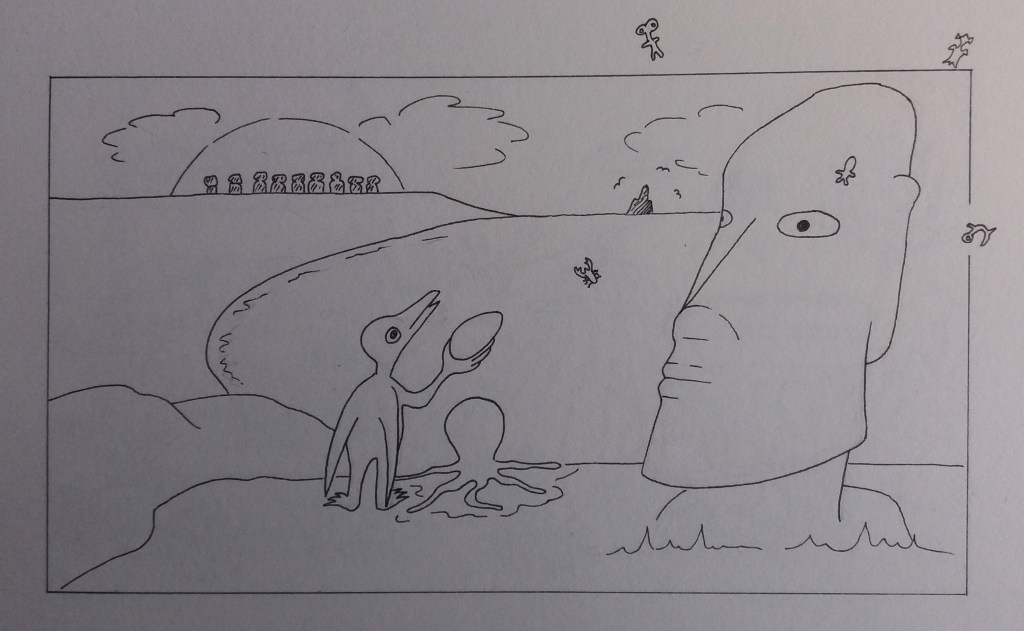
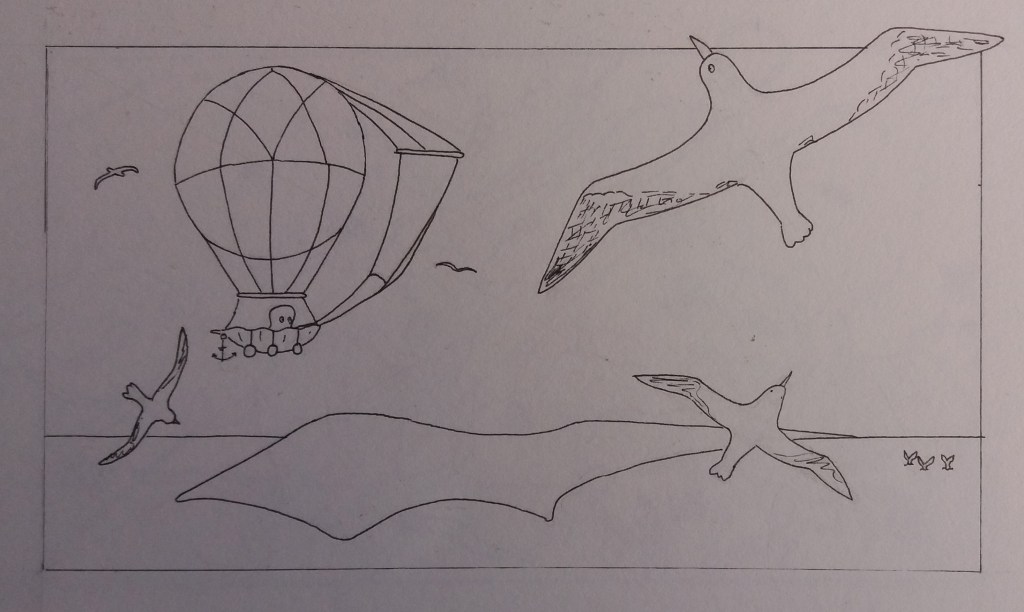
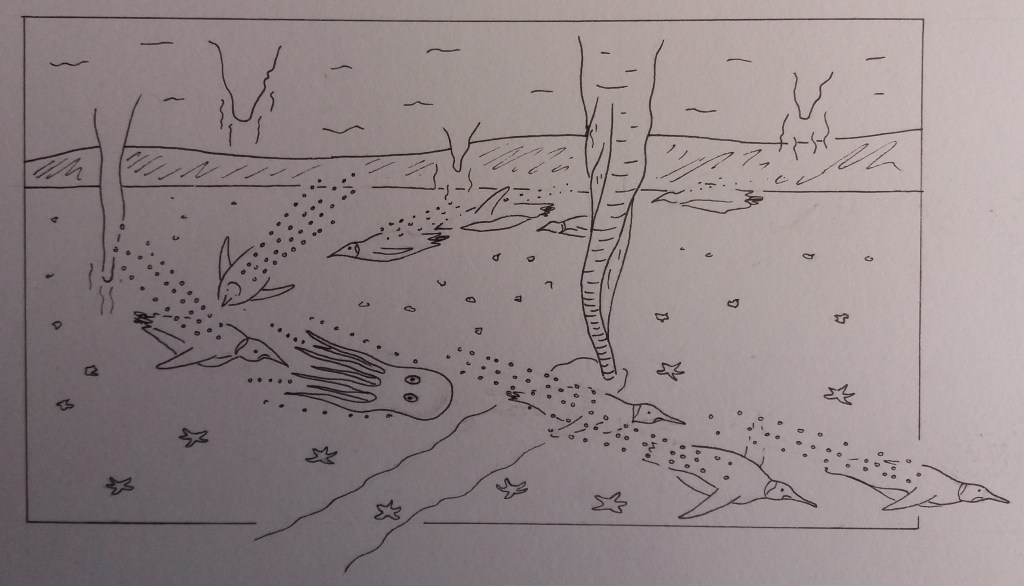

I haven’t yet made the client visuals for the ‘front page’ advertising the holiday or the map to locate the destination each day. My feeling is that it is good to let the map evolve alongside the final images, so that I can add clues to the destinations into the map.
Front page advertising image
I began by researching some images advertising holidays.
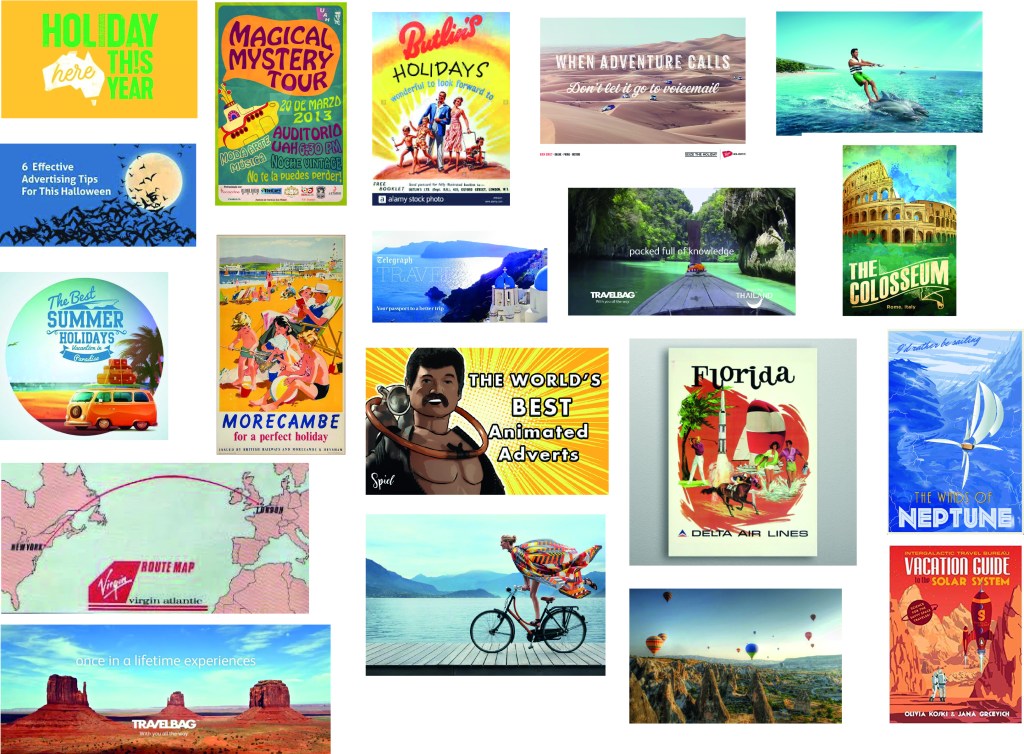
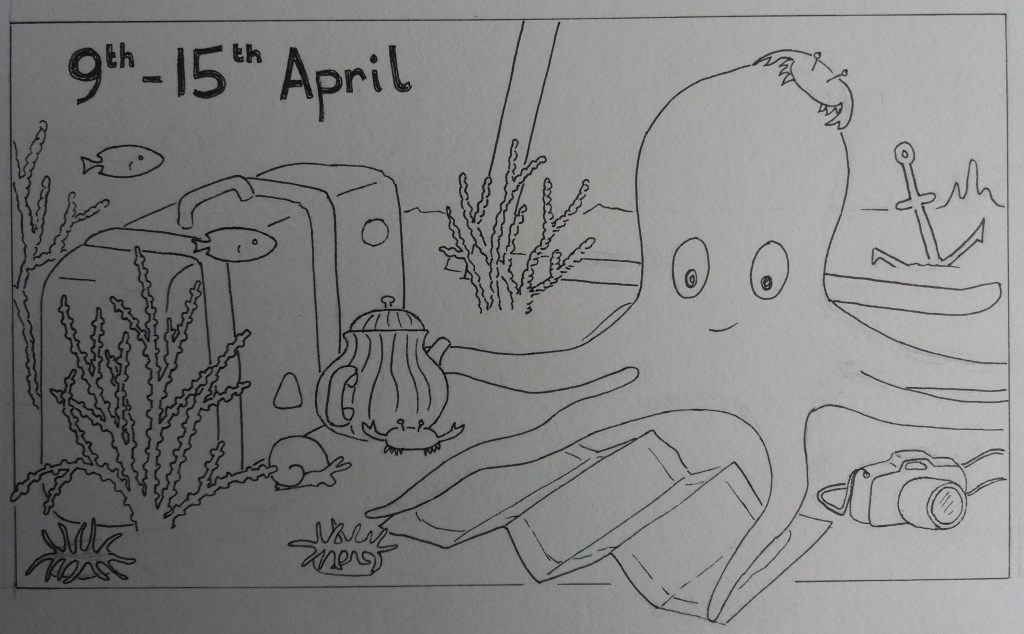
My advert definitely needs to include inkfish, it needs to demonstrate that the holiday is in the oceans. I’d also like it to include something whimsical, in order to provide a feel of what the adventure wil be like. However, I’m unsure about including text. I’ve generally been avoiding text in my images, in order to make them inclusive. The colours will ultimately be bright and in the same size as the rest of the images. I could include some things from the trip, however, I also don’t want to give the game away on where we’ll be going. So my aim with this image is to give people a feel for what the adventure is, where we’re going, and the style of the holiday.
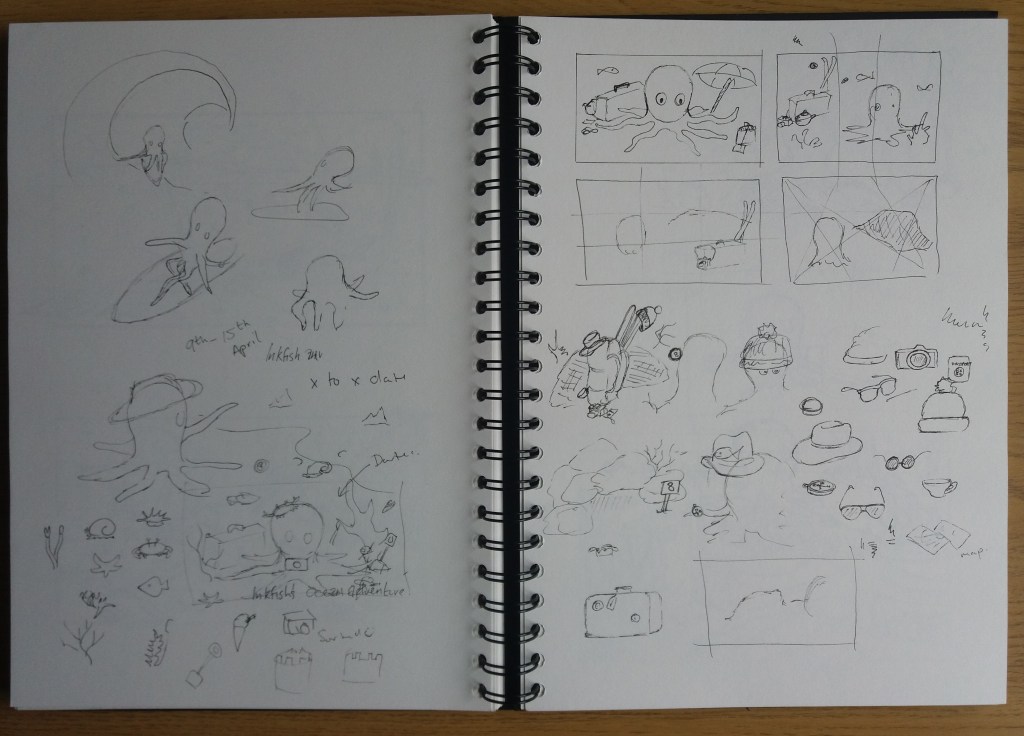
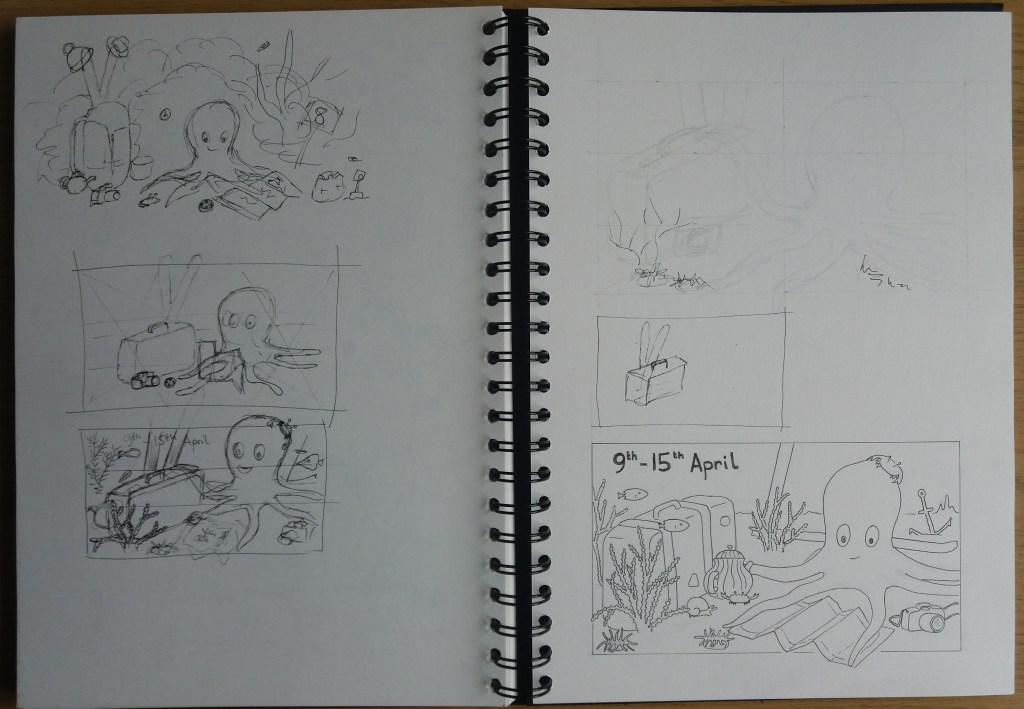
The design I came up with for the front page prominently features the character inkfish, who is packing and preparing for her holiday. I think that I will include the dates of the holiday in this image but will save the rest of the text for the captions.
Colour scheme
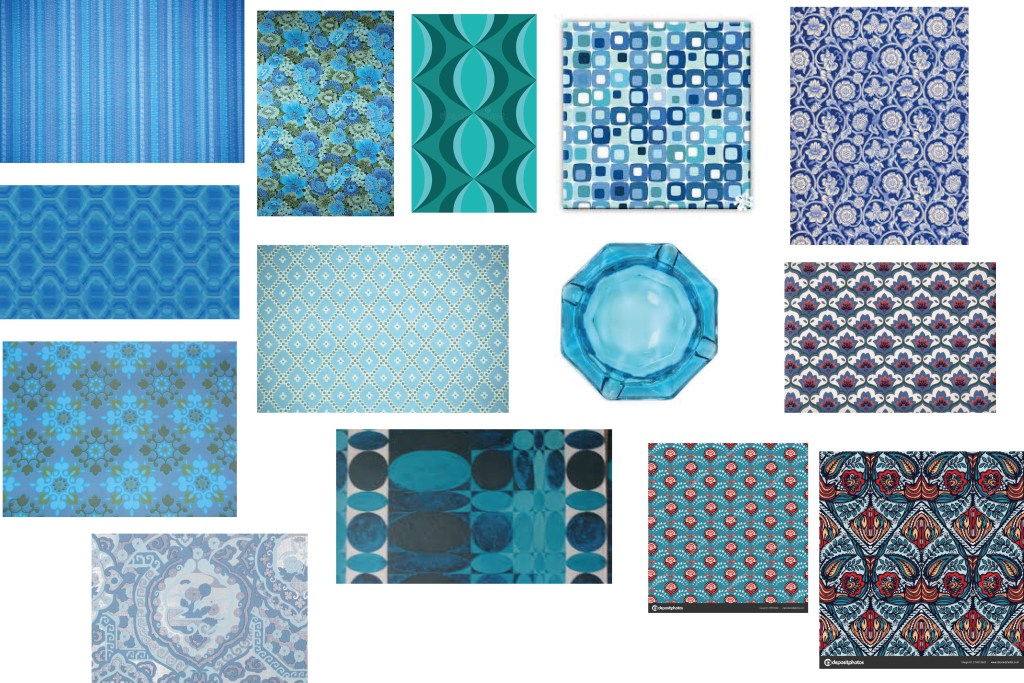
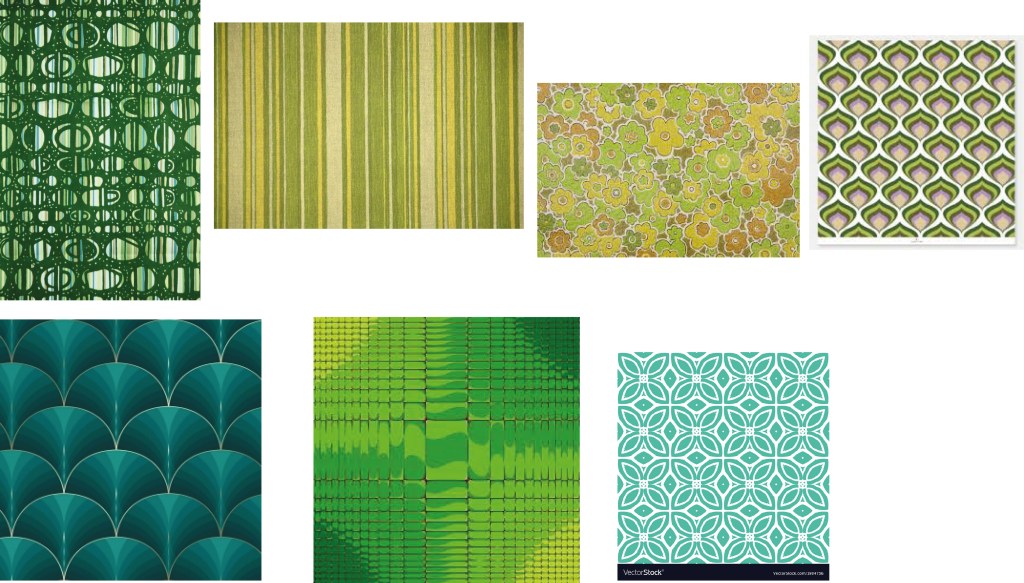
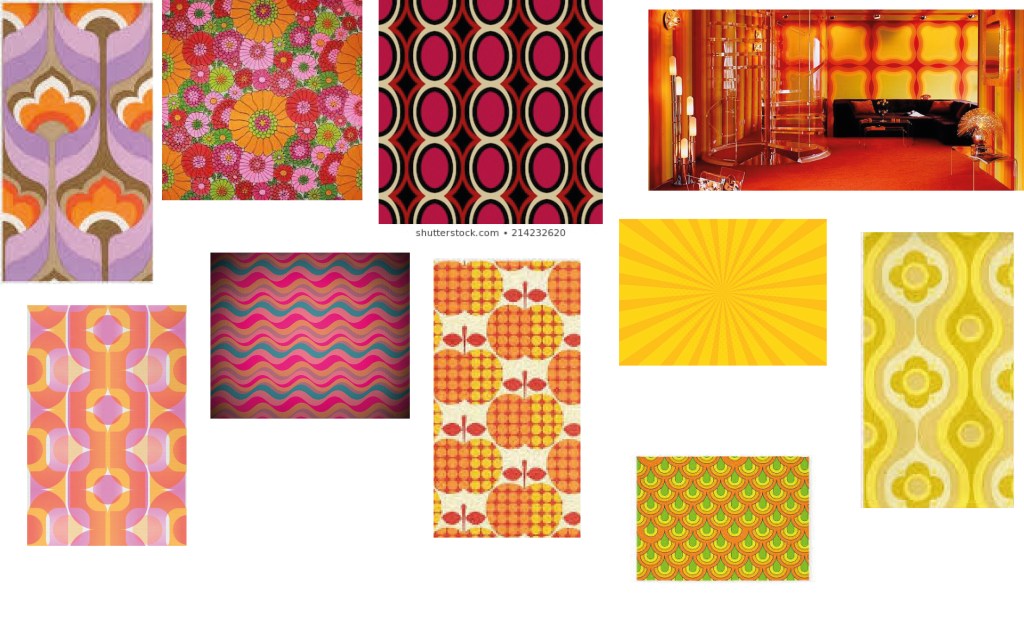
I’m going to follow the 1970s wallpaper colour scheme of my lion from a previous exercise. I like the happy, childish fun theme of this piece. I think that the kind of adults that I’m trying to appeal to, will quite like these ‘nostalgic’ images. They’re fun and happy.

So, my first task is to rummage through the internet finding 1970’s wall paper swatches.
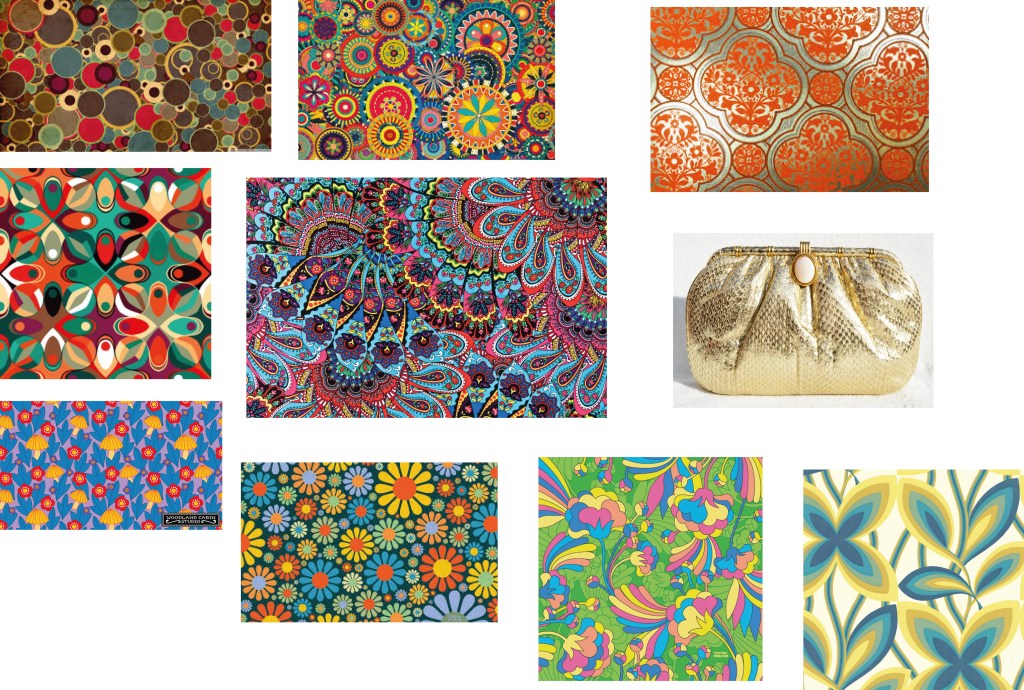
Final images
In this section I’ve presented my final images with their twitter captions. Beneath each image I evaluate what I think works well about the image and what I think could be improved.

Then join Inkfish on an ocean adventure.
Yes, there really is such a thing as a free holiday! All you need to do is sit back, relax … oh and invite as many friends as you like – the more the merrier!
I think that this image works quite well in terms of introducing the character of Inkfish and providing hints towards the nature of the adventure. The composition is simple. I chose to make Inkfish red in order that people’s eyes will be drawn to her in each image. I considered whether her colour might change among images – as octopus do – however, it felt more coherent to keep her the same colour throughout. Something I found tricky whilst making this image, was integrating different styles of ‘paper’. In particular I think that the gold teapot and the plain coloured camera stick out a bit and aren’t that well integrated into the image. I did also struggle with getting the balance of colours right across the image and not overloading the image with patterns.
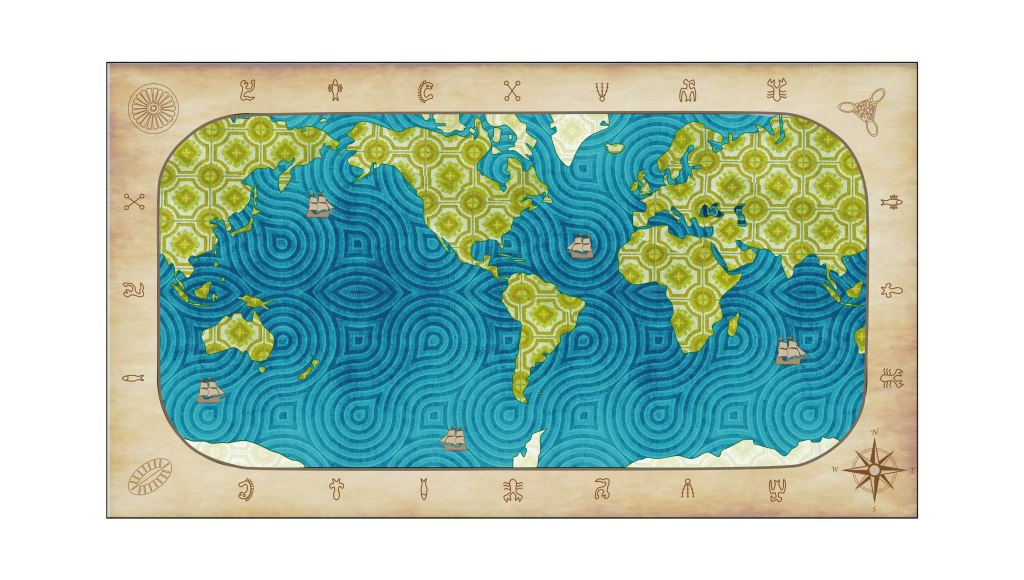
Inkfish has made her decisions and packed her bags. She looks forward to seeing you all tomorrow … have a big breakfast, day one will be energetic.
I think that the style of the map is quite effective and the different patterns and limited colour palette integrate well. Although, I wonder if it would look better to have the swirly sea pattern at a similar scale to the pattern used for the green of the land. I would have liked to include more ornamentation on the map, for example by including sea monsters etc but I didn’t have time. The little ships were also rather rushed and their style isn’t quite in keeping with the rest of the image.
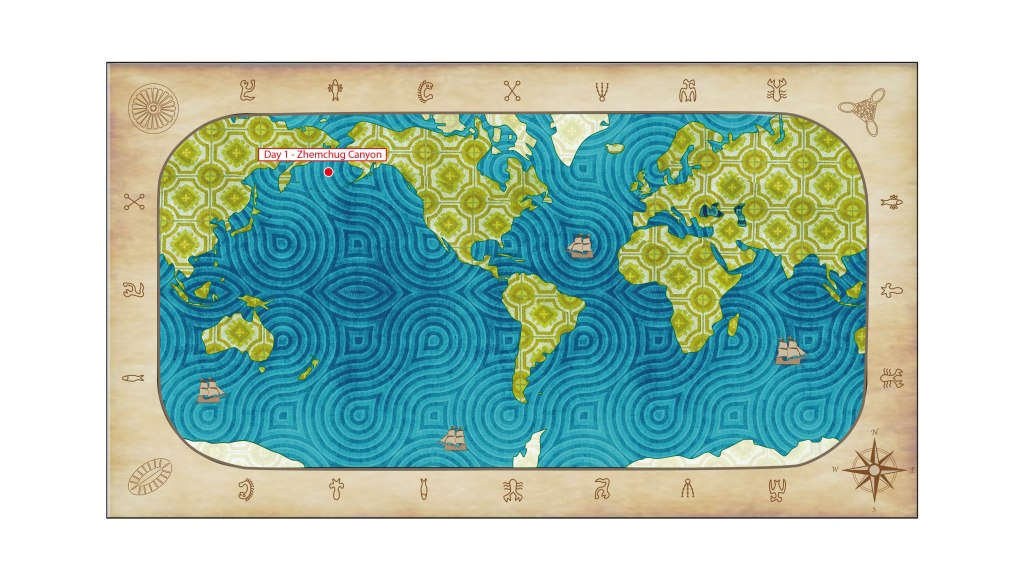

We’ll be descending over 2.5km to the bottom of the deepest canyon on Earth – this one makes the Grand Canyon look like a baby!
Luckily for us the marine snow conditions are excellent at this time of year!
I like the composition that I used for this image, it has lots of energy and in general I think that the colours and patterns work well. I played around with different colours for the coral and fish in the bottom right of the image and never quite got it to work. My biggest frustration is that the angle of the skis isn’t correct for the orientation of Inkfish’s legs – this error is carried over from the client visual stage.
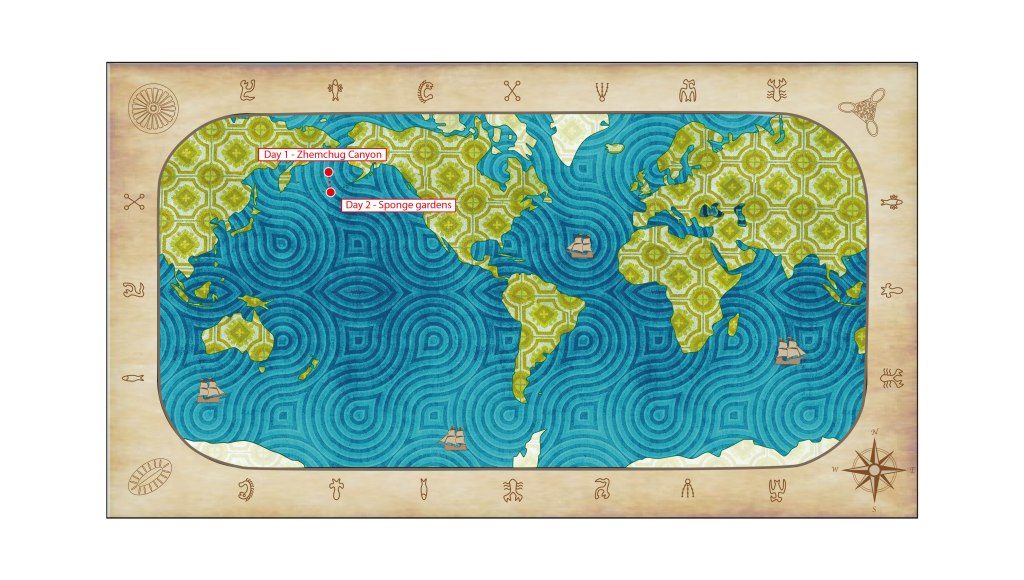

Who’s that little punk rocker who wants to join us? Why I think it’s a nudibranch – I’ve heard that they’re partial to Victoria sponge cake.
This is one of my favourite images. I like it’s whimsy. I remember really struggling with the colouring of this image. It was hard to make the colours varied – as I wanted them to be – but not totally incoherent. I think this image is very flat; especially the cake stand. I’m not sure that this is such a negative as it’s clearly not meant to be a realistic image. I could probably make it more three dimensional quite easily by thinking more about the lighting and adding some shadows.

If you’re in need of freshening up after a couple of days travel, then the cleaner fish will be happy to oblige.
I think that this is an image where the lightiing and depth work quite well. I tried to make it that the volcano was a light source. I also consciously made everything in the foreground bright. In this image and many of the others I began by colouring in Inkfish, then added the background colours and then chose the colours of the other characters. I think that the background is a little too dark, so that it is difficult to pick out the mantaray in the background. I was never fully satisfied with how I created the smoke from the volcano – probably making the pattern smaller would have helped. I think it does work to reserve the only pure white in the image for the volcano.

The Easter Islanders would select their new chieftan via a swimming race to collect an egg from the islet in the distance …hopefully your Easter eggs were a little easier to procure!
Happy Easter everyone!
With the Easter Island image, I really like the structure of the original ‘client visual’ for the image. However, I don’t like the colours in the final image – they’re too bright. I think the structure and contents are fighting each other. It’s all a bit too cartoony, whereas I’d rather it were mystical. I think the water works well and the pattern of horizontal lines gives the image stability. I like the light on the water and the bright white egg that attracts the eye. However, the green used in the foregroud is maybe too bright. The sun is a little too ‘cornflakes packet’. Making the hieroglyphs brightly coloured, draws attention to them, however retrospectively I think it would maybe have been better to choose a single colour for them.

Where next … should we head north into warm Atlantic waters, or south into the infamous Southern Ocean …?
This is one of my favourite images. I really like the composition. It’s very simple and I like that the view is from a height. I think saving the bright colours for the balloon works well. I love the pattern that I found for the sea. I think the colours of the sea and sky are the wrong way round in terms of which is dark and which is light. The land may be a little too plain and it might have been good to have an overlay to make it appear more hazy and distant. The original image didn’t have the kraken and ship – these elements add to the story but I don’t think that they benefit the composition.

Just one thing … don’t touch the brinicles (icy stalactites) – unless you fancy becoming a popsicle!
I think that my main satisfaction in this image is the ice. I was quite satisfied with the semi-translucent ice effect in the end – made from layering images of blue and green glass and altering their translucency. Retrospectively, I think that there’s too much empty space in this image. The characters would benefit from being larger, certainly in the foreground. I think that a lot of the patterns that I used in this image – particularly the penguin textures – are lost because they are so small. I quite like the idea of my composition in this image – mirroring triangles with the shape of the penguin path and the brinicles. However, I didn’t really pull it off. The purple seafloor may also have been a step too far, the overall colour scheme ended up a bit disney princess.

And as with many a good party, it’s not long before Inkfish has a crab sitting on her head, boogying along to the YMCA …
… enjoy!
Inkfish would like to thank you for joining her on this adventure – you were great company!
Thank you to the lovely people who suggested destinations. Finally, special thanks to the designers of 1970s wallpaper, without whom this adventure would not have been possible!
I like the liveliness of this final image. However, I think it would benefit from being more colourful. It’s all a bit too brown. The composition is also not particularly exciting. I think the addition of the glasses with their bubbles is an improvement on the client visual, as well as including a lot more crabs. Maybe I should have shifted further away from reality and made the image much more colourful.
It was quite an interesting and fun process making these images. I ended up making the final images a day ahead of publishing them on twitter. This meant that I had to veer away from wanting everything to be perfect and instead find quick methods for doing things. My biggest struggle with the images was trying to get the colour schemes and balance of colour across the images to work, particularly in the busier images. This is definitely something for me to learn more about in the future. I probably need to think about colour from an earlier stage in image development. It was also quite challenging for the patterns to be a key part of the feel of the images without them taking over completely.
It was a lot of fun. I had a good holiday and it seemed like other people did too.
 Esther's OCA Blog