The aim of this exercise is to produce a visual set of instructions for making a cup of tea. I began by collecting examples of tea making instructions and relevant images.
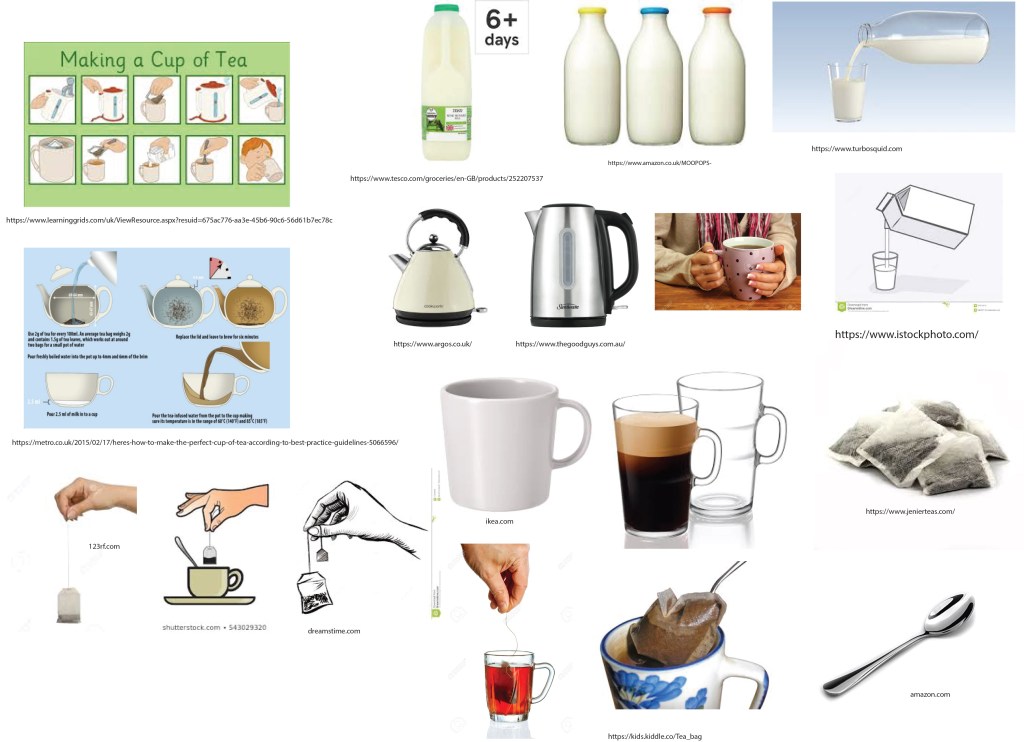
My reference material includes two sets of visual instructions for making a cup of tea. The top image provides a very clear set of instructions without using words; however, the layout is a little plain. It does also miss out some information such as how long the tea should be brewed for. The bottom image is very specific – including appropriate dimensions for the tea pot! This image requires a lot of reading to absorb all of the information.
Based on my research, how to make the perfect cup of tea is a somewhat controversial topic! To avoid all of this controversy, for the purposes of this exercise I decided to illustrate how I typically make a cup of tea. I began by thinking about how many steps need to be illustrated in order to instruct somebody how to make a cup of tea. I then started making sketches of the different objects that are used in the tea making process.
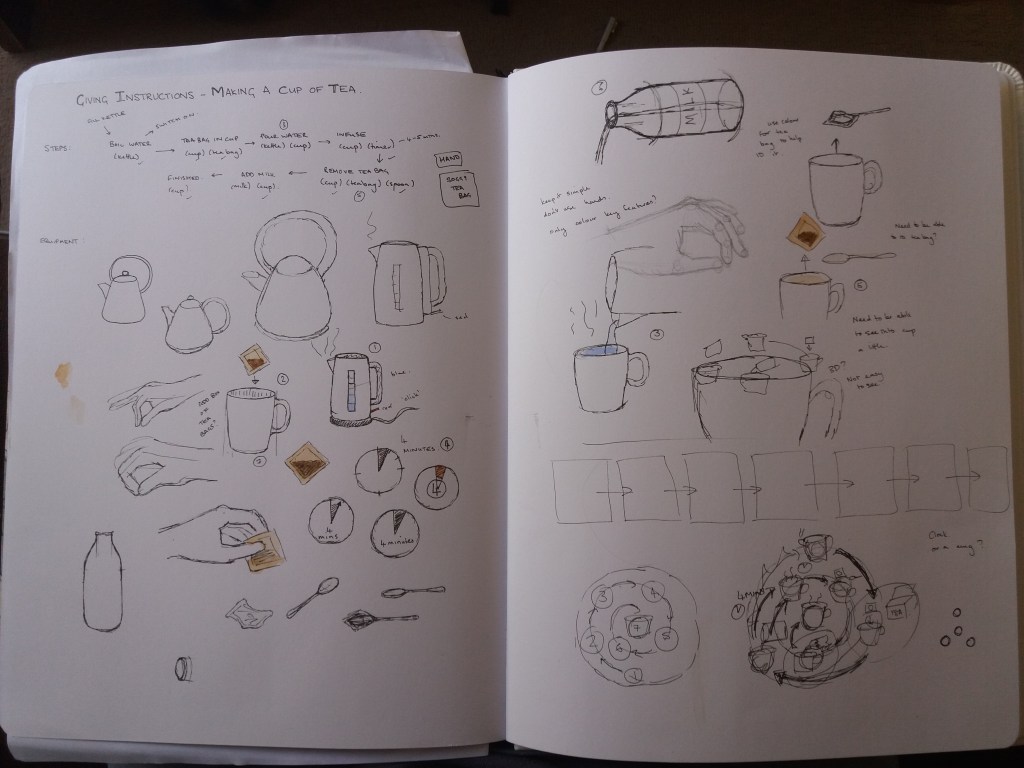
This process made me think about how to make objects easily recognisable. For example, kettles come in all sorts of shapes and sizes, as do bottles and boxes of milk. In order to maximise the accessibility of my illustrated instructions I chose what I think are the most recognisable forms of these objects. I also decided that I should include a few key words in the image e.g. a box of tea bags including the word ‘tea’, a label on the ‘milk’ bottle and the words ‘4 minutes’ alongside the timer. These words increase the clartity of the instructions without cluttering it with text. I also began to think about the use of colour. For now I have only coloured key elements within the drawings e.g. the switch on the ketlles, the tea bag etc. However, I am wondering if this might lead to quite a boring looking diagram. An alternative may be to lightly colour all of the objects but have key parts of those objects e.g. the switch on the kettle in bold colours.
I began to think about the layout of the instructions. I didn’t particularly want to have a linear set of panels as this is quite boring. I quite quickly liked the idea of the panels spiralling to a central cup of tea – the end point of the instructions. This shape is reminiscent of a clock (‘time for tea’) or looking down on a cup of tea. I thought about making the image 3D with the steps sitting on top of a cup but decided that it would be difficult to clearly illustrate the steps if I did this. The focus might also end up on the tea cup rather than the instructions.

In the end I decided to use colour throughout in order to make the illustration visually attractive. I’m not particularly satisfied with the end result. I think that the layout is a little confusing to follow. There are also endless red cups of tea such that the final cup, in the middle of the diagram, does not stand out.I considered giving the middle cup a coloured background, to help it stand out, however, I think this could make the image even busier. If I were to redesign this, I might have a much larger cup of tea in the middle. I might also have make the image larger and have more white space between the different elements of the image. I might also put a boundary around each diagram and have a more geometric/ formal layout for the positions of the image representing each step in the process.
It was also challenging to use watercolour on this paper. The water was ripping up the surface of the paper. I’m enjoying working with paint, however, I’m sort of making it up as I go along in terms of technique, which in some cases is more succesful than others.

 Esther's OCA Blog